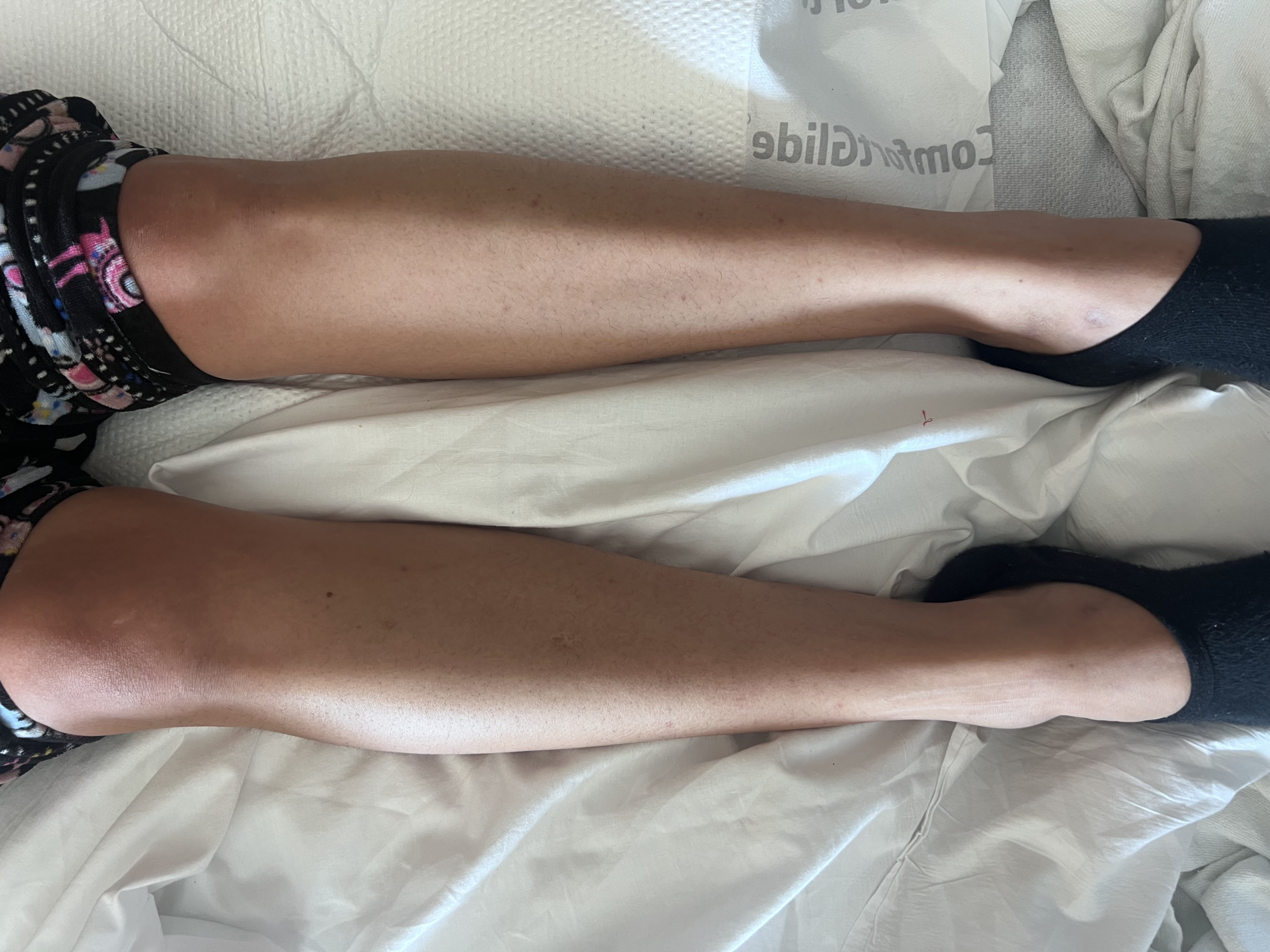
Case Presentation: A 22-year-old (G2P2) female with no significant past medical history presented to the emergency department with four-days of fevers, myalgias, retro-orbital headache, nausea, vomiting, abdominal pain, and petechial rash involving the bilateral lower extremities. Her symptoms began after returning from a month-long trip to Northern Mexico, where she noted numerous mosquito bites and multiple family members with similar symptoms. Of note, the patient was three months postpartum and exclusively breastfeeding a healthy appearing infant. On arrival, she was afebrile but reported fever of 105.2 F at home; she was otherwise hemodynamically stable. Physical exam was notable for a faint petechial rash on the bilateral lower extremities and mild abdominal tenderness to palpation, most significant in the right upper quadrant. Workup revealed thrombocytopenia and elevated Dengue Fever IgM antibodies. Chikungunya IgG and IgM, ANA profile, HIV 1/2, Rickettsia rickettsii IgM and IgG were all negative. AST was elevated at 94 U/L; ALT, ALP, and bilirubin measurements were all within normal limits. Abdominal ultrasound revealed a mildly distended gallbladder with a mobile gallstone without other features to suggest cholecystitis. She was treated supportively with IV fluids, antiemetics, and acetaminophen with improvement, and discharged home with instructions to continue breastfeeding as usual. Outpatient follow up was recommended for cholelithiasis as she reported occasional symptoms consistent with biliary colic.
Discussion: Dengue virus, a vector-borne Flavivirus, is the causative agent of Dengue fever in humans. Dengue virus is most commonly transmitted by Aedes aegypti mosquitos. Dengue fever’s endemicity includes tropical and subtropical regions worldwide. After an incubation period of 4-10 days, Dengue’s clinical manifestations range from asymptomatic infection to severe, lethal infection. Symptomatic disease typically includes a febrile phase characterized by a high-grade fever that lasts between two and seven days. Rarely, dengue can cause critical illness including dengue hemorrhagic fever and dengue shock syndrome. In this case, special consideration was taken to advise the patient on breast feeding. Animal studies have shown evidence of milk-related transmission of dengue virus, and dengue virus RNA has been detected in human milk. Despite this, limited data exists that support mother-to-child-transmission of Flaviviridae infections as non-breast feeding-related routes of transmission are difficult to exclude. In addition, although Flaviviridae RNA has been detected in human milk, it has not been determined if these viral components are replication competent or present at infectious quantities. Further, Dengue-specific IgG and IgM have been detected in human milk, although it is uncertain if these antibodies confer passive immunity. Both the Centers for Disease Control and Prevention and the World Health Organization recommend that mothers with dengue virus infection continue breast feeding as the risk for infection transmission is low and is outweighed by the benefits of breast feeding.
Conclusions: While a rare cause of fever in the US, Dengue is an important consideration in returning travelers and immigrants given its endemicity worldwide, especially in Mexico and the Caribbean. The question of how to manage exclusively breastfeeding mothers is poignant for frontline providers and both WHO and CDC recommend mothers with active Dengue continue breastfeeding.