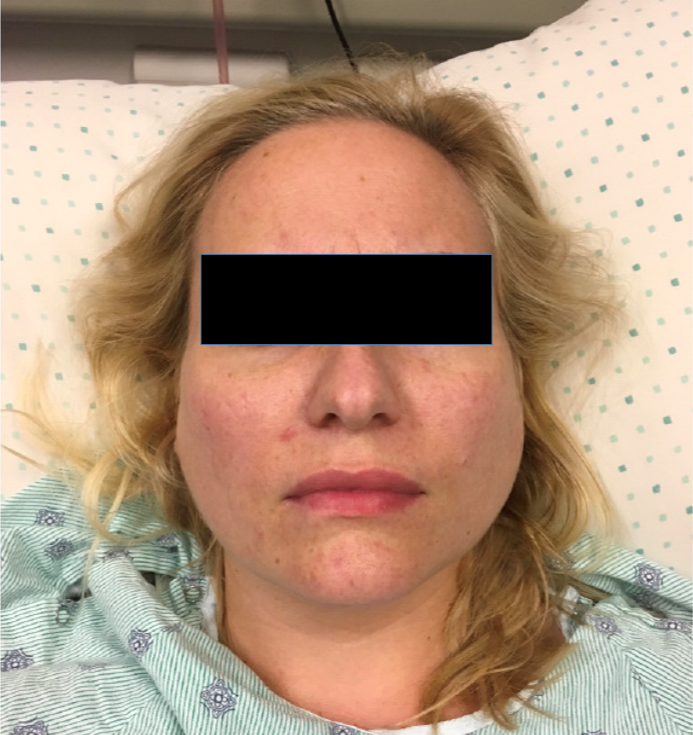
Case Presentation: A 32-year old woman at 17 weeks gestation presented with subacute headaches, parotid swelling, oral and perioral paresthesias, dysgeusia, and bilateral jaw pain. Her headaches began 3 months prior to presentation followed by left facial droop. She received prednisone and valacyclovir for presumed Bell’s palsy with resolution of symptoms. The headaches recurred and became associated with the above symptoms as well as intermittent eye pain and photophobia. She was seen twice in emergency departments where non-contrast brain MRI and CT venogram were unremarkable. She was treated for presumed complex migraines with steroids and analgesics. For the parotid swelling, she saw an otolaryngologist who suspected infectious parotitis and prescribed cephalexin without improvement.On hospital presentation, she was afebrile with stable vital signs. Eye exam revealed mild anisocoria with normal light reactivity. She had bilateral parotid swelling, trismus, and impaired sensation of V2 and V3 dermatomes bilaterally. Labs including ESR, CRP, ANA, SSA, SSB, IgG4, ACE, LDH, SPEP, mumps and EBV serology, lyme screen, RPR, quantiferon TB, and HIV were unremarkable. CT scan of the neck and chest showed enlarged mediastinal and hilar lymph nodes without parotid mass. Brain MRI with gadolinium noted symmetric thickening and enhancement of bilateral cranial nerves V2 and V3. She underwent biopsy of mediastinal and hilar nodes demonstrating lymphocytes and non-necrotizing granulomatous inflammation consistent with sarcoidosis. Treatment with prednisone 60 mg daily resulted in rapid improvement of parotid swelling and partial response of paresthesias and headaches.
Discussion: Heerfordt-Waldenström Syndrome (HWS), or uveoparotid fever, is a rare subacute manifestation of sarcoidosis defined by the presence of parotid gland enlargement, uveitis, facial nerve palsy, and low grade fever. Presence of all symptoms constitutes complete HWS, thought to affect 0.3% of patients with sarcoidosis. Incomplete HWS requires two of the following three symptoms: facial nerve palsy, parotid gland enlargement, and uveitis. Up to 30% of patients with sarcoidosis present with extrathoracic disease. Ocular, neurologic, and parotid gland involvement vary widely across demographics but occur in up to 50%, 10%, and 6% of cases respectively. Case reports of HWS depict wide variation in presentation as well as numerous associated findings including cranial nerve V palsy, anosmia, otic symptoms, loss of taste, and sicca. HWS has also been described as a variety of neurosarcoidosis. Though facial nerve palsy is often presumed due to direct nerve compression from parotid mass effect, electrophysiological evidence suggests central pathology. Complete HWS, like the more common Löfgren syndrome, is highly specific for sarcoidosis, allowing for diagnosis to be made without biopsy. The mainstay of therapy is a prolonged steroid taper. For patients with refractory or progressive symptoms, steroid sparing immunosuppressants can be used.
Conclusions: Our patient presented with incomplete HWS, consisting of facial nerve palsy and parotid swelling. By history of ocular symptoms, she may have also had uveitis but following two courses of steroids this was not seen on our ophthalmologic exam. This case highlights the importance of considering sarcoidosis when unexplained symptoms are partially steroid responsive. Early recognition allows for identification and proper surveillance of asymptomatic thoracic disease.