Background: Accurate estimation of hospital discharge date (EDD) is essential for optimizing patient flow, resource allocation, and care coordination. Inaccurate predictions contribute to prolonged hospital stays, which increase the risk of hospital-acquired infections and delay discharge. Inaccurate initial discharge plans raise the odds of delays by 2.72 times (Burns et al.). Conversely, accurate EDD not only improves care transitions and enhances efficiency but also significantly impacts patient satisfaction (Esmilla). Machine learning models integrated into clinical workflows have demonstrated promising prediction accuracy (Mahyoub et al.). These findings underscore the critical role of accurate EDD in both clinical outcomes and operational performance. This abstract examines the role of primary hospital care team documentation of “medical readiness” (MR) and its impact on the timely and accurate estimation of discharge dates.
Methods: Primary hospital care teams were asked to begin documenting MR in the electronic health record (EHR) as of October 2024. This is a dynamic approximation of when the patient is (or will be) medically ready for their non-hospital destination. Options include “Ready now”, “Today”, “Tomorrow”, “2-4 days”, “5+ days”, and “Unknown” and are displayed as calendar dates for reference. Documentation was tracked in the EHR along with the “estimated discharge date” (EDD), which is updated regularly by care transitions and social work team members. EDD is a dynamic approximation of the date and time the patient is expected to be discharged from the hospital. We evaluated the documentation of both MR and EDD to determine the frequency of “accurate” (within 1 day of the actual discharge) and “timely” (present at least 24 hours before the discharge event) predictions, with and without MR documentation.
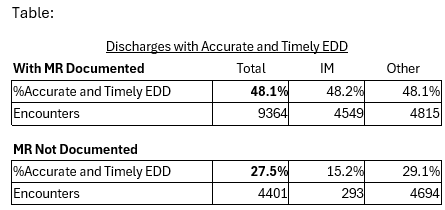
Results: All hospital service lines discharged 14,058 patients with accurate, timely EDDs between November 1, 2024, and September 30, 2025. 9,364 discharges had MR documented at least once during the encounter (2.92 updates per encounter). Estimated discharge date documentation (2.54 updates per encounter) was “accurate” and “timely” in 48.1% of these discharges. 4,694 discharges had no MR documentation (0.00 updates per encounter). Estimated discharge date documentation (2.22 updates per encounter) was “accurate” and “timely” in 27.5% of these discharges. The internal medicine service line subgroup (majority of patients are cared for by hospital medicine) discharged 4,842 patients during the study period. 4,549 of those had MR documented at least once during the encounter (3.00 updates per encounter). Estimated discharge date documentation (2.51 updates per encounter) was “accurate” and “timely” in 48.2% of these discharges. 293 of those had no MR documentation (0.00 updates per encounter). Estimated discharge date documentation (2.41 updates per encounter) was “accurate” and “timely” in 15.2% of these discharges.
Conclusions: EDD is a crucial part of clinical and operational efficiency. The accuracy of EDD enhances throughput and patient satisfaction while reducing the risk of complications. The documentation of MR by primary hospital care teams played a pivotal role in increasing the rate of ‘accurate’ and ‘timely’ EDD predictions from 27.5% to 48.1% in 14,058 hospital discharges between November 1, 2024, and September 30, 2025. It’s important to note that the EDD was consistently updated at a similar frequency per encounter across all groups.