Background: The effective use of health information technology and efficient workflow management are essential aspects of a well-trained medical professional. Without specific electronic health record (EHR) training, clinicians face information overload and time spent navigating information systems detracts from interacting with patients, scholarship, and education. Time motion studies have consistently noted that clinicians spend greater than 50% of shift time using the EHR (1). Despite occupying a large portion of a physician’s workflow, formal education on the EHR environment varies widely between institutions, and training programs that focus on effective and efficient utilization are rare. The consequences of inadequate provider EHR education are numerous, affecting both provider and patient. Lack of EHR chart review skills can lead to delays and neglect of critical patient information (2), and inexperience in order entry can contribute to medical errors (3).
Purpose: This study evaluated the impact of different educational interventions targeting improvement of EHR usage efficiency among residents.
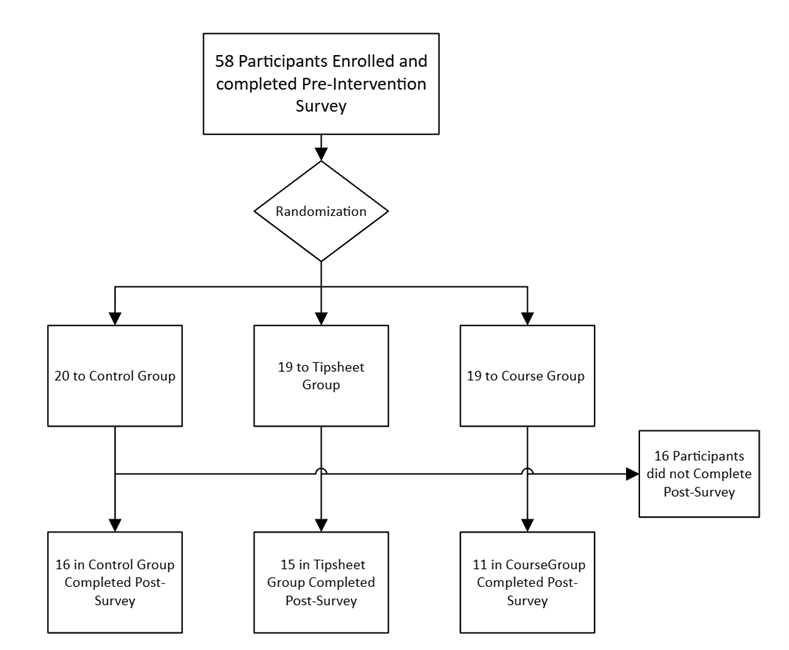
Description: All residents rotating through a 4-week general internal medicine ward rotation at an academic site utilizing Epic were approached via email at the start of their rotation for enrollment and completion of a pre-participation survey. Fifty-eight participants were randomized to one of three groups: 1) a control group with no additional education resources (n=20), 2) a tipsheet group where a 5-page electronic guide on efficient EHR utilization was provided (n=19) or 3) an online course group where participants were enrolled in a course featuring video modules on efficient EHR usage (n=19). At the end of the rotation, a post-participation survey was administered. 42 (72%) completed the post-participation survey.
Conclusions: While participants’ overall comfort in EHR usage improved across all groups, there were important differences between the groups in how comfort with specific EHR tasks were rated. The course group reported the greatest increases in comfort with patient list management (+55% vs +31% in control and +27% in tipsheet group), while the tipsheet group reported the greatest improvement with pre-rounding and daily data collection (+47% vs +31% in control and +27% in course group). Both the tipsheet and course groups had greater increases in participant comfort compared to the control group on topics of reviewing chart history, performing patient admissions and performing patient discharges. Participant reports of EHR education resources were generally positive, with 58% reporting that they would recommend resources to a colleague and 73% reporting that they would use the skills learned from the resources.In developing a curriculum to improve EHR efficiency, both passive and active modalities may be effective and optimal strategies may depend on the learning objectives. Learning objectives that mirror and address daily clinical workflow are valued by participants.
.png)