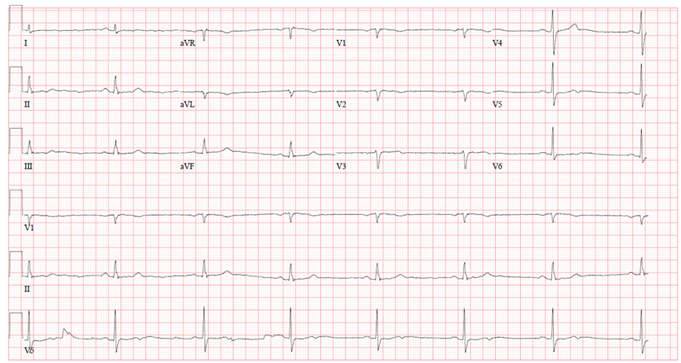
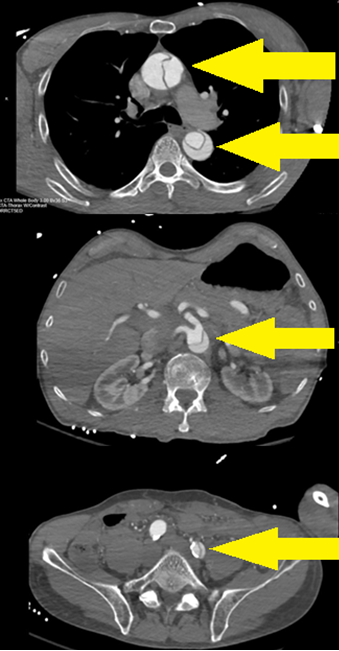
Case Presentation: JG is a 62 year old male presenting to the Emergency Department (ED) as a medical code by EMS for bradycardia and generalized weakness. Per EMS, JG was working in his yard when he suddenly felt debilitating fatigue and asked his wife to call 911. Patient history was limited due to fluctuating somnolence. He endorsed generalized weakness but denied chest pain, abdominal pain, shortness of breath, and back pain. Vitals obtained as follows: heart rate 45, blood pressure 103/75, temperature 36.5, respiratory rate 20, SPO2 of 100% on room air. Labs were drawn and JG was started on a bolus of NS. Physical examination revealed little about JG’s current condition apart from a fluctuating level of consciousness. EKG obtained showing marked sinus bradycardia (Figure 1). Chest X Ray obtained showing no acute pulmonary process and a mediastinum within normal limits. The decision was made at this time to send the patient for head CT to rule out acute intracranial processes. During the head CT, the patient developed persistent hiccuping. He also started complaining of left leg pain and numbness. With these new symptoms in mind, the decision to perform a CTA Thorax was made to investigate the possibility of a vascular abnormality as an explanation for his persistent bradycardia and hypotension refractory to fluid resuscitation. The decision against atropine or pressor administration was made due to a high index of suspicion for aortic dissection in process. The CTA confirmed the diagnosis of a Type A Descending Aortic Dissection extending down to the level of the left common iliac artery (Figure 2). Pt was taken for emergency aortic dissection repair by CT surgery and is currently recovering in the ICU.
Discussion: Acute aortic dissection (AAD) is a rare but fatal condition with the mortality reaching 50% within the first 48 hours of symptom onset without prompt treatment. Identifying and treating AAD immediately should be the goal of every physician who examines patients with significant symptoms and risk factors. The classic presentation of AAD is a rapid-onset, tearing chest pain that may radiate to the back. However, the signs and symptoms of AAD are not uniform. With the rarity of this condition and higher likelihood of other etiologies, correct diagnoses are missed in the Emergency Department; only 15% to 43% of verified cases are accurately diagnosed at first presentation.One important symptom is bradycardia, typically due to sensory stimulation of the aortic depressor nerve and subsequent vagal parasympathetic activity on heart rate. Another unique symptom is the presence of hiccups. This is typically due to involvement of the phrenic nerve as it courses down the descending aorta. As the dissection grows, it can mechanically compress the phrenic nerve, leading to dysfunction in the normal respiratory process, resulting in the diaphragm pulling down against a closed glottis (hiccups).
Conclusions: Acute Aortic Dissection is considered to be a “can’t miss” diagnosis in the ED due to its high mortality rate. However, sifting through the various presentations of “chest pain” can be a difficult task. This task is further complicated by differing presentations of AAD. Thus, a high index of suspicion is appropriate in order to provide adequate treatment. If any of the classic or atypical signs and symptoms exist, further imaging may be appropriate in order to determine how best to proceed. At the same time, avoiding potentially dangerous interventions such as atropine or pressors may be necessary until such a determination is made.