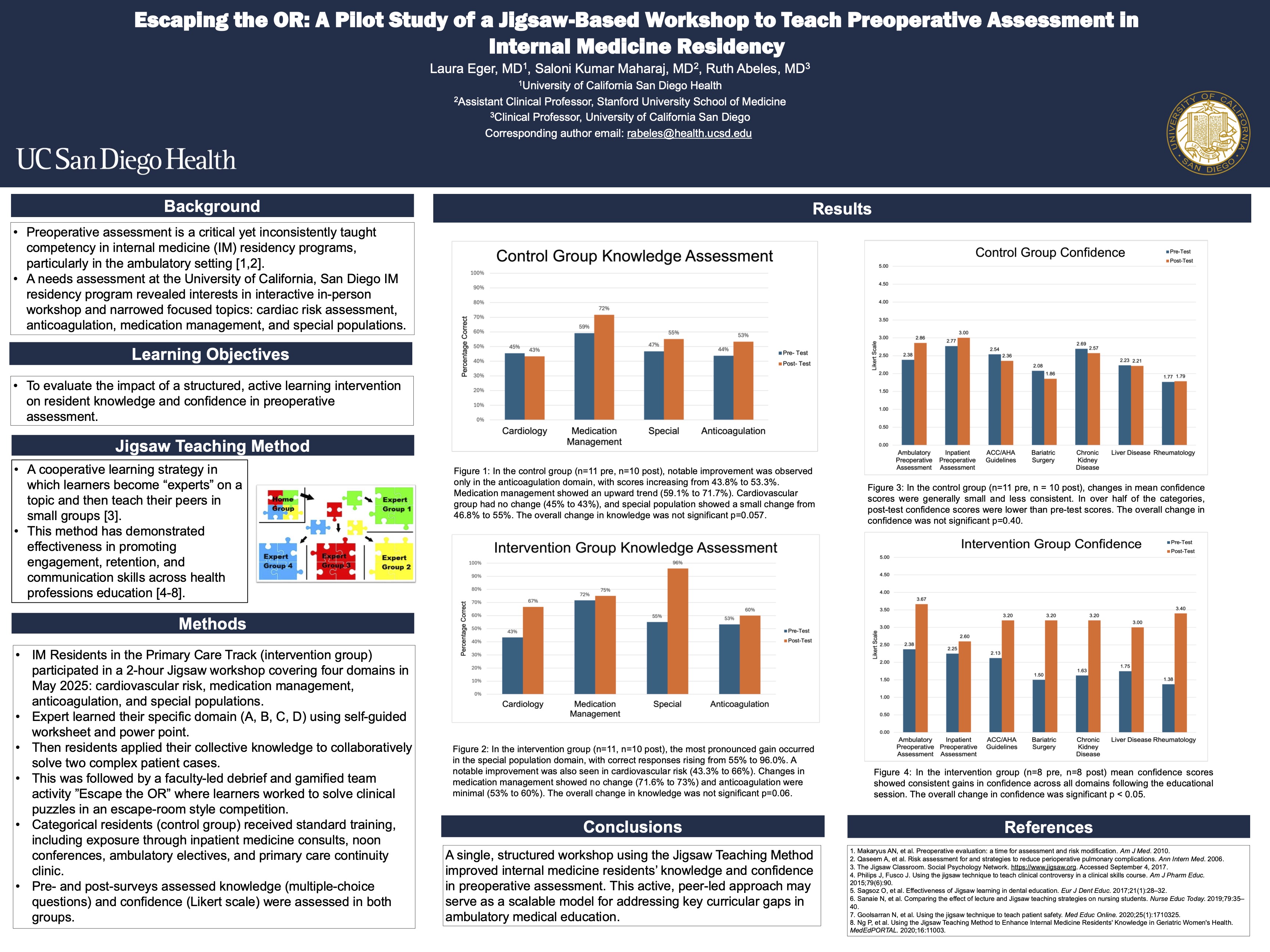
Background: Preoperative assessment is a key but inconsistently taught skill in internal medicine residency. Many residents report low confidence and limited formal training. To address this gap, we developed and piloted a Jigsaw-based workshop on preoperative medicine.
Purpose: To evaluate the impact of a structured, active learning intervention on resident knowledge and confidence in preoperative assessment.
Description: In 2025, we conducted a quasi-experimental pilot study at the University of California, San Diego. Primary Care Track residents (intervention) completed a 2-hour Jigsaw workshop on cardiovascular risk, medication management, anticoagulation, and special populations. Categorical residents (control) received usual training through consults, conferences, electives, and clinic. Pre- and post-surveys assessed knowledge (multiple-choice) and confidence (Likert scale).A needs assessment of 159 residents (12% response) revealed low confidence in perioperative care; over half reported no structured training. In the control group (n=11 pre, n=10 post), minimal gains occurred (p = NS), with improvement only in anticoagulation (43.8% to 53.3%). In the intervention group (n=11 pre, n=10 post), knowledge rose in special populations (55% to 96%) and cardiovascular risk (43.3% to 66%); however, the p value was not statically significant. Confidence scores (n=8 pre, n=8 post) improved consistently across all domains (p < 0.05), unlike controls (p = NS). Residents valued the interactive, case-based format and the gamified “Escape the OR” activity.
Conclusions: A single Jigsaw-based workshop significantly improved resident knowledge and confidence, offering a scalable model to address gaps in perioperative education.