Background: General pediatrics residents often provide initial assessment in the management of pediatric emergencies in various clinical settings and, therefore, must demonstrate timely and accurate decision-making as well as procedural competence. Yet, many report lack of confidence in their ability to perform pediatric resuscitations efficiently due to limited hands-on opportunities in early years of training. Simulation-based training is an effective way to enhance these skills; however, traditional sessions are often broad, reducing the opportunities for targeted skill practice. Repetitive and focused simulation sessions tend to be more effective in promoting long-term specific skill mastery.
Methods: A pretest-posttest study design was used to evaluate the effectiveness of targeted skill training. General pediatrics residents were randomly assigned to either SVT or SE simulation scenarios. The study was conducted over a three-week period: initial simulation session (week 1), targeted teaching session on key management principles (week 2), and final simulation session (week 3). Residents’ performance was assessed after each simulation session using standardized performance checklists and a post-session self-assessment questionnaire. Data were analyzed using the Chi-square test, with p < 0.05 considered statistically significant.
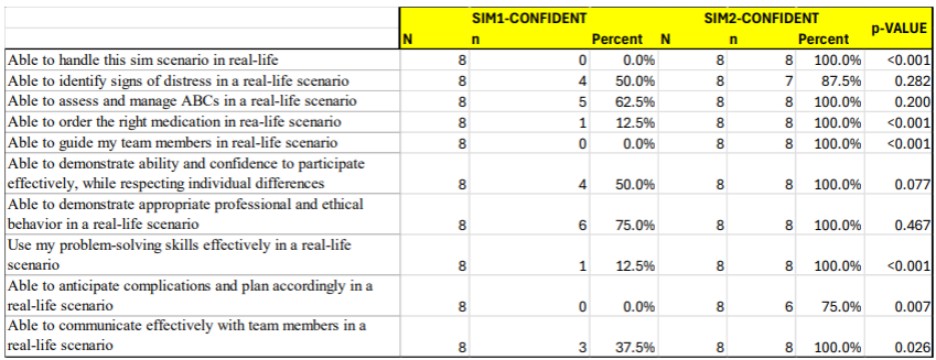
Results: A total of 8 participants were enrolled and randomly divided into two groups. Both groups received a pre-intervention assessment score of 38.9%, based on performance and communication/team dynamics assessed by standardized checklists. Post-intervention, both groups demonstrated significant improvement in performance scores. The SVT group improved from 38.9% to 88.9% (p < 0.004), while the SE group improved from 38.9% to 83.3% (p < 0.008). Self-assessment checklists also demonstrated a significant increase in confidence levels.
Conclusions: Focused, skill-based simulation training in SVT and SE effectively improved pediatric residents’ confidence and performance in these high-acuity emergencies. The study was limited by small sample size, single-department participant pool, and resident availability. Larger, multi-center studies are needed to confirm these findings and further evaluate the long-term impact of focused simulation-based education on pediatric emergency preparedness.