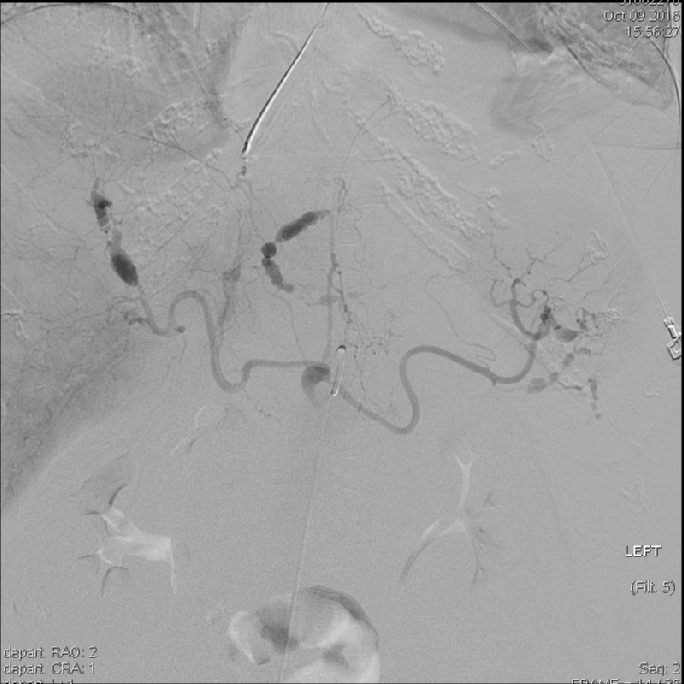
Case Presentation: A 77 year old female with history of prolapsed bladder and back pain was admitted with epidural abscess. Antibiotic therapy with vancomycin and piperacillin/tazobactam was started. She underwent decompression/evacuation of the T12-L4 vertebrae. Cultures of the blood and epidural space grew methicillin-sensitive Staphylococcus aureus. Antibiotics were narrowed to nafcillin. Post-operative course was complicated by deep vein thrombosis, for which she was started on heparin and bridged to warfarin. She was to be discharged when she became acutely unresponsive.
Exam: temperature 96.3F, blood pressure 74/42, heart rate 108, respiratory rate 22, oxygen saturation 99%. Patient was cool, clammy, diaphoretic, tachycardic with poor capillary refill and thready pulses. Lungs were clear. She responded only to sternal rub and palpation of the abdomen which was soft, nondistended, and without appreciable bowel sounds.
Lab data: WBC 11.3 x 10^9/L, Hemoglobin 5.8g/dL, hematocrit 17.9%, platelets 362,000, prothrombin time 64.8 sec, INR 5.6. Lactic acid 1.2 meq/L. CT abdomen/pelvis: large hemorrhage in the peritoneal cavity.
Hemodynamic stabilization was achieved with massive transfusion protocol and INR reversal. The patient was intubated. Emergent CT angiogram identified segmental areas of fusiform dilatation throughout the left gastric artery, splenic artery and right hepatic artery for which she underwent coil-assisted embolization. The patient remained hemodynamically stable and was extubated without issue. Autoimmune workup (rheumatoid factor, ANA, ANCA, dsDNA, lupus anticoagulant, and anti-beta 2 glycoprotein) was negative. She was discharged on nafcillin for her known bacteremia.
Discussion: Segmental arterial mediolysis (SAM) is a rare, noninflammatory, nonatherosclerotic disease that affects medium-sized abdominal arteries. The hallmark of SAM is mediolysis, which involves vacuolization and lysis of the medial layer of the arterial wall. This occurs in a segmental distribution. Affected areas are prone to dissection, hematoma, and aneurysm. Clinical presentation ranges from nonspecific abdominal pain to acute intra-abdominal hemorrhage. The natural history of SAM is largely unknown and there remains no guideline for management of the stable patient. SAM occurs in the middle-aged and elderly, with a slight male predominance.
Differential diagnosis includes vasculitis, mycotic aneurysm, and collagen vascular disease (CVD). Definitive diagnosis requires pathology from resected arterial segments. In cases of endovascular intervention, diagnosis relies on the exclusion of other causes of vasculopathy.
Unlike inflammatory vasculitis, SAM does not present with elevated erythrocyte sedimentation rate and C-reactive protein, and there are no specific autoantibodies. SAM can be distinguished from mycotic aneurysm based on location: mycotic aneurysms occur in areas of bifurcation; SAM rarely involves the branching sites. CVD can be distinguished from SAM based on the affected arteries: CVD tends to affect large vessels like the aorta; SAM tends to occur in the celiac and mesenteric arteries. Diagnosis in this case is based on characteristic radiographic findings.
Conclusions: Segmental arterial mediolysis (SAM) is an uncommon but important vasculopathy that can present with acute intraperitoneal hemorrhage, and carries a mortality rate of close to 50%. Hospitalists’ awareness of this disease and prompt involvement of endovascular intervention can be lifesaving.