Background: Hospital at Home (HaH) is a patient-centered care model that delivers acute-level services in patients’ homes, improving patient satisfaction, enhancing quality of care, reducing hospital costs, and increasing health system efficiency and throughput. Expanding house staff exposure to HaH serves three key purposes: first, it increases cultural buy-in from inpatient teams by fostering familiarity with HaH workflows, admission criteria, and available services; second, it seeks to expose learners to modern medical practices, equipping them with essential skills in telehealth and decentralized, team-based care; and third, it promotes interest in HaH as a career pathway, helping to sustain the future workforce for this growing care model. Despite these benefits, few structured curricula exist to give learners practical experience in HaH.
Purpose: To provide house staff with direct hands-on experience with the HaH model via a dedicated elective and to evaluate changes in their familiarity with the model, confidence in HaH care, and acquisition of relevant clinical skills.
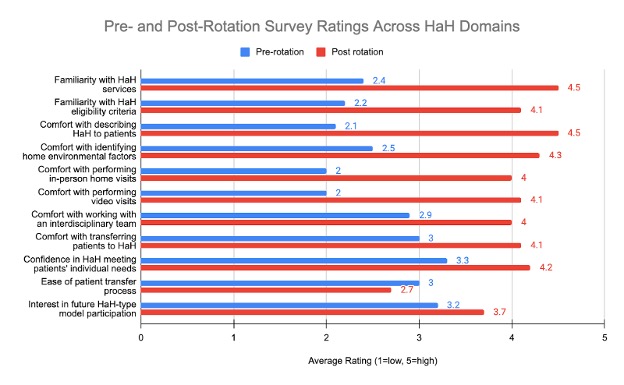
Description: A standardized HaH elective curriculum for internal medicine trainees was implemented in July 2024 and expanded in August 2025 to include geriatrics and palliative care fellows. The curriculum provides hands-on experience across all aspects of HaH, including patient screening, admissions, virtual rounding, home visits, and coordination of care with decentralized clinical and administrative teams. Trainee learning is supplemented by a lecture series led by program leadership and a web-based tool offering educational materials, rotation instructions, and references to seminal HaH literature. Between July 2024 and November 2025, a total of 26 individuals enrolled in the elective, including 20 internal medicine residents (10 of whom were in the primary care track), 4 geriatrics fellows, and 2 palliative care fellows. Fifteen trainees (10 residents, 5 fellows) completed anonymous pre- and post-rotation surveys assessing familiarity with the HaH model, comfort with core HaH skills, and confidence in HaH care delivery.Survey results demonstrated substantial improvements across nearly all domains, rated on a 1–5 scale, with higher scores indicating more favorable responses. Average familiarity with HaH services increased from 2.4 to 4.5, and familiarity with eligibility criteria rose from 2.2 to 4.1. Comfort describing HaH to patients increased from 2.1 to 4.5. Confidence performing in-person home visits improved from 2.0 to 4.0, and comfort with video visits rose from 2.0 to 4.1. Comfort working in an interdisciplinary team increased from 2.9 to 4.0, and confidence that HaH can meet patients’ individual needs improved from 3.3 to 4.2. Perceived ease of the transfer process decreased slightly from 3.0 to 2.7, and interest in future HaH participation rose from 3.2 to 3.7.
Conclusions: Participation in the HaH elective was associated with substantial gains in trainee familiarity with the HaH model, confidence in delivering HaH care, and comfort with core skills such as home visits, video visits, and interdisciplinary collaboration. Trainees also expressed greater interest in future HaH involvement. These findings suggest that structured hands-on HaH training effectively prepares house staff for emerging models of care and may help support institutional efforts to sustain and expand HaH capacity.