Background: Description of problem/Background: Annually, there are 300,000 hip fractures and 95% are due to low impact trauma in patients with osteoporosis. The risk of recurrent hip fractures is 9% within 5 years. Treatment with bisphosphonates decreases this risk by 35%. However, less than 10% of these patients receive osteoporosis treatment after discharge.At our hospital, these hip fracture patients are admitted to an internal medicine hospitalist service with orthopedic consult. We observed low local rates of osteoporosis treatment and hypothesized this was due to providers perceiving osteoporosis care as unimportant. Aim: Assess hospitalist perceived importance and actual practice of osteoporosis treatment in hip fracture patients.
Methods: Interventions: An online email survey to assess hospitalist perceptions of the importance of various aspects of patient care following hip fracture.Measures: The eight non-osteoporosis aspects assessed were medical preoperative evaluation, orthopedics consult, medication reconciliation, and also management of anemia, blood glucose, blood pressure, deep vein thrombosis (DVT) prophylaxis and pain. The three aspects of osteoporosis management were bone density testing, medical treatment and vitamin D management. We categorized hospitalist perceptions of individual care aspects as important (strongly agree, agree) OR unimportant (strongly disagree, disagree, neutral). We compared the proportion of hospitalists, who felt osteoporosis diagnosis and treatment was important, to the overall perceived importance of all other aspects of care. To corroborate these findings, we did retrospective chart audit of 30 patients with fragility hip fractures admitted to hospitalist service over one year period. The above three aspects of osteoporosis management were measured along with DVT prophylaxis. We used a Fischer exact test to compare proportions.
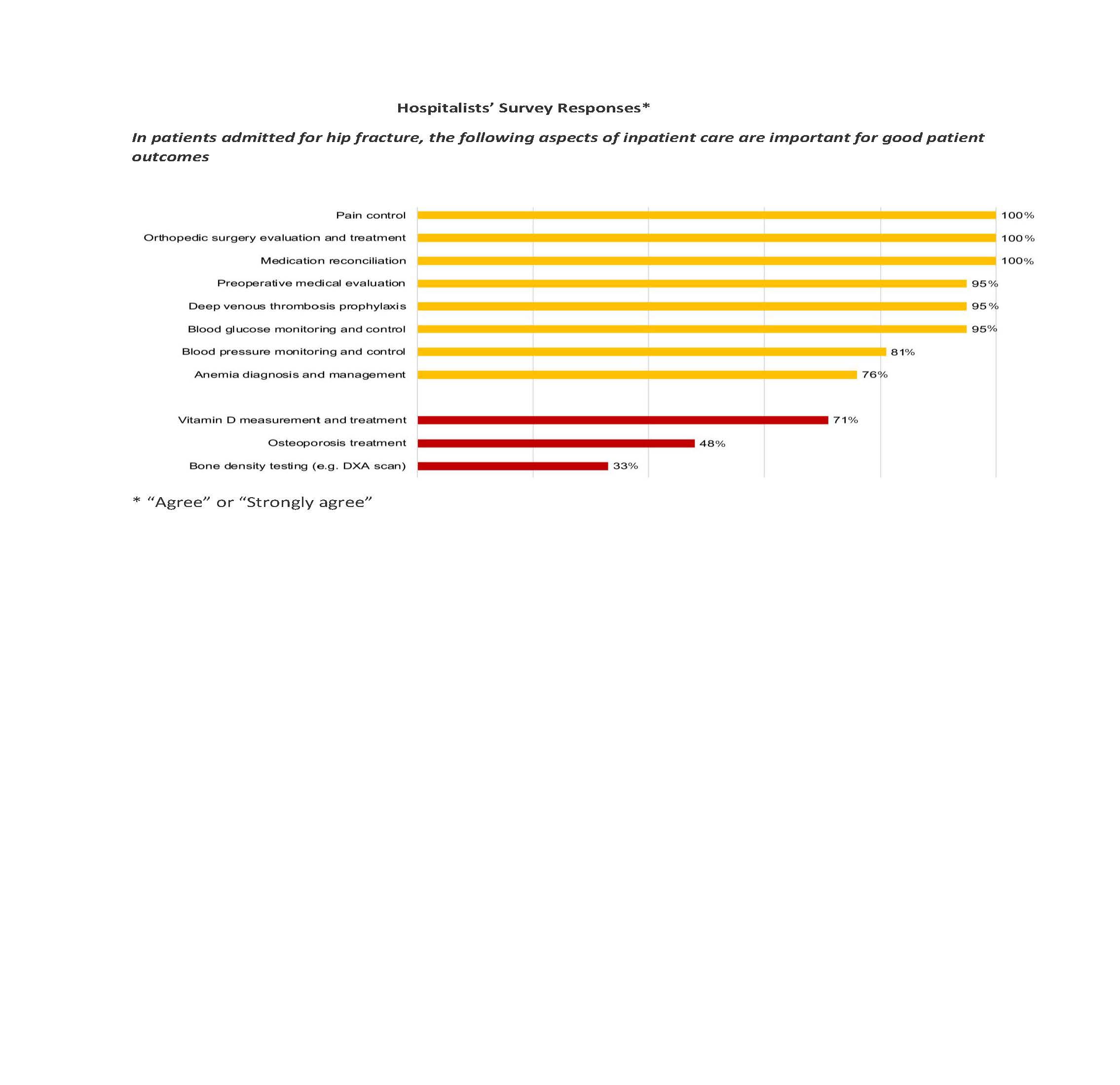
Results: Results: For the survey, response rate was 80% (21 of 26). The three aspects felt to be least important were bone density testing (33%, 7/21), osteoporosis treatment (48%, 10/21) and vitamin D measurement and treatment (71%, 15/21). Hospitalists perceived osteoporosis diagnosis and treatment as less important to good patient outcomes than other aspects of care (51% vs 93%, p = < 0.001).24 of 30 patients who underwent operative management were included in the retrospective chart review. The audit showed similar low rates of bone density testing (80%, 9/24) and Vitamin D measurement and treatment (71%, 17/24).But in comparison only 12 %, 3/24 were on osteoporosis treatment at the time of discharge which was significantly lower to the perceived assumption of 48%.P value was <0.001, 0.009 and <0.001 respectively.100% of patients received DVT prophylaxis.
Conclusions: Conclusion: Hospitalists perceive osteoporosis care as less important to good patient outcomes in hip fracture patients than other aspects of care which is reflected in clinical practice. This contrasts with clinical reality, as clinically relevant DVT after hip fracture occurs in <4% of patients and is rarely associated with mortality. On the other hand, a recurrent hip fracture occurs in 9% of patients within 5 years, with an associated 24% 1-year mortality. Hospitalists misperceptions and practices regarding osteoporosis treatment may be leading to suboptimal patient care.