Background: Excessive and unnecessary lab draws have been linked to increased cost, added downstream testing and procedures [3], and iatrogenic anemia [2]. As part of ABIM’s Choosing Wisely Campaign, Society of Hospital Medicine and other professional societies have recommended against routine testing of CBC and chemistries in clinically stable hospitalized patients [1]. Importantly, initiatives that reduce routine testing have not been associated with worsened patient outcomes such as mortality or readmission rate [4-6]. Audit and feedback initiatives on ordering practices are well studied and effective in reducing unnecessary daily lab ordering, although most studies focus on resident physicians rather than direct care physicians or advanced practice providers (APPs). [7]
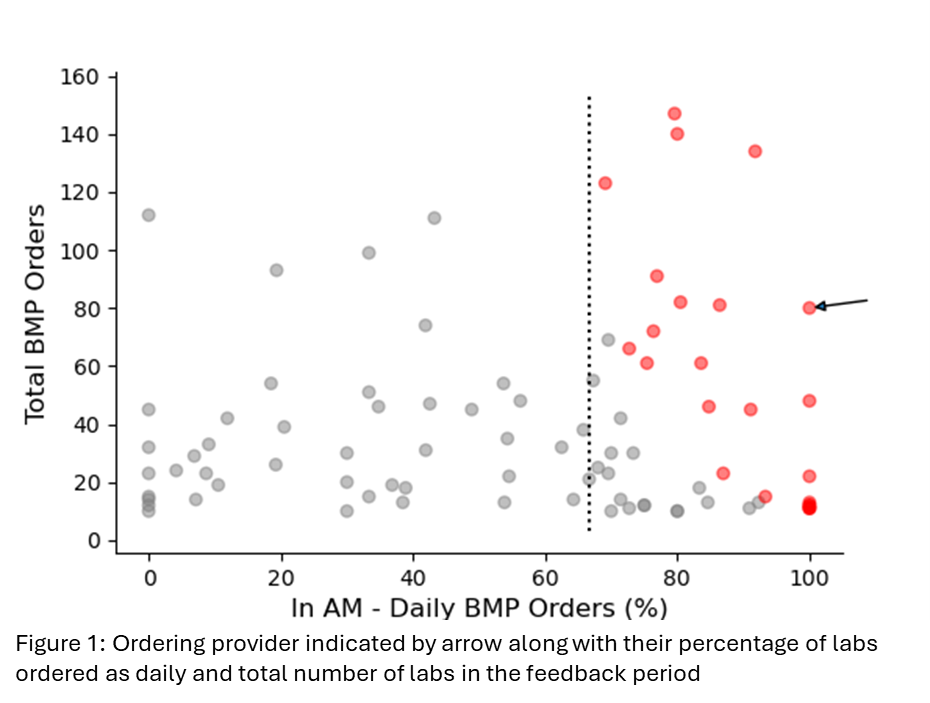
Methods: CBC and BMP orders by direct care physicians and advanced practice providers on hospitalist care floors at our institution were collected from July 2023 to August 2024. Orders were grouped by their frequency as specified in our institution’s EMR including: In Am – Daily, Once, STAT, every 48 hours, and others. Intermittent education was provided via presentations and handouts through August 2023 to announce the project and educate faculty on their lab ordering practices. Individualized feedback and peer comparison was sent to providers’ personal emails on their lab ordering practices on February 2024, May 2024, and October 2024. Individualized feedback included lab ordering practices for CBC and BMP including total orders as well as % orders placed as “In-AM Daily” (Fig 1.) All providers with over 10 orders were included in the feedback with each individual provider identified by an arrow. Providers who were above 2 standard deviations of the mean lab ordering practices were highlighted in red.
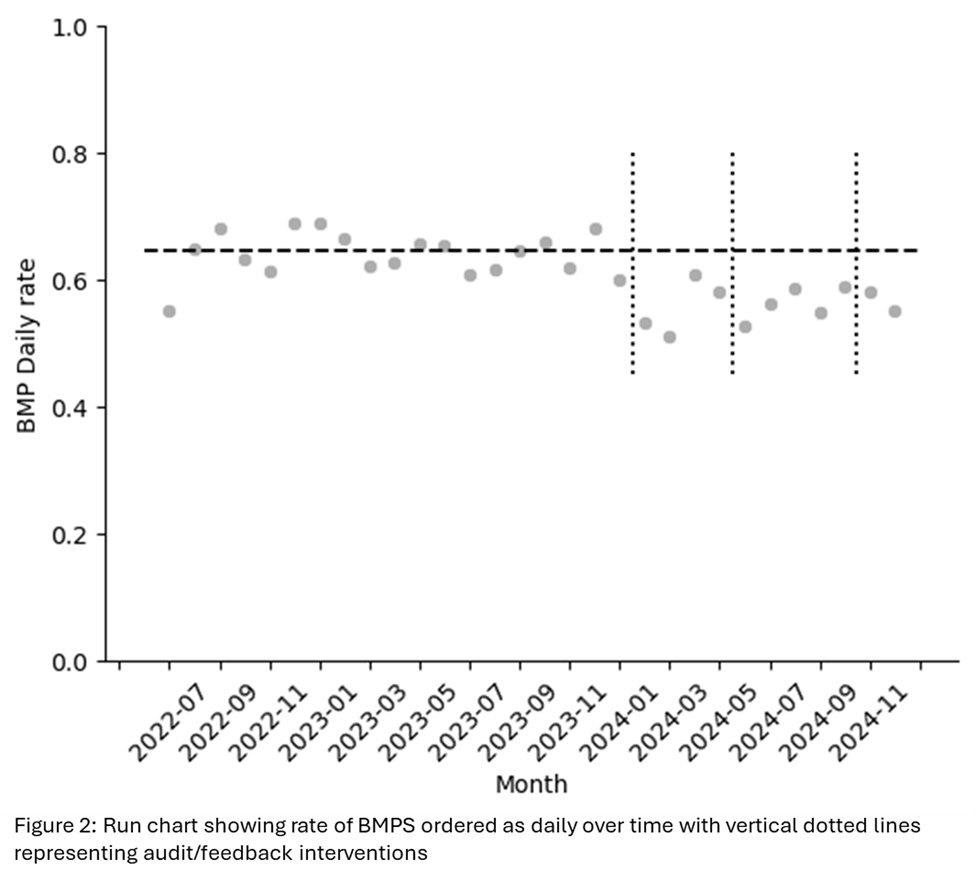
Results: 106 unique providers received individualized feedback and peer comparison for CBC and BMP ordering respectively through the study period. CBC order rates for “In-AM Daily” per month was reduced from 62% vs 57% (p< 0.001). Rates of daily CBC for providers in the feedback pool were reduced from 62% to 55% (p< 0.001), while rates of daily CBC for providers not in the feedback pool remained unchanged 63% to 62% (p=0.27). BMP ordered as “In-AM Daily” per month was reduced from 63% to 55% (p< 0.001). Rates of daily BMP for providers in the feedback pool were reduced 64% to 55% (p< 0.001), and rates for providers not in the feedback pool were also reduced 62% to 57% (p< 0.001) (Figure 2.) Rate of total CBC per patient encounter days was unchanged at 72% (p< 0.40), while BMP per patient encounter days was reduced 56% to 53% (p< 0.001). 67% of orders were placed by providers who received feedback.
Conclusions: Direct provider feedback and peer comparison provided every 3 months reduced the percentage of CBC and BMP labs ordered as daily, indicating a more mindful lab ordering process. Despite a significant number of labs being ordered by providers not in the feedback pool, BMP orders per patient encounter days showed a reduction. These results demonstrate that provider feedback can impact lab ordering practices in the absence of forced function EMR-based interventions (eg, interruptive alerts or removal of daily lab ordering functions).