Background: ICU readmissions pose a significant challenge in healthcare, being associated with up to a four-fold increase in mortality, prolonged hospital length of stay, and healthcare costs estimated at $15–20 billion annually in the United States.1 Notably, 27% of ICU readmissions occur within 24 hours of downgrade, and 45% are due to recurrence of the initial ICU admission diagnosis.3 This study aimed to develop, implement, and validate into practice a risk prediction tool, “ICU Downgrade Risk Score,” to improve safety surrounding medical ICU (MICU) transitions and reduce ICU readmissions.
Methods: Risk factors for ICU readmission were identified through a comprehensive literature review, stakeholder conversations, and a retrospective review of MICU reupgrades at our institution.2 Fifteen prognostic determinants were incorporated into the ICU Downgrade Risk Score, each weighted on a scale of 1-5. Prognostic determinants included but are not limited to: weighted RASS scores, MEWS scores, length of stay, age, and active orders for ICU level of care including medications or interventions such as arterial lines. The tool was embedded in the electronic health record (EHR) as a tool hospitalists could passively incorporate into their workflow. A retrospective 6 month cohort of MICU downgrade prior to implementation was used as comparison to the 3 month post implementation cohort. Score performance was assessed by comparing median risk scores at hours: 0, 2, 4, 8, 12, and 24 prior to downgrade, at the time of transfer order, and at discharge disposition. Logistic regression was performed to evaluate associations between the risk score (using a cutoff of 3.5) and readmission. Additional logistical regression examined score change over the 24-hours prior to downgrade and readmission risk.
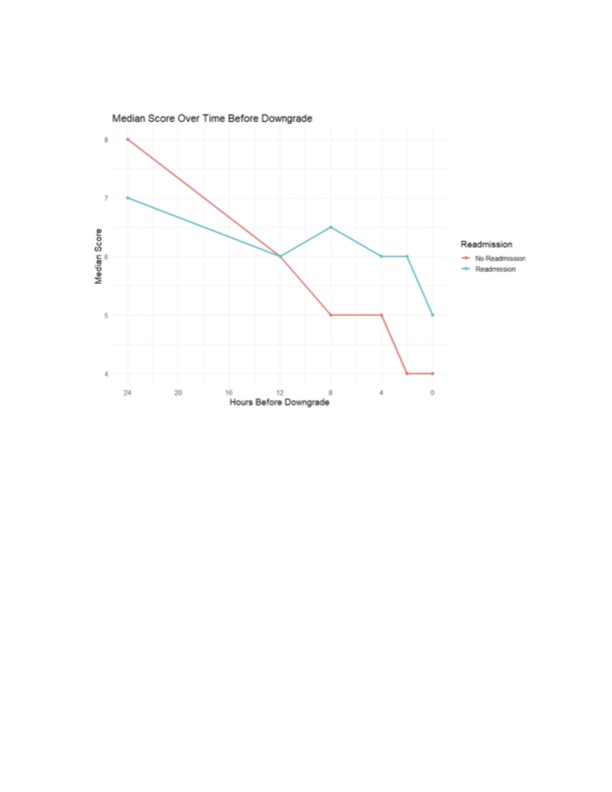
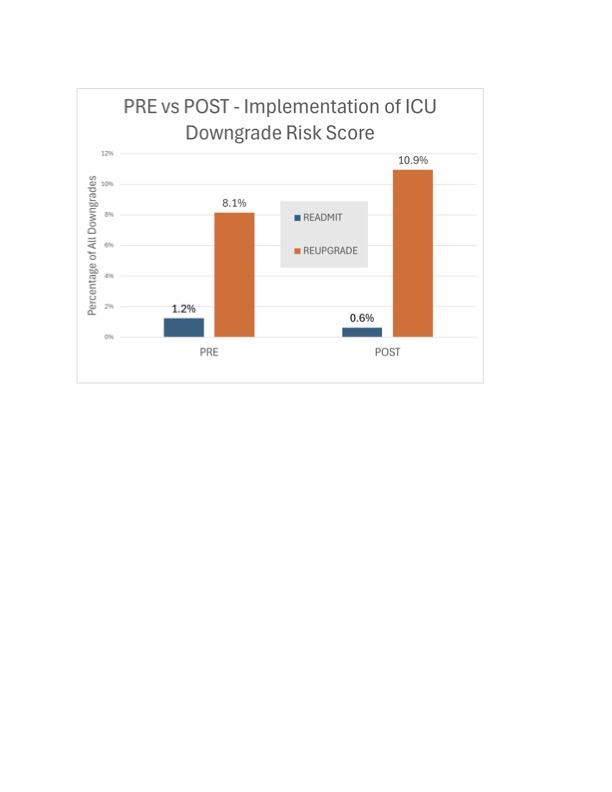
Results: Readmission to MICU at 48 hours was 1.2% (13/1056) over 6-months pre-intervention and 0.6% (4/640) for 3-months post-implementation (p=0.225). The median downgrade risk score was 4 for non-readmitted patients versus 5 for readmitted patients (p = 0.003). A score ≥3.5 was associated with 2.35-fold higher odds of readmission compared with a score < 3.5 (95% CI 1.40–4.09, p = 0.002). Logistic regression of score change over the 24 hours prior to downgrade demonstrated that patients with a more rapid drop in score are less likely to be readmitted (95% CI 1.02–1.14, p = 0.015).
Conclusions: The ICU Downgrade Risk Score effectively identifies MICU patients at elevated risk for readmission and may assist clinicians in triaging downgrades and addressing clinical instability prior to transfer. Further multicenter prospective studies are warranted to externally validate and refine the model.