Background: With the growth of hospitalists staffing general medicine inpatient teaching services, many faculty prefer shorter time-on-service to align with direct patient care schedules and balance the competing demands of hospitalist practice. However, the impact of one- versus two-week attending rotation duration on patient outcomes, faculty burnout and learning environment is unknown. We hypothesized that one-week compared to two-week attending rotation will not be associated with worse patient or learning environment outcomes.
Methods: We performed a retrospective cohort study comparing patient and learning environment outcomes associated with one- vs two-week attending rotations on general medicine teaching services at a large academic medical center. We used electronic medical record (EMR) data to evaluate outcomes for patients. The primary patient outcome was hospital length of stay (LOS). Secondary outcomes included readmission within 14 days, return to the emergency department within 14 days of discharge, and death during hospitalization or within 30 days. We also collected survey data from faculty about satisfaction, burnout, and professional fulfillment and from residents about satisfaction with the learning environment.
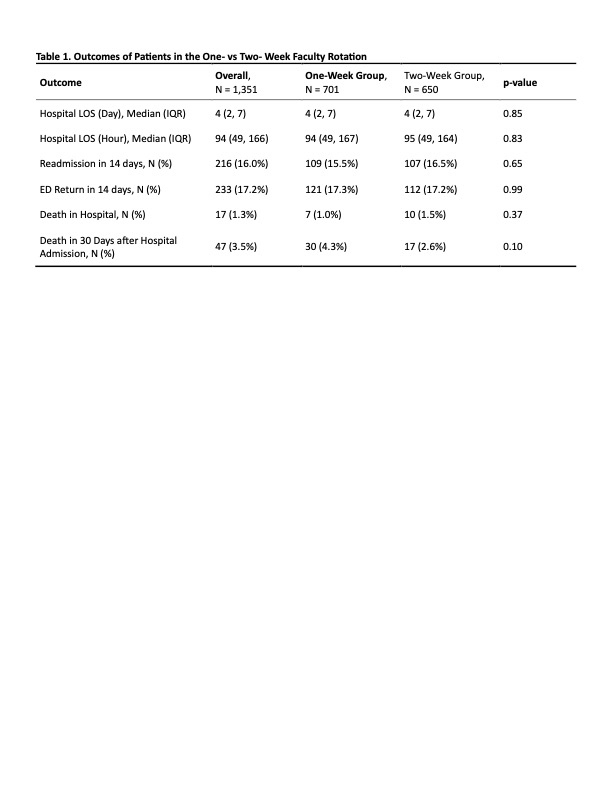
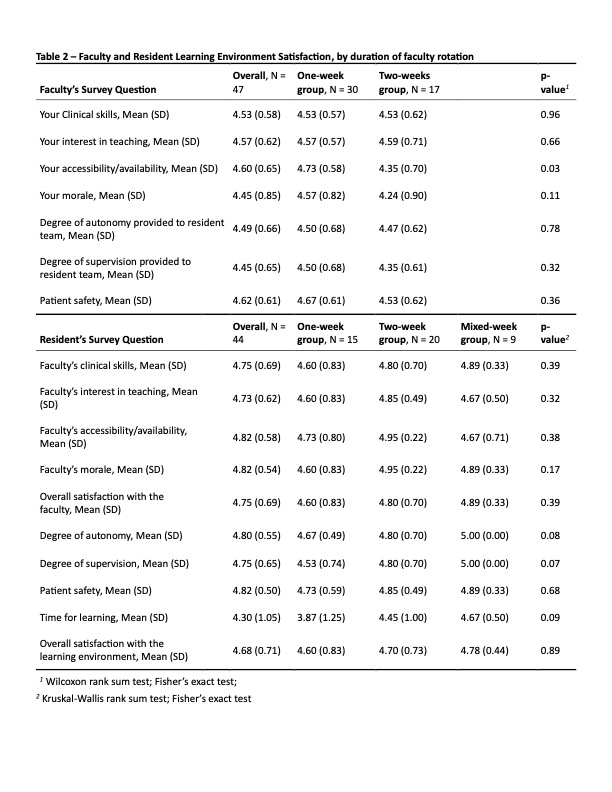
Results: Of 1351 patient hospitalizations analyzed, 701 patients were cared for by faculty rounding for one week, and 650 patients were cared for by faculty rounding for two weeks. Median patient age was 64 years (IQR 49-79 years), 51% (N=694) were men and 77% (N=1045) were white. The median hospital LOS was similar between the one- and two-week groups (94 hours [IQR 46,166] vs 95 hours [IQR 49,164]; p=0.83). There were no differences in readmission or return to ED within 14 days or 30-day mortality. Survey response rates were 53% (47/89) for faculty and 44% (44/99) for residents. Faculty and resident learning environment satisfaction responses in the one-week group were similar to those in the two-week group, except faculty rounding for one week were slightly more satisfied with their accessibility/availability (4.73 [SD 0.58] vs. 4.35 [SD 0.70]; p = 0.03). There was no difference in the proportion of faculty meeting cut-point for professional fulfillment between groups (53% for one-week vs 41.2% for two-week; p = 0.55). There was no difference in the proportion of faculty meeting cut-point for burnout (10% for one-week vs. 23.5% for two-week; P > 0.99)
Conclusions: General medicine faculty rotation duration of one week versus two weeks was not associated with difference in patient outcomes, overall faculty or resident satisfaction with the learning environment, or faculty professional fulfillment or burnout. Our findings suggest that flexibility in faculty scheduling can be considered when staffing resident services.