Background: Hospital throughput is key to help optimize the availability of inpatient beds. It is well known that throughput decreases through the weekend due to a variety of reasons. Because of this voltage drop, Monday becomes a crucial day to safely discharge patients that have had delays on the weekend. Our Hospitalist Division mostly follows a 7-clinical/7-non clinical day rotating schedule which is consistent with the majority of other hospitalist groups across the country. There is no clear data on which 7-day block maximizes quality and operational metrics. A prior study looking at the effect of moving the start day from Tuesday to Thursday did not find a significant difference in length of stay (LOS). Mondays represent a start day for many individuals in the interdisciplinary team. We hypothesized that changing the hospitalist start day to Tuesday from Monday would result in an increase in Monday discharges by promoting continuity of care by the attending physician.
Methods: Starting on April 18, 2022, the hospitalists schedule was changed from a Monday start day to a Tuesday start day. There was no change to the number of weeks covered by each hospitalist. Hospitalists continued to work on a 7-clinical/7-non-clinical day rotation. Data for O:E LOS by day of week as well as the percent discharge for each day of the week was tracked using inpatient discharge data from NYU Langone Health’s analytics center. We compared data from 7 months prior to the change to data from the 17 months following the change. Two-sample t-tests were utilized for assessing differences in O:E LOS, and chi-square tests for examining variations in discharge percentages on Monday and Tuesday, before and after the intervention.
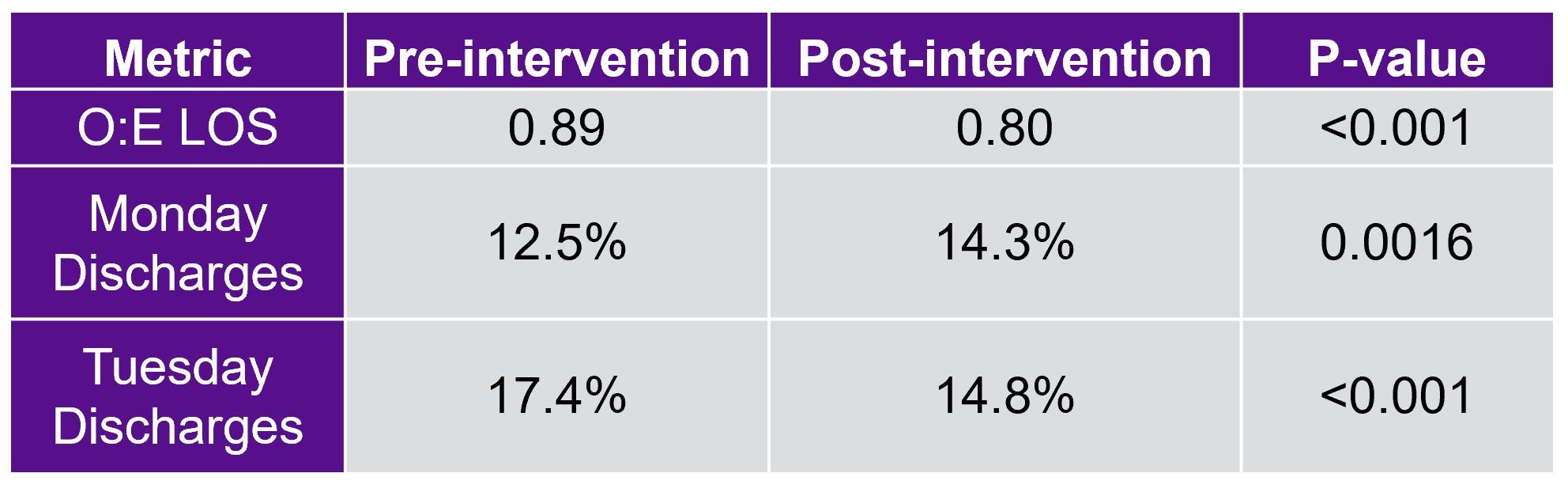
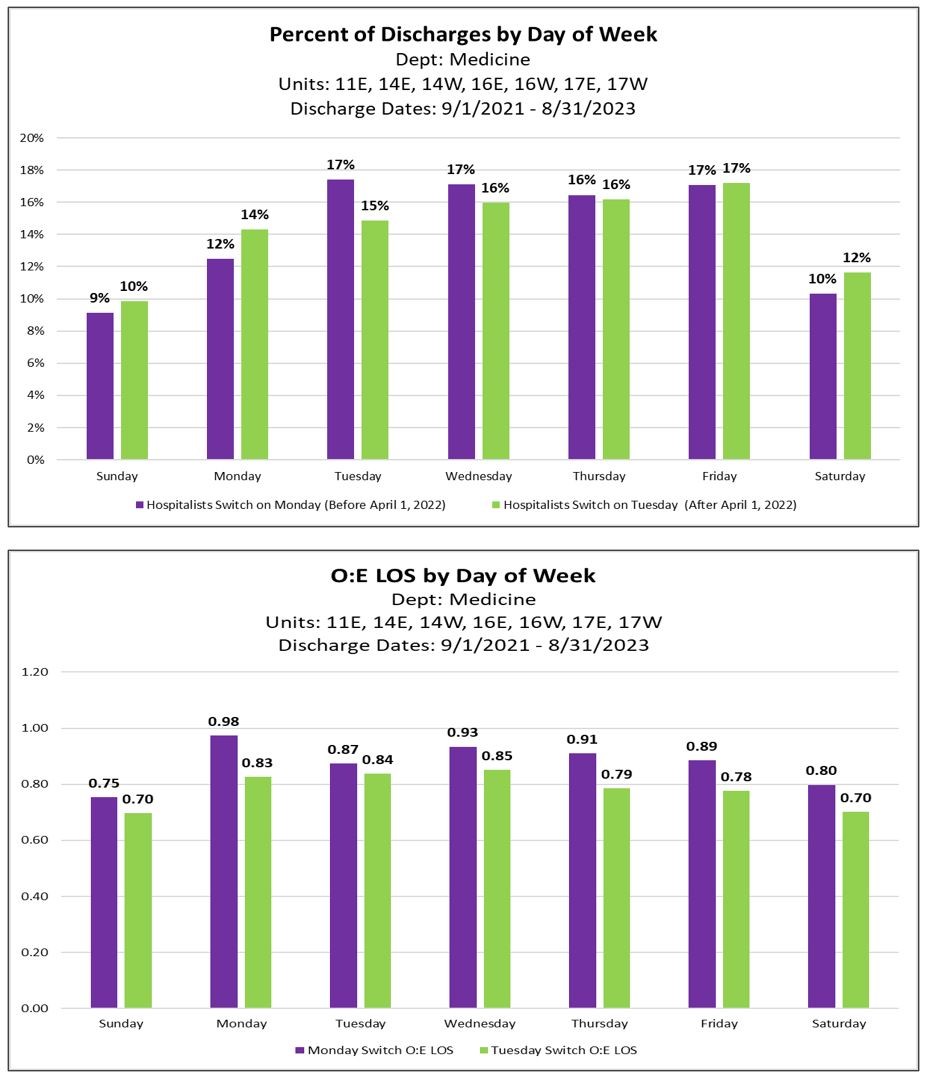
Results: From April 18, 2022 – August 31, 2023, there was a 1.8% absolute increase and a 14% relative increase (p = 0.0016) in Monday discharges after we changed service start days from Monday to Tuesday. Consequently, there was an 2.6% absolute decrease and a 15% relative decrease (p< 0.001) in Tuesday discharges (See Figure 1). There was an absolute reduction in O:E LOS by 9% (p < 0.001) following the change in hospitalist start day. Although not the goal of this intervention, we also observed an increase in weekend discharges by percentage both Saturday and Sunday (See Figure 2).
Conclusions: Changing the hospitalist start day from Monday to Tuesday resulted in a statistically significant increase in Monday discharges and a statistically significant reduction in Tuesday discharges. There also was a statistically significant reduction in O:E LOS.