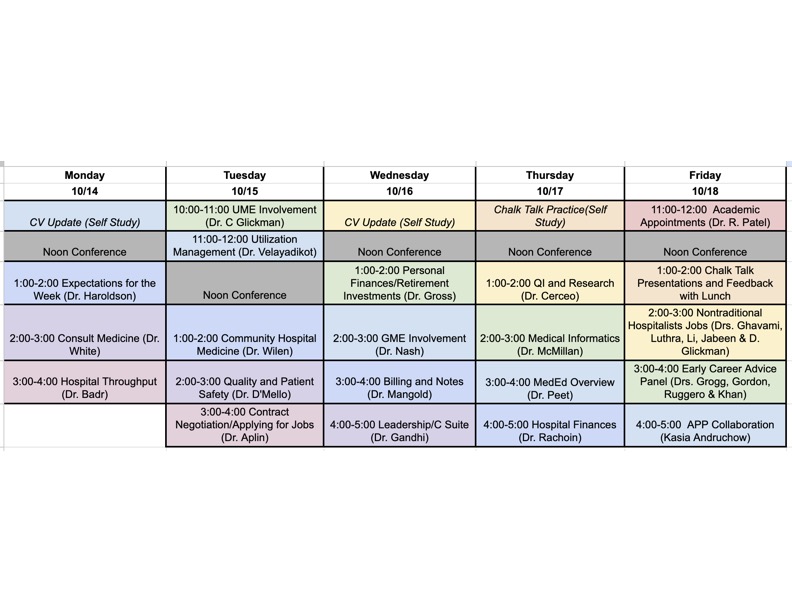
Background: The Hospitalist track at Cooper Hospital was created to provide residents with the opportunity to learn more about the different non-clinical aspects of hospital medicine. The track is divided into four weeks: one didactic week and three junior hospitalist weeks, which serve as the inpatient clinical experience. Additionally, there are four elective weeks that are mandatory in order to graduate with distinction in this track: addiction medicine, palliative care, neurology, and medical education. This opportunity is granted to PGY-2 and PGY-3 internal medicine residents who are interested in hospital medicine as a career path.
Purpose: The didactic week in the hospitalist track is designed to be both informative and insightful. During this week, PGY-2 and PGY-3 internal medicine residents learn more about ways to get involved with academic medicine, operational medicine, quality/safety, medical informatics, and management. Each topic is discussed by a hospitalist who specializes in the given field, shares their background and their career path that led them to their current position. The didactic week is a novel model that was initiated since Fall 2022 in the hospitalist track. The goal is to introduce this concept to other residency programs for implementation on a local and national scale.
Description: During didactic week, the hospitalist track physician works with small groups consisting of 6-9 residents. The week is comprised of 4-5 presentations daily, each being hour-long. Topics for each lecture can be either lecture-based, Q&A style, chalk talks, or interactive group activities. Residents learn how to build their professional resumes, negotiate contracts when applying to jobs, and manage their finances with an attending salary. Additionally, several presentations are structured to serve as informative pieces, where presenters explain the business model of the hospital system. This focuses on how to manage a hospital, the hierarchical system of workers and their respective duties, and quality/safety projects that aid to improve the overall model. Another component of the didactic week is the Q&A panel where non-traditional hospitalists answer questions about their work and lifestyle as per-diem, part-time, global health, or locum tenens. Learning about the versatility of hospital medicine is useful when residents apply for hospital medicine positions as it serves to help them establish their roles as new attending physicians. Residents were given feedback forms every day and were asked to provide comments/suggestions about each presenter as well as their topic of discussion.
Conclusions: Since the initiation of this track, 12 internal medicine residents have graduated, 8 of which are hospital medicine physicians. There are currently 7 PGY-3 and 9 PGY-2 residents enrolled in the hospitalist track. The feedback has been overwhelmingly positive. Many residents appreciated the informal aspect of the presentations and particularly favored the interactive activities that kept them engaged as well as anecdotal stories from all the presenters. There was a strong preference for more financial discussions with emphasis on investment, retirement plans and student loans. Early exposure to the different non-clinical opportunities offered within hospital medicine is crucial.