Background: Gamification is a novel and evolving concept in the digital age of medical education (1,2). Traditionally, gamification efforts have focused on single session interventions such as Jeopardy-style lectures or online tools like Kahoot (3). More recently, educators have used escape rooms with puzzles themed around concepts in medicine (4). However, single experiences within a limited time frame are difficult for learners to repeat for practice or reference.
Purpose: We hypothesized that novel online interactive medical education modules, developed using Godot, a free open-source video game engine, would improve learning retention among residents and medical students.
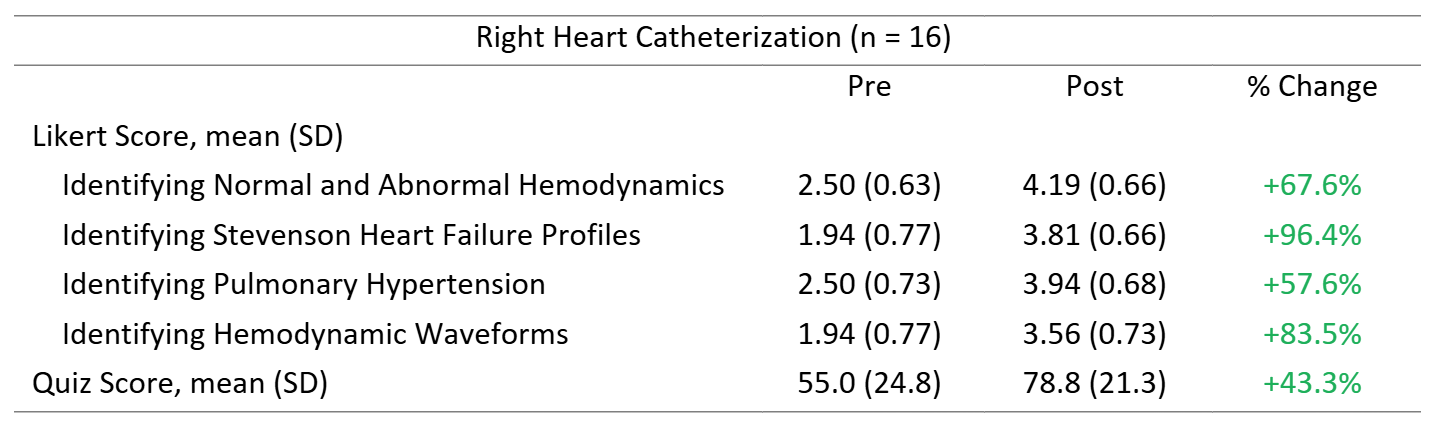
Description: Between July 2023 and November 2024, first-year residents and medical students at two hospital systems were given a survey prior to rotating onto inpatient cardiology or pulmonary services. In addition to collecting demographic data, surveys measured subjective confidence in skills related to acid base or right heart catheterization interpretation through Likert scale ratings and objectively through multiple choice questions. Learners were then given access to the online module to utilize at their convenience. All participants then received a follow-up survey approximately one week later with the same Likert scale and multiple-choice questions to measure improvement. The novel online interactive modules cover how to systematically interpret a patient’s acid-base status and how to interpret hemodynamic data and waveforms from a right heart catheterization. Both feature a full didactic course that learners can go through at their own pace as well as a built-in practice problem generator which can provide additional practice. Modules are also programmed to provide instant feedback on incorrect answers to help reinforce concepts. Based on the sizes of the first-year resident classes, approximately 130 unique learners received the surveys. Of those, 65 completed the right heart catheterization pre-survey and 60 completed the acid base pre-survey. On follow up, 16 (24.6%) and 11 (18.3%) learners completed the respective post-surveys. Those who utilized the right heart catheterization module experienced over a 50% increase in confidence in all domains as measured by Likert scores. They also scored 43.3% higher on the five-question quiz at the end of the survey, showing objective improvement. Similarly, the acid base module led to over a 30% increase in confidence and 33.4% higher scores on the four-question quiz.
Conclusions: These novel gamification modules provide an accessible means of self-directed learning which led to higher confidence and competence in the interpretations of acid base status and hemodynamic data. These types of tools are especially crucial for modern learners as the primary learning resources for the next generations of medical trainees will be digital. Our goal is to expand the scope of learners utilizing these tools and to also create new modules covering other topics in internal medicine.