Background: Many hospitalists at academic institutions are eager to grow as effective clinical educators but face barriers that limit their development opportunities. With limited time on teaching wards, hospitalists have fewer chances to engage in “learning by doing” in their roles as educators. Many who enter these positions straight after residency are expected to serve as clinical educators with little formal training in essential teaching skills. Attendance at external conferences or formal faculty development programs, however, is frequently restricted due to high costs related to conference fees, travel, accommodations, and time away from clinical duties. Additionally, budget constraints within divisions further limit access to these essential faculty development opportunities.
Purpose: In order to support our hospitalists’ professional development and to enhance the education of our trainees, our Division created an annual faculty development conference, Learning to be Better Ward Teachers.
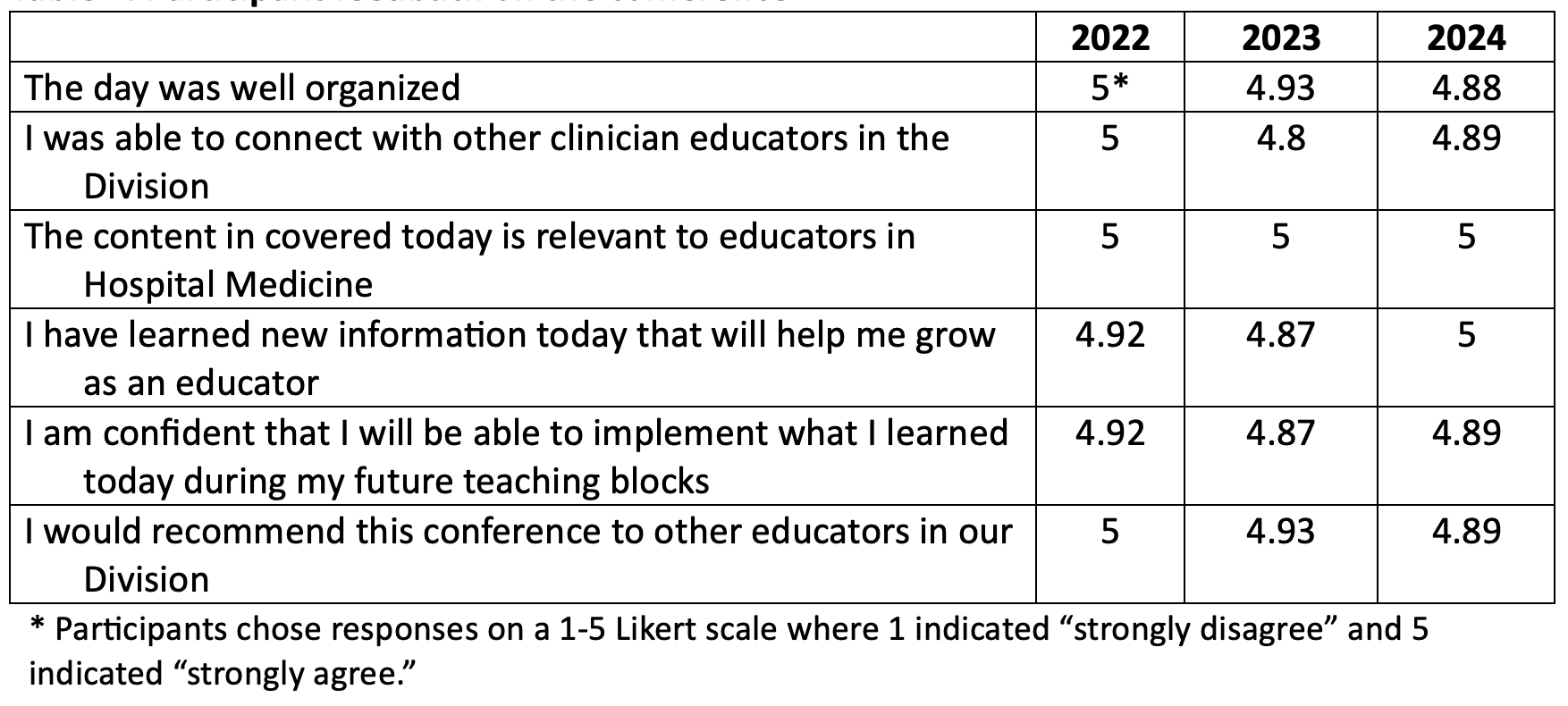
Description: Each half-day conference includes three 80-minute interactive workshops on medical education topics relevant to teaching hospitalists (see Table 1). This conference is planned, presented, and attended by our hospitalists, offering valuable opportunities for our experienced teaching hospitalists to share their expertise, further hone their educational niches, and enhance their CVs and teaching portfolios. At the same time, it addresses the crucial development needs of our clinical educator hospitalists. Furthermore, this conference creates a multisite environment that fosters community among clinical educators within our Division, bringing colleagues together who are otherwise geographically separated. This conference is advertised months in advance, allowing hospitalists to request time off from clinical duties to attend.At the end of each conference, attendees complete evaluations for both individual sessions and the day overall. This feedback has been invaluable, providing formative input for presenters and guiding conference improvements for subsequent years. Over the 3 years we have offered this conference, responses have been overwhelmingly positive, especially from early-career faculty who developed teaching skills they can carry forward, as well as from faculty who value the opportunity to present and receive feedback. The evaluation forms also allow attendees to suggest additional topics, which we use to shape future agendas. As a next step, we are exploring options for offering CME to boost attendance.
Conclusions: This free, local conference has not only fostered a community of education leaders among our hospitalists, but also presents an easily scalable model for other institutions.