Background: There is increasing awareness that social determinants of health (SDOH) contribute to inequities in health outcomes. Due to methodological challenges, most studies have focused on adult metrics and quantitative data are limited. The Child Opportunity Index (COI) is a unified measure of SDOH with local specificity at the level of census tracts, using indicators that are especially relevant to children. I hypothesized that disparities in health outcomes, such as infant mortality rates, would be associated with pediatric SDOH as reflected by COI.
Methods: Neighborhood-level estimates of infant mortality (death at less than 1 year of age) in California in 2015 were obtained for 8,047 census tracts (Tracking California). State-normed COI scores for 2015 were available for 7,980 census tracts (99.2%), ranging from 1 (least opportunity) to 100 (greatest opportunity) (diversitydatakids.org). Association between infant mortality and COI score was examined using nonlinear least squares regression to obtain a best fit model.
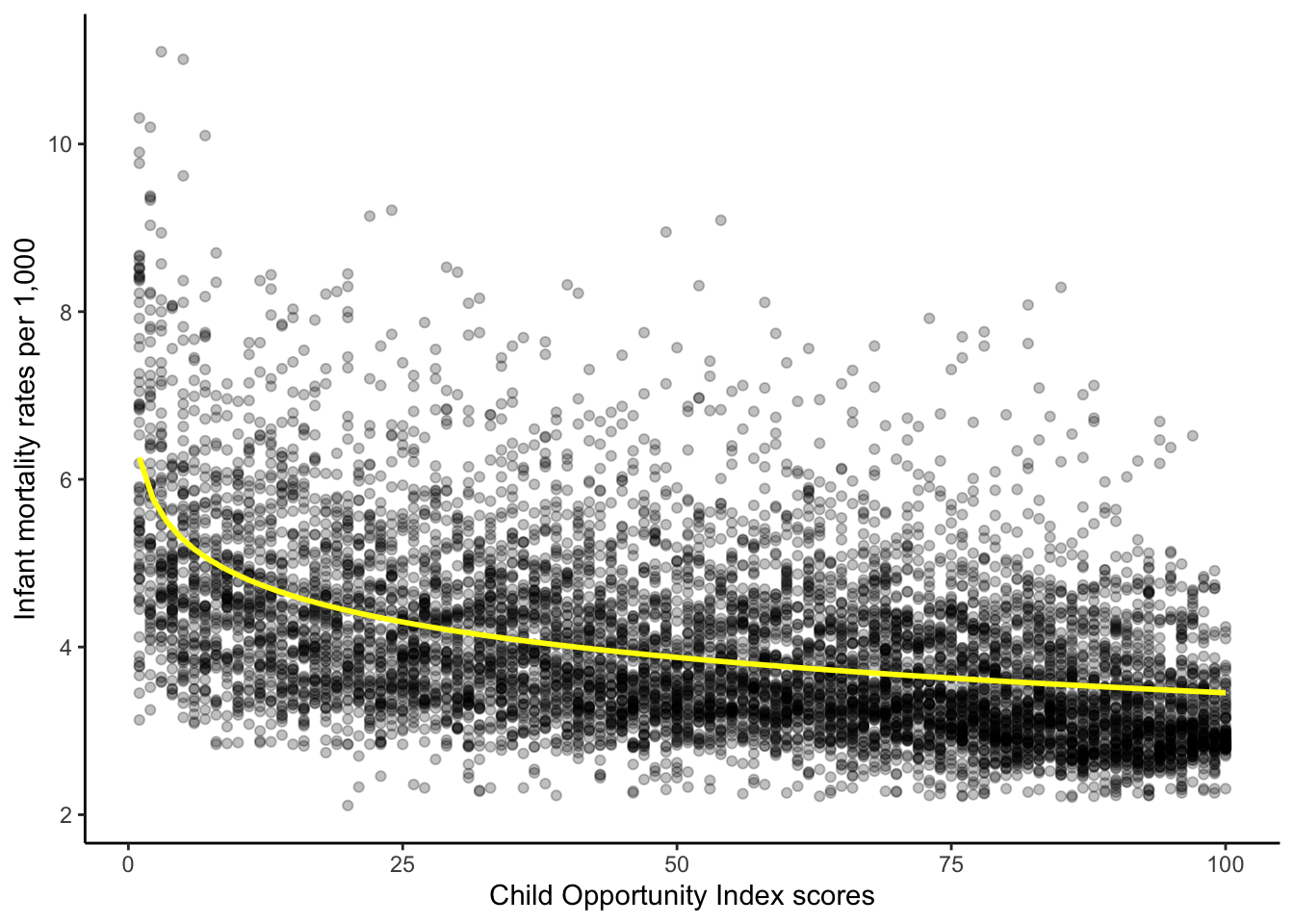
Results: Infant mortality was unequally distributed among neighborhoods, showing an inverse correlation with opportunity levels. Census tracts with lower opportunity levels were more likely to have higher infant mortality rates. This disparity was best fitted by a logarithmic model, y = -0.61 log(x) + 6.26 (Figure). On the low end of the opportunity axis, a 1-point increase in COI score was associated with a decrease in mortality rate by 0.18 per 1,000 infants, whereas in the middle of the axis, a 10-point increase in COI score only decreased the mortality rate by 0.05 per 1,000 infants.
Conclusions: These data show that SDOH on a local level can predict disparities in infant mortality. Neighborhoods with factors that promote thriving of children are likely to have beneficial effects on infants as well. Although statistically significant, effect size may have been limited due to the use of a composite measure like the COI. Future work can investigate specific SDOH that may inform more targeted interventions. The findings also suggest that interventions may be more effective if focused toward lower-opportunity neighborhoods.