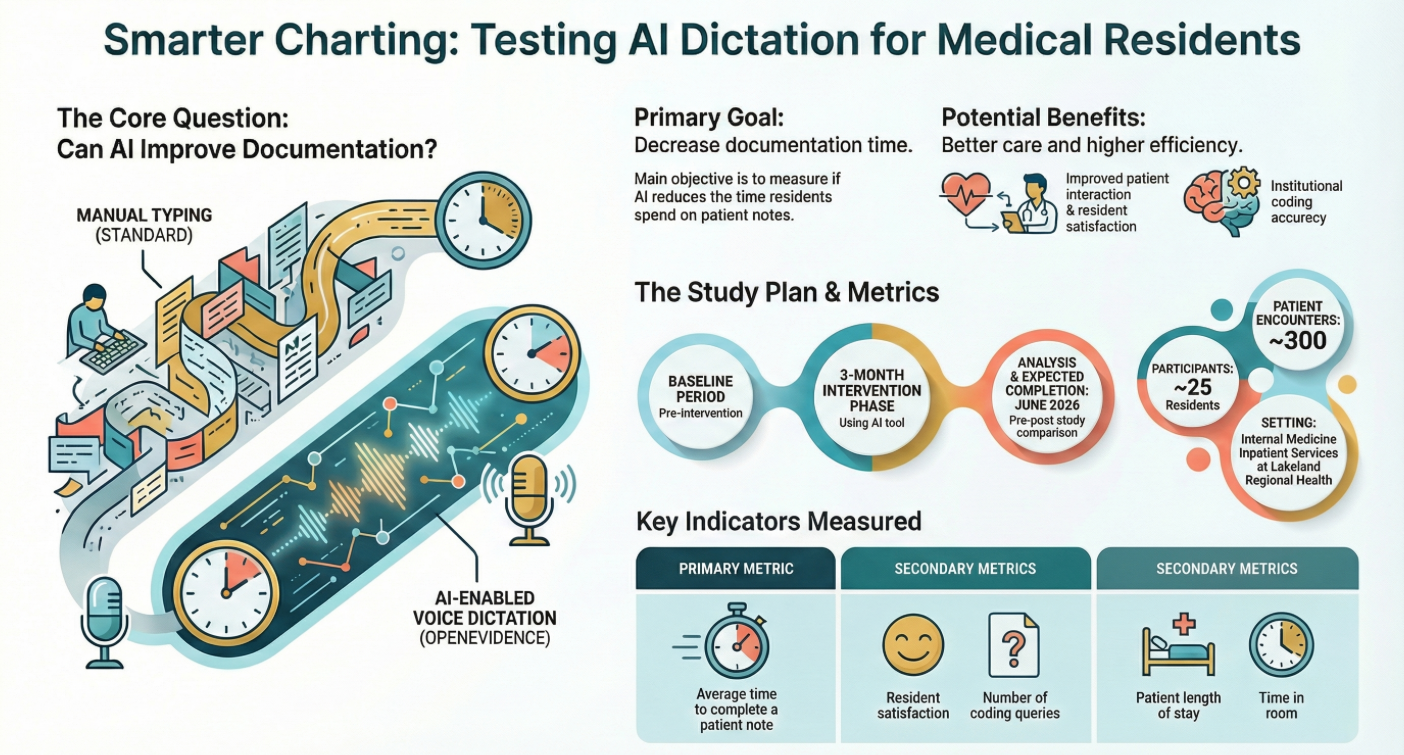
Background: Documentation is a major contributor to clinician workload and burnout. Most clinicians complete notes manually, or through dictation often after hours, which affects efficiency and delays patient care tasks. Artificial intelligence enabled voice dictation tools like OpenEvidence may streamline this process by reducing charting time while improving documentation completeness. Despite growing interest in AI assisted documentation, prospective controlled data in clinical training environments remain limited.
Purpose: To evaluate whether implementing OpenEvidence for inpatient internal medicine clinicians improves efficiency, documentation quality, and satisfaction while maintaining patient centered outcomes. The study focuses on objective workflow metrics and the clinician experience to guide future system wide adoption.
Description: This is a prospective controlled study comparing standard manual documentation with OpenEvidence dictation across inpatient internal medicine services. The design includes a baseline pre intervention phase followed by a three month intervention phase where participating clinicians use OpenEvidence for all SOAP and H and P notes. Approximately 300 patient encounters from 20 to 25 clinicians will be analyzed. Primary outcome is average time to complete a patient note. Secondary outcomes include clinician satisfaction, coding queries, coding levels, time spent with patients, and SA LOS. Data sources include note time stamps, coding reports, HCAHPS elements, and clinician surveys. All data are de identified and stored securely in compliance with IRB and institutional standards. Participation is voluntary and clinicians can withdraw at any time. No PHI is recorded.
Conclusions: This QI provides a structured evaluation of AI assisted documentation within clinical practice and training. By pairing objective workflow metrics with clinician reported outcomes, it aims to determine whether OpenEvidence meaningfully reduces documentation burden, enhances efficiency, and supports better coding accuracy without compromising patient care. Findings may inform broader integration of AI tools within medical education and hospital systems to improve the clinician experience and patient outcomes.