Background: As the landscape of healthcare changes, hospitalists are progressively at the fore front of medical training as educators for both students and residents. There is some literature suggesting that hospitalists are rated favorably by both house staff and medical students as better clinical educators on inpatient internal medicine rotation as compared to traditional non-hospitalist faculty. Some studies have raised concerns about possible negative impacts on autonomy and decision making, bedside teaching and subspeciality exposure of housestaff. However, impact of hospitalists on medical student education has received relatively less attention. Our study focuses on the educational experience of medical students and hospitalists on general inpatient hospitalist teams that are comprised of a hospitalist attending and advanced practice provider along with one to two medical students.
Methods: This qualitative project involved one-on-one interviews with eleven third year medical students and seven hospitalist physicians who worked on a hospitalist service in last one year. A team of three third year medical students was deployed as interviewers to minimize pressure on student intervieews. Hospitalist physicians were interviewed by the author (hospitalist attending). Verbatim transcription was performed by three medical students and the author. All data was coded and analyzed by the author via thematic analysis.
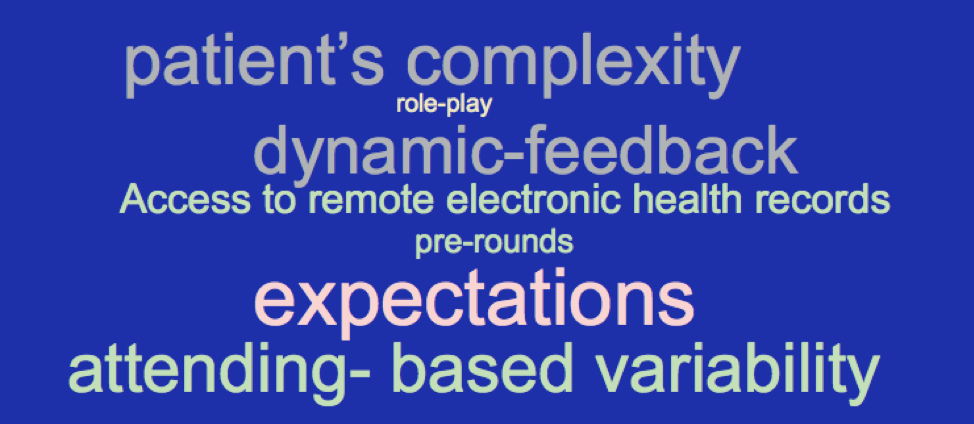
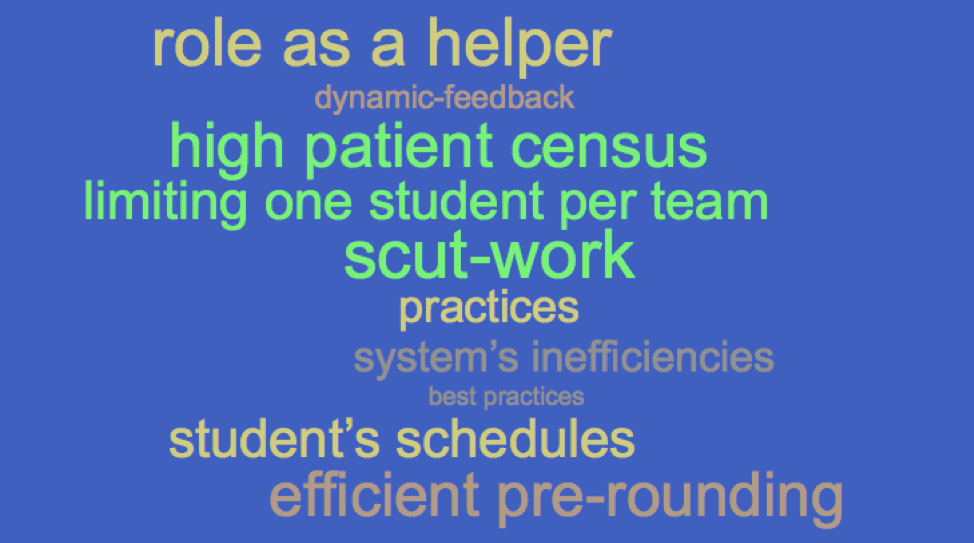
Results: Multiple themes emerged from these interviews. Student interviews generated themes around the ideal structure and content of rounds. In addition, student perceptions around the impact of attending and team-based variability on learning experiences were elucidated. The hospitalist attendings interviewed opined on barriers to providing a better learning experience for students. In addition, several learner and rotation based changes to optimize student experience were suggested by the hospitalists.
Conclusions: Data collected so far suggests that students appreciate variability in different attending’s style of working and teaching and are willing to adapt as long as expectations are discussed beforehand. They really value dynamic feedback. The hospitalist attendings perceived high patient census as the biggest barrier to providing better learning experience for students. Changes recommended by them included more proactive involvement of students in the logistics of patient care and a desire for a set of recommended best practices to optimize learning experiences on hospitalist teams.