
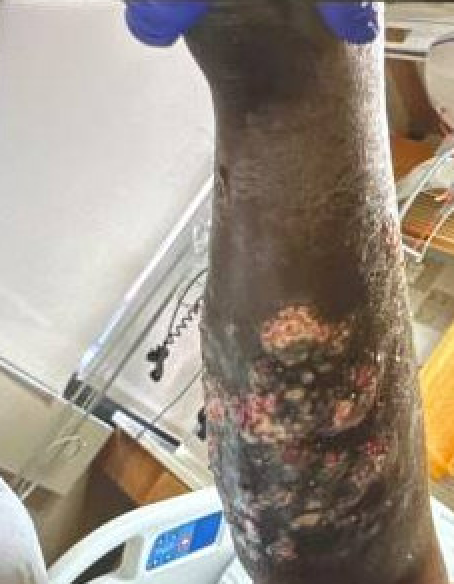
Case Presentation: A 40 year old female with a history of acne vulgaris and hidradenitis suppurativa presented with bilateral lower extremity pain.Patient had two prior admissions for extensive suppurative hidradenitis (SH) complicated by abscess development within the past two years. Patient began developing bilateral lower extremity edema, pain and ulcerating sores for the past 6 months prior to current presentation, causing her to return to the ED. She had no fevers or chills but pain progressed to the point where she was unable to ambulate. On arrival to the ED, she was found to be afebrile with HR to 116 and BP 95/65. WBC 8.3 ESR >130 and CRP 13.5. MRV ruled out DVT. Vancomycin and Zosyn was started due to initial concern for infection and she was also given IV dilaudid given her significant pain. Dermatology was consulted who believed her wounds were consistent with pyoderma gangrenosum (PG). Given this, she was diagnosed with PASH syndrome which is characterized by the triad of PG, acne and SH. She was started on methylprednisolone 80 IV with 4 week taper for symptom control. Her antibiotics were discontinued as there was now a lower suspicion for infection. After rule out of TB with negative quantiferon gold and negative hepatitis b/c studies, she was also started on infliximab. Her lower extremity pain and wounds subsequently improved and she was discharged with follow up with dermatology. Her symptoms were still in remission 1 year after discharge.
Discussion: PASH syndrome is a rare autoinflammatory disorder characterized by the triad of PG, acne and SH. The exact pathophysiology of PASH syndrome is still unclear – research thus far seem to indicate it is a polygenic autoinflammatory disorder – but is associated with elevated proinflammatory cytokines such as IL-1 and TNF. Patients typically develop severe, extensive acne and SH during young adulthood. SH additionally tends to be recurrent while PG tends to develop later in adulthood. Given the rarity of PASH, there have been no randomized controlled clinical trials on optimal therapies but is usually treated with immunosuppression with systemic glucocorticoids and anti-TNF medications such as infliximab. Isolated SH treatment often begins with antibiotics such as tetracyclines, retinoid therapy and metformin, and typically only includes anti-TNF medications in moderate to severe cases. Proper diagnosis therefore is important to avoid delays in immunosuppression.
Conclusions: PASH Syndrome is a rare disorder characterized by severe and extensive PG, acne and SH. A high level of suspicion is needed for appropriate diagnosis and management.
.png)