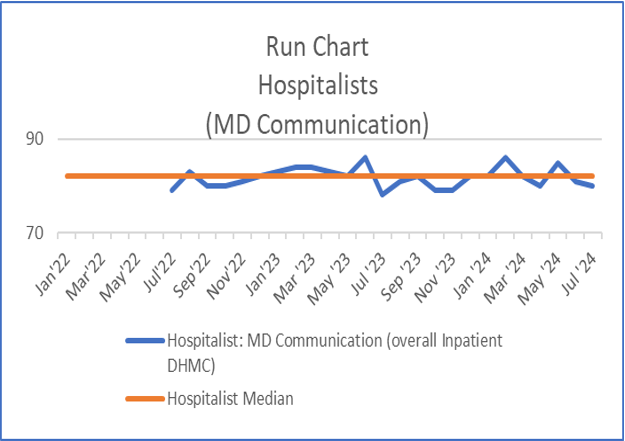
Background: Effective discharge communication is critical to ensuring safe patient transitions from the hospital and can improve outcomes. We have observed declining HCAHPS communication performance across our Section of Hospital Medicine and the transition out of the hospital was identified as a significant contributor. HCAHPS data was too slow to inform real-time improvement, so we developed a real-time feedback approach.
Purpose: To use rapid real-time feedback from patients recently discharged to assess communication quality and identify improvement opportunities.
Description: An improvement team was organized and supported by the Promise Partnership, a learning health system initiative in our health system. We used a technology-augmented real-time feedback approach using third-party software (Truthpoint), to capture patient feedback. Data is collected in contacts with patients who had recently been discharged home or to a non-facility destination. Real time feedback reports were generated for use by the improvement team. If requested via the survey, a phone call to clarify residual patient concerns was implemented by the team.We have collected 850 responses from patient encounters over 14 consecutive months. 23% of respondents reported confusion regarding symptom management plans post-discharge and 15% reported concerns about medication changes. Our improvement team was also able to track survey recipients who were readmitted to our hospital. Discharging providers in the section retrospectively identified that delayed access to post-hospital follow-up was contributory in 38% of these readmissions and that overall, 16% of these readmissions were preventable.
Conclusions: Patient experience HCAHPS data can identify improvement opportunities and measure longitudinal performance, but a rapid feedback mechanism is required to inform experience-based improvement. Our approach has quickly identified improvement opportunities we can test to improve discharge communication.