Background: Obstructive sleep apnea (OSA) is closely associated with obesity, and weight reduction is a critical component of its management. Glucagon-like peptide-1 (GLP-1) and glucose-dependent insulinotropic polypeptide (GIP) agonists have shown promise in promoting weight loss, potentially improving outcomes in OSA patients. We aimed to calculate the mean reduction in BMI and waist circumference after use of GLP-1 and GIP agonists.
Methods: A systematic review and meta-analysis of clinical trials were conducted according to PRISMA criteria, focusing on the effects of GLP-1 and GIP agonists compared to standard treatment (e.g., CPAP). Relevant studies from PubMed, Ovid, Medline, and ClinicalTrials.gov were screened using MeSH keywords. Non-clinical, non-English, non-full-length, and non-human studies were excluded. Data were extracted and analyzed using a random-effects model to calculate weighted mean differences (MD) with 95% confidence intervals (CI). Heterogeneity (I²) was assessed, and forest plots were generated using RevMan 5.4.
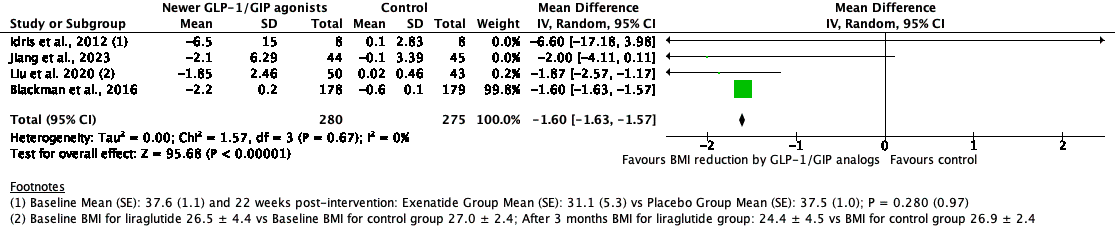
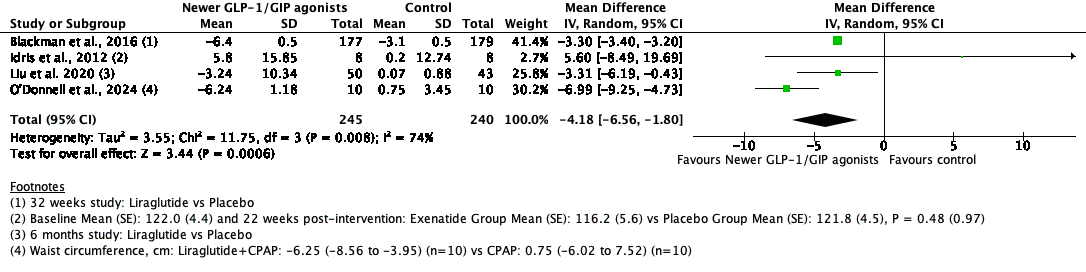
Results: Of a total 24 studies having data on BMI, a pooled analysis of four studies assessing BMI reduction demonstrated a consistent and statistically significant decrease with newer GLP-1/GIP agonists compared to controls. The overall MD was -1.60 kg/m² (95% CI: -1.63 to -1.57, I²=0%, p< 0.00001). Subgroup analyses showed:* Idris et al., 2012: MD = -6.00 (95% CI: -17.18 to 3.98).* Jiang et al., 2023: MD = -2.00 (95% CI: -4.11 to 0.11).* Lu et al., 2020: MD = -1.87 (95% CI: -2.57 to -1.17).* Blackman et al., 2016: MD = -2.20 (95% CI: -2.20 to -2.20).The results consistently favor GLP-1/GIP agonists for BMI reduction, with minimal variation across studies. Notably, the greatest reduction was observed in the study by Idris et al., 2012, despite its wide confidence interval.Waist Circumference: A meta-analysis of four studies evaluating the impact of newer GLP-1/GIP agonists on WC revealed a significant reduction compared to controls. The overall mean difference (MD) was -4.18 cm (95% CI: -6.56 to -1.80, I²=74%, p = 0.0006), favoring the intervention group. Subgroup analyses included:* Blackman et al., 2016: MD = -3.30 (95% CI: -3.40 to -3.20).* Idris et al., 2012: MD = 5.60 (95% CI: -8.49 to 19.69).* Lu et al., 2020: MD = -3.31 (95% CI: -6.19 to -0.43).* O’Donnell et al., 2024: MD = -6.99 (95% CI: -9.25 to -4.73).The findings highlight the efficacy of GLP-1/GIP agonists in reducing WC, with the greatest reduction noted in the study by O’Donnell et al., 2024.
Conclusions: GLP-1 and GIP agonists significantly reduce BMI and WC, supporting their use as effective interventions for weight reduction in OSA patients. Further research is needed to address the moderate heterogeneity observed in WC outcomes