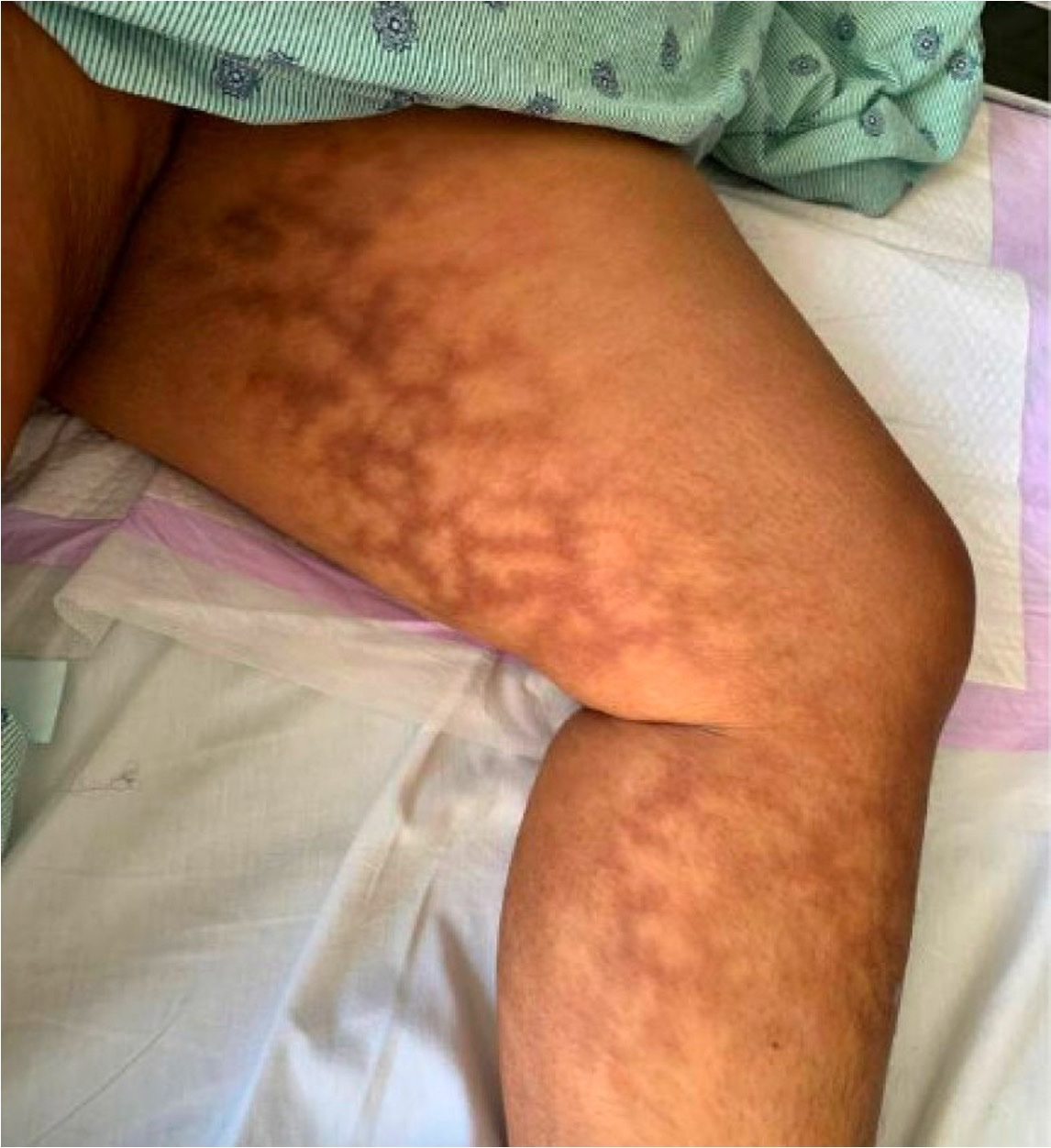
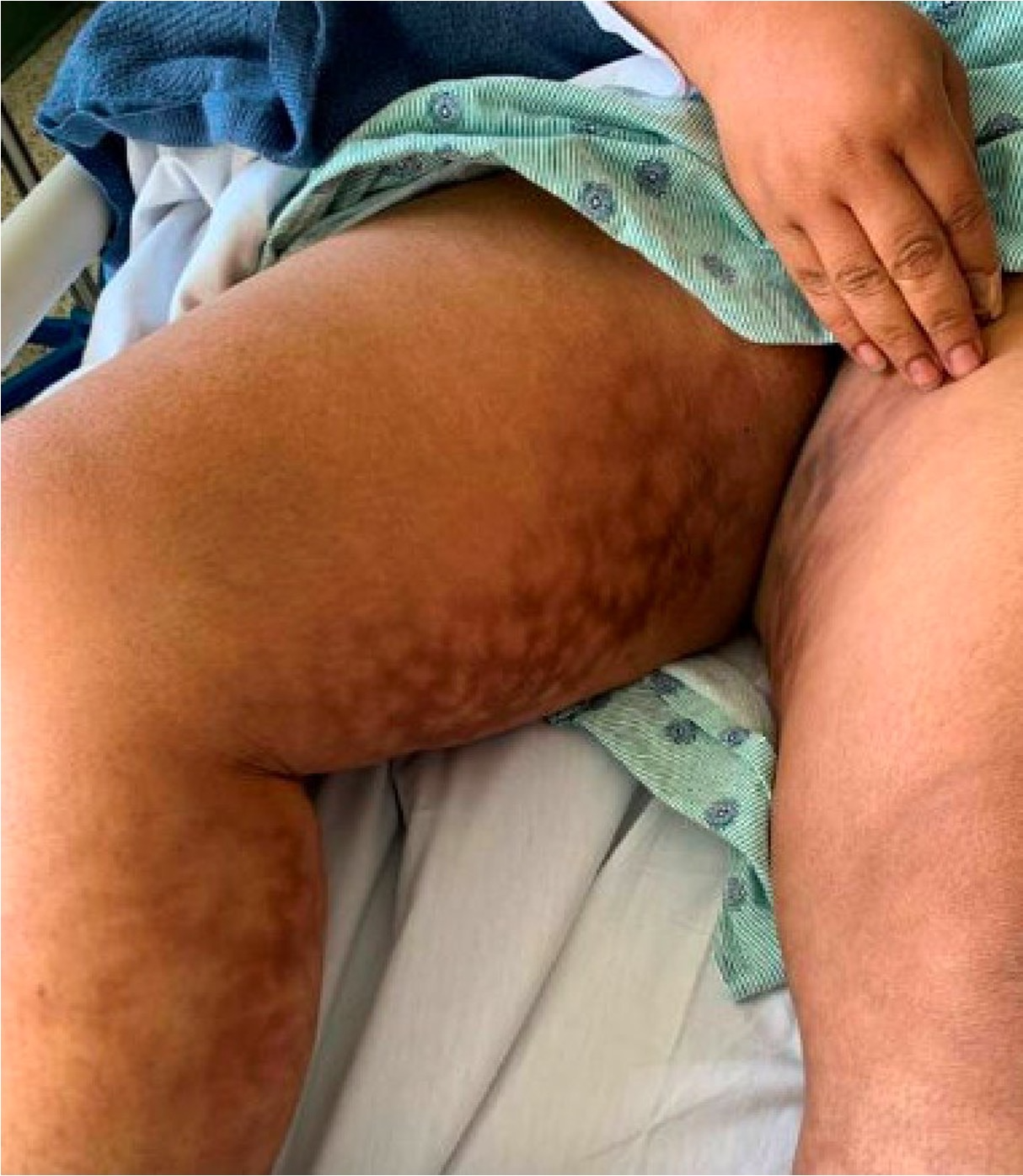
Case Presentation: A 37-year-old woman with no known past medical history presented with several weeks’ history of worsening crampy pain in her legs; she reported taking nonsteroidal anti-inflammatory drugs for pain with little relief. She had also noticed discoloration and a lacy rash, particularly around her calves and moving upward toward her inner legs. She reported feeling cold in her legs, further contributing to her discomfort, along with increased fatigue, lightheadedness, and dyspnea on exertion during this time. On presentation, her vitals were temperature 36.4 °C, heart rate 101, blood pressure 125/77 mm Hg, and her oxygen saturation was 100% on room air. She denied any signs of bleeding and reported normal menstrual cycles. Labs were significant for hemoglobin of 6.8 gm/dL. An extended anemia panel revealed iron of 32 mcg/dL, ferritin of 3 ng/mL, and an iron saturation level of 7%, suggesting iron deficiency anemia. On exam, she had extensive mottling of skin with hyperpigmented changes involving bilateral lower extremities involving calves and inner and back of thighs. She was admitted and transfused 1 unit of packed red blood cells and hemoglobin with appropriate response. For the lower extremity rash, we were concerned about livedo reticularis and consulted dermatology. Upon further history obtained by dermatology, the patient revealed that due to her legs feeling cold and cramping, she has been placing a space heater with direct exposure of her skin in between her legs for several hours a day on a daily basis for the past few months. Due to this history of routine, prolonged, direct heat to the inner thighs and a clinical finding of fixed, brown retiform patches and thin plaques isolated to the area, the diagnosis was thought to be consistent with erythema ab igne. The treatment recommended by dermatology was to avoid ongoing heat exposure.
Discussion: Erythema ab igne (literally “redness from fire” in Latin) is a rare condition manifesting in a reticulated, hyperpigmented rash that develops from chronic exposure to direct heat or infrared radiation (1). It closely resembles livedo reticularis, which is associated with underlying systemic illness and requires additional workup and treatment. Historically, individuals repeatedly exposed to direct heat such as bakers and metalworkers were at increased risk, but since the development of central heating, incidence has significantly decreased in developed countries. There are still rare cases reported in individuals exposed to space heaters, heated car seats and heating pads. The pathophysiology of the rash includes melanin release causing dark mottling discoloration from the degeneration of elastic fibers and basal cells due to chronic exposure to infrared heat. Although it is mainly a benign condition, rarely it can lead to malignant transformation (2). The mainstay of treatment of erythema ab igne is removal of the offending heat source which may reverse the skin changes of hyperpigmentation (3). In some cases if removal of the heat source does not fully or only minimal improve the rash, topical steroids, hydroquinone, 5-fluorouracil, or tretoin may aid in reducing the discoloration (4).
Conclusions: This case highlights the importance of considering erythema ab igne in the differential for a reticulated rash. The workup of more sinister causes of reticulated rashes can require extensive workup and treatment and can be avoided with a thorough history to ascertain potential prolonged exposure to heat.