Background: There are significant racial and ethnic disparities in pediatric healthcare outcomes. Accurate and reliable race and ethnicity data are essential for identifying disparities, allocating resources, and designing equitable interventions. Recent evidence raises concerns about the accuracy of these data, suggesting that discrepancies between self-reported and administratively recorded race and ethnicity are common.Study objectives for patients treated at U.S. children’s hospitals: 1) To measure how often identified race or ethnicity changed across encounters and 2) To identify patient- and encounter-level factors associated with changes in recorded race and ethnicity.
Methods: We conducted a retrospective cohort study using the Pediatric Health Information System database, which includes administrative data from 50 U.S. children’s hospitals. We included patients < 21 years of age with at least two hospital, emergency room or ambulatory surgery encounters between 2010 and 2023, limited to 42 hospitals with complete data for the study period. The primary outcome was any change in recorded race and/or ethnicity across encounters. Race and ethnicity were analyzed as separate fields. We summarized patient characteristics, encounter types, and institutional variability, and compared patients with and without recorded changes using chi-square and Wilcoxon Rank-Sum tests.
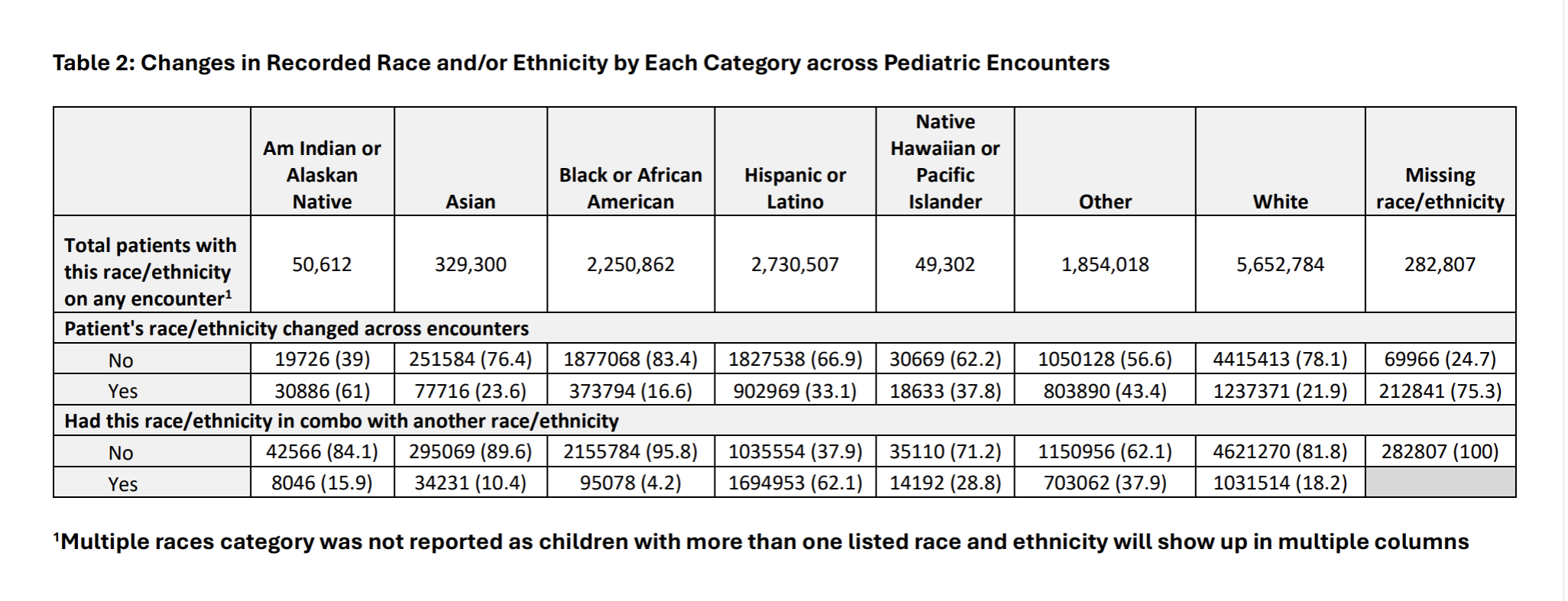
Results: We included 9,559,481 patients; 1,758,162 (18.4%) had at least one change in recorded race or ethnicity. Children with changes were more likely to have their initial race or ethnicity recorded as Other, Missing, or Hispanic/Latino, and to have public insurance (Table 1). They also had more encounters and longer follow-up durations than those without changes.Changes were most frequent among patients with missing (75.3%) and American Indian/Alaska Native (61%) designations, and least frequent among Black (16.6%) and Asian (10.4%) patients (Table 2). The proportion of patients with any change varied across hospitals, ranging from 3.0% to 55.0%.
Conclusions: In this cohort of U.S. children’s hospitals, nearly one in five children had at least one change in recorded race or ethnicity over time. Variability across patient age, race/ethnicity categories, and institutions underscores the complex, dynamic nature of race and ethnicity data in pediatric healthcare. Inconsistent documentation may obscure disparities and bias equity analyses. As federal standards for race and ethnicity data collection are updated, healthcare systems should prioritize standardized, patient-centered data collection practices to ensure data integrity and advance equity in pediatric care.
.png)