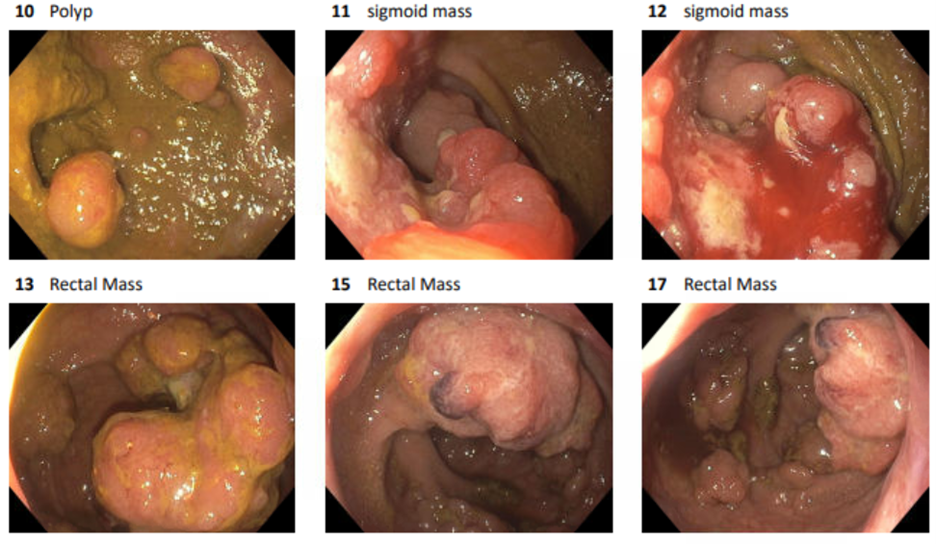
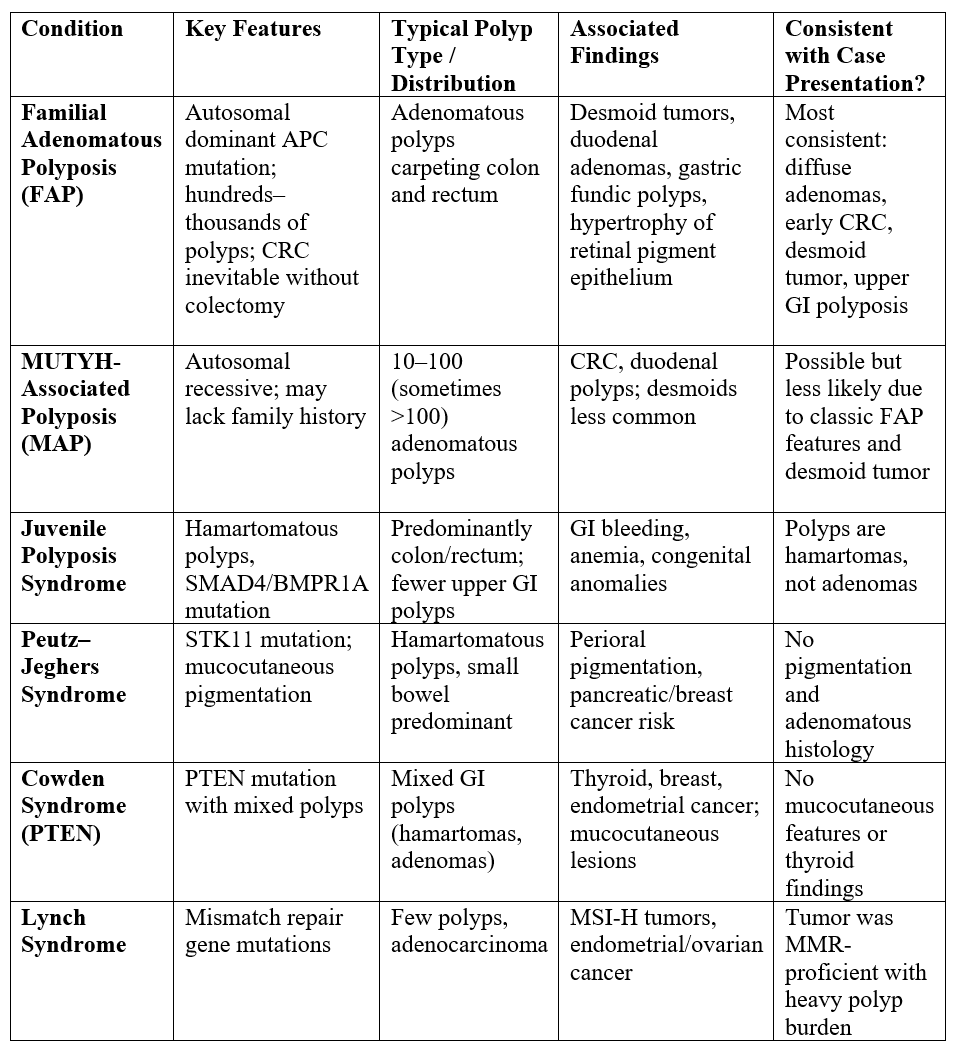
Case Presentation: A 28-year-old female with no significant medical history presented with two weeks of hematochezia and lower abdominal cramps. She endorsed a 6-month, 30-pound weight loss and intermittent diarrhea/constipation. She denied family history of gastrointestinal malignancy. Physical exam was notable for firm palpable mass on the abdomen and left chest wall. Laboratory evaluation was significant for a hemoglobin of 7.6 gm/dL, ferritin of 9 ng/mL, iron saturation of 5%, and CEA of 28.9 ng/mL. Colonoscopy revealed two fungating rectal masses and innumerable adenomas carpeting the colon. Biopsies confirmed colorectal adenocarcinoma. EGD demonstrated innumerable polyps in the fundus/antrum/body of stomach and the duodenum, confirmed low-grade dysplasia on pathology. A left chest wall lesion noted on CT was biopsied and found to be desmoid fibromatosis. MRI staged the tumor as T4aN2b colorectal adenocarcinoma. Given the early-onset colorectal cancer, extensive colorectal adenomas, gastric polyps, duodenal adenomas, and desmoid disease, the presentation was highly suggestive of classical familial adenomatous polyposis (FAP). Multigene panel testing (MGPT) is pending, and the patient is undergoing multidisciplinary planning for curative management.
Discussion: FAP is an autosomal dominant polyposis syndrome characterized by mutations in the adenomatous polyposis coli (APC) gene and accounts for the majority of adenomatous polyposis syndromes. Other polyposis syndromes include non-adenomatous diseases such as Cowden syndrome or non-cancerous conditions including IBD-related pseudopolyposis (1). FAP is rare overall, but remains the most common inherited polyposis syndrome, with incidence ranging from 1 in 5,000–18,000 (1,2). All patients with FAP will develop colon cancer and have extracolonic manifestations including desmoid tumors, retinal hypertrophy, thyroid cancer, and duodenal cancer (1). Within these APC mutations, phenotypic variability may pose a diagnostic challenge (3). While classically familial, around 20-30% of patients have de novo APC mutations, which may occur as either germline or mosaic mutations (4). In these patients, diagnosis is typically delayed, and APC mutations are often identified only after advanced polyposis (2). Due to these rates of de novo mutations, absence of family history does not exclude FAP, and current guidelines recommend MGPT for all patients with more than 10-20 cumulative adenomas. This helps to ensure timely diagnosis and management. MGPT includes both high- and moderate-penetrance genes associated with colorectal cancer/polyposis including APC, MUTYH, and PTEN (2,5). If a genetic variant is identified, cascade testing and early surveillance can be offered to at-risk relatives, as screening may increase life expectancy by 17 years and dramatically reduce cancer-related morbidity and mortality. Registry and genetic counseling participation are associated with a 79% reduction in colorectal cancer incidence and 59% reduction in mortality in FAP families (2,6). Definitive management of FAP involves removal of the colon and lifelong surveillance for extracolonic disease (1).
Conclusions: This case demonstrates the importance of considering FAP in young patients presenting with red flag symptoms of bleeding, weight loss, and significant iron-deficiency even in the absence of family history. Early diagnosis and timely genetic testing can lead to improved outcomes for both the patient and at-risk family members.