Background: Attending on inpatient teaching services is a vital component of faculty development for clinician educators. However, the expansion of hospitalist service lines has outpaced the growth of graduate medical training programs, creating a relative scarcity of inpatient faculty teaching opportunities. This issue has been discussed in commentaries and message boards, but to our knowledge no one has attempted to characterize it more broadly within the hospital medicine community. With this national survey we aimed to evaluate the extent of the problem within academic Internal Medicine hospitalist groups and compile information on the strategies being used to overcome the problem and ensure continued development opportunities for clinician educators.
Methods: We surveyed Hospital Medicine Division Directors and Division Administrators from the largest 150 Internal Medicine GME training sites (N=27 responding institutions). We calculated means, standard deviations, and ranges for each quantitative survey item. We also utilized basic thematic analysis of free text comments to identify response patterns.
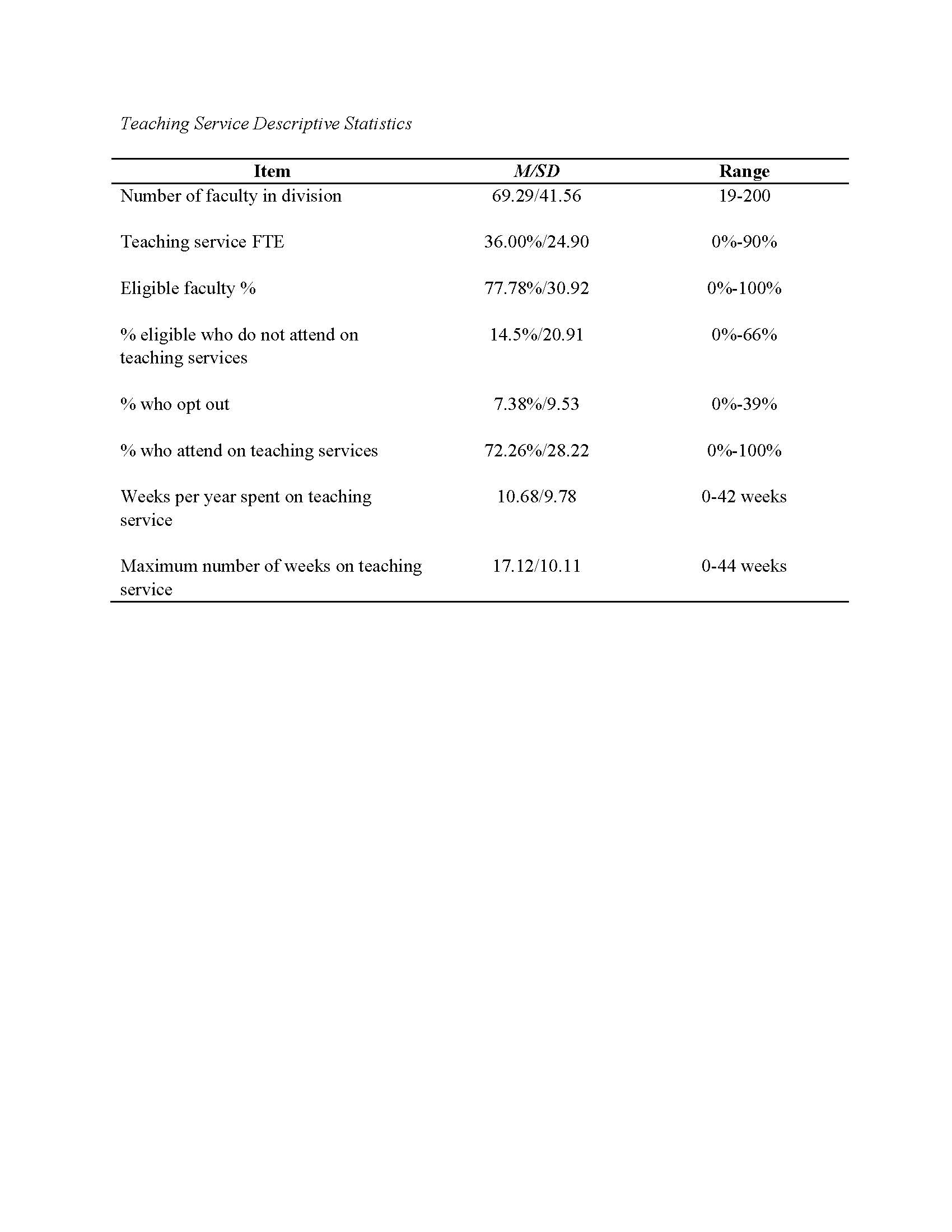
Results: The descriptive results (Table 1) revealed that there is ample variation in teaching service across institutions. On average, 36% of inpatient clinical FTE was dedicated to traditional teaching services (SD=25%, range 0%-90%) and 72% of clinical faculty attended on these services (SD=28%, range 0%-100%) for an average of 10.68 weeks (SD=9.78, range 0-42 weeks) per year. In the thematic analysis, three themes emerged around how institutions are handling a lack of traditional teaching service opportunities: 1) Intentional allocation: Teaching time allocations were made intentionally, often based on specific factors (e.g., faculty preference, strong trainee evaluations, and seniority). 2) Expanding educational opportunities: Institutions provided non-traditional clinical teaching opportunities (e.g., procedure services, direct care elective rotations) and non-clinical teaching (e.g., lectures, faculty development). 3) Expanding traditional inpatient teaching time: Some institutions have created new opportunities, such as allocating services from another division, creating a traditional teaching service, or expanding teaching eligibility.
Conclusions: Among the responding institutions, overall we found that deliberate allocation of traditional teaching service and a focus on expanding traditional and non-traditional teaching opportunities are strategies being used . Groups reported innovative approaches to provide developing clinician educators with fulfilling non-traditional teaching experiences in both clinical and non-clinical settings. Although the overall low response rate and our focus on large academic institutions limit the broad generalization of these results, we believe that there is still significant value in sharing these strategies with the Hospital Medicine community.