Background: Burn injuries and corrosion are significant contributors to global mortality, particularly in severe cases where complications such as sepsis and organ failure arise. This study analyzed trends and disparities in mortality rates due to burns and corrosion among different age groups and demographic categories from 1999 to 2020.
Methods: Analysis of Burns and corrosion deaths in the US from 1999-2020 was conducted using death certificate data from the CDC WONDER database, utilizing the ICD-10 code T20-T32. Age-adjusted mortality rates (AAMR) per 1,000,000 population were extracted, and trends were analyzed using Joinpoint regression to calculate the Average Annual Percent Change (AAPC) with p value for statistical significance. Data were stratified using year, gender, race/ethnicity and geographical regions.
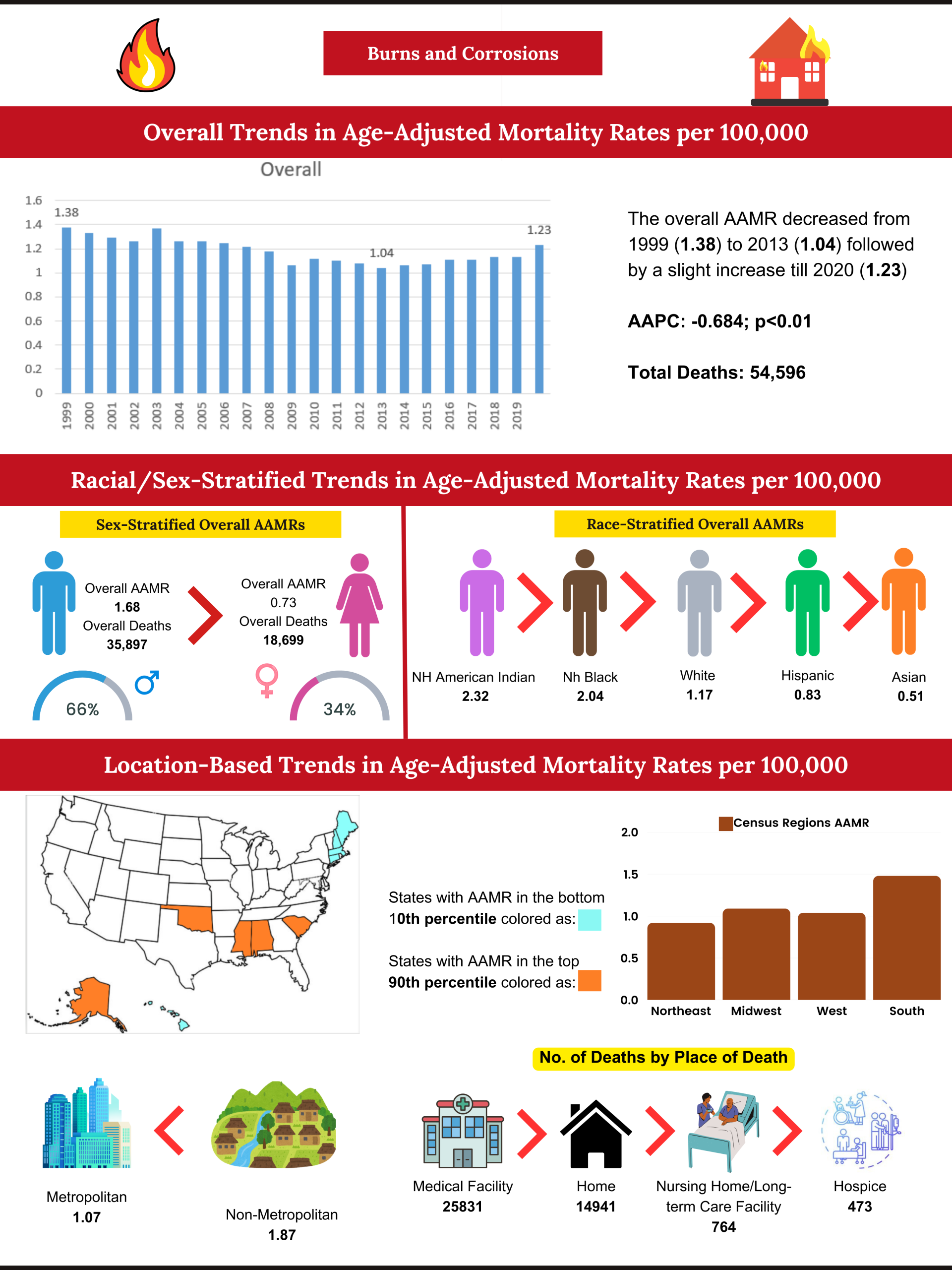
Results: Burns and corrosions accounted for 54,596 deaths in the USA in the last 2 decades. The AAMR exhibited a decreasing trend from 1999 (1.38) to 2020 (1.23) with a significant AAPC of -0.68 (p< 0.01). AAMR for Burns and corrosions was 1.68 in males and 0.73 in females. A decrease of AAMR in both genders occurred with a greater decrease in male population (AAPC; F: -0.60, M: -0.89). American Indian had the highest AAMR (2.32), and Asian or Pacific Islander with the lowest (0.51). Over the study period, Asian or Pacific Islander had the greatest decrease in AAPC (-2.43, p< 0.01). Numbers of death was highest in medical facilities (25,831, 47.3%), followed by Decadents Home (14,941, 27.4%). Regional stratification shows South had the highest AAMR (1.48) while Northeast had the lowest AAMR (0.92). Significant decrease of AAMR was seen in all regions with the lowest in South (AAPC: -1.09, p< 0.01). Urbanization-wise, nonmetropolitan areas had a higher AAMR (1.87) than metropolitan areas (1.07). States in the top 90th percentile included: Mississippi (2.72), Oklahoma (2.45), Alaska (2.33), Alabama (2.21), and South Carolina (2.20).
Conclusions: Burns and corrosions have shown a significant decline in mortality rates in the USA over the past two decades, with notable gender, racial, and geographic disparities. These findings underscore the need for targeted prevention and healthcare interventions, particularly in high-risk populations and regions.