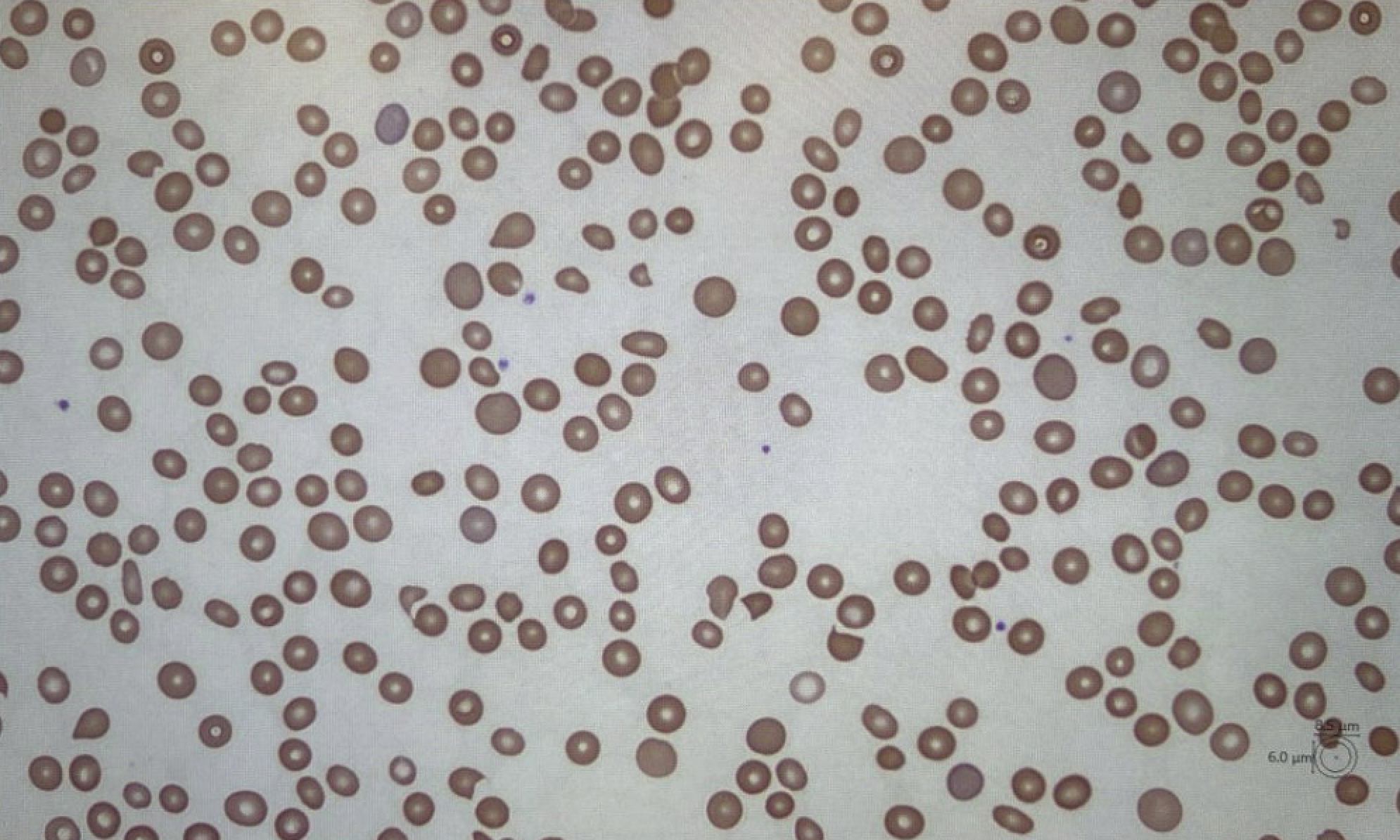
Case Presentation: We present the case of a 43-year-old female with no prior medical history who presented for progressive dyspnea and fatigue following several weeks of heavy vaginal bleeding. She was found to have bicytopenia with hemoglobin of 6.4 and platelet count of 58,000. Labs were notable for hemolysis with schistocytes on peripheral blood smear, LDH 1,655, total bilirubin 1.3, and haptoglobin < 10. Direct antiglobulin testing was negative. Disseminated intravascular coagulation panel was negative. Her PLASMIC score was 6 (hemolysis, no known cancer or transplant, MCV < 90, Cr < 2, INR < 1.5) suggesting high risk of thrombotic thrombocytopenic purpura (TTP). ADAMSTS13 testing was sent. Empiric treatment for TTP was initiated with prednisone 1 mg/kg daily and therapeutic plasma exchange for one day before ADAMSTS13 level returned at 40 and those interventions were discontinued. As part of an evaluation for prominent dyspnea, CT pulmonary angiography was negative for pulmonary embolism but incidentally revealed a left breast nodule and a T1 vertebral body lesion. Transvaginal ultrasound for menorrhagia was negative for intrauterine pathology. Peripheral flow cytometry for leukemia and lymphoma, serum free light chains and protein electrophoresis were unremarkable. Bone marrow biopsy demonstrated metastatic breast adenocarcinoma (ER positive 3+, PR positive 2+ with Her2 0+ ultralow). Subsequent nuclear medicine bone scan showed diffuse uptake concerning for widespread osseous metastasis with bone marrow infiltration. The patient was diagnosed with cancer-related thrombotic microangiopathy (CR-TMA) due to metastatic breast cancer with marrow carcinomatosis. Paclitaxel was initiated while inpatient with improvement in cytopenias and symptoms.
Discussion: Occult malignancy is an uncommon but morbid differential for thrombotic microangiopathy of unclear cause, possibly responsible for as many as 5% of undifferentiated TMA in some populations (1). Of all cancers, breast cancer has the second highest incidence of CR-TMA, with prevalence estimated at less than 0.1% (2,3,4). Interestingly, cancer-related TMA is more common in patients with multiple bone metastases or marrow carcinomatosis (5). While bony metastases are common in breast cancer, it is rare for a patient to develop clinically significant marrow involvement from breast cancer. The incidence of bone marrow carcinomatosis in metastatic breast cancer has been estimated at 0.17% (2). Bone marrow carcinomatosis is theorized to produce tumor emboli to the marrow vasculature and induce fibrinoid necrosis, resulting in CR-TMA (6). Exact mechanisms remain unconfirmed.
Conclusions: Diagnostic considerations for thrombotic microangiopathy are broad and complex. Hospitalists and hematologists alike should maintain a broad differential diagnosis and avoid anchoring until confirmatory testing is finalized, as in this case of CR-TMA masquerading as TTP. Although macrometastases are often more evident at the time of diagnosis, diffuse metastatic syndromes like marrow carcinomatosis may be associated with morbid complications such as CR-TMA. CR-TMA and marrow carcinomatosis are both known rare complications of breast cancer. Given the poor prognosis of these conditions, early diagnosis and treatment are critical.