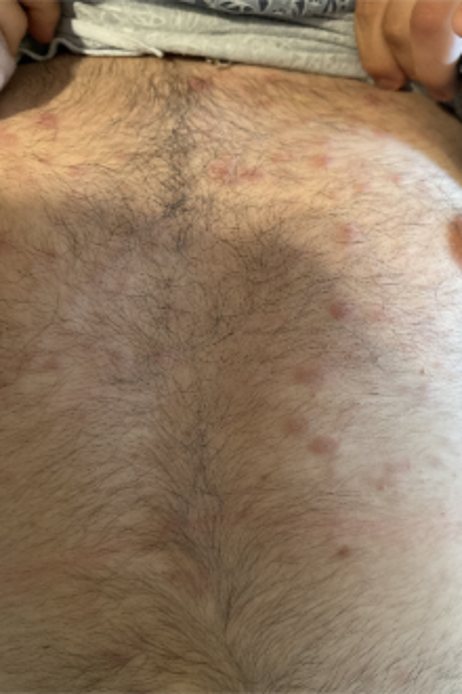
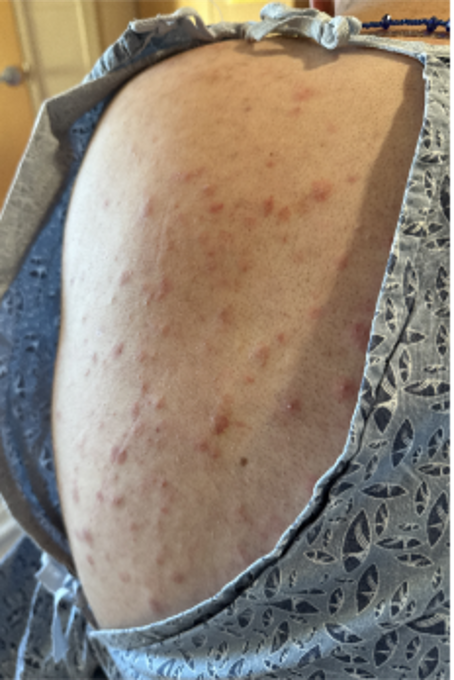
Case Presentation: A 17-year-old male with a recent history of Bell’s palsy presented with two months of migratory joint pain, beginning in the shoulders and progressing to his hands, knees, and feet. He also reported a two-week history of a pruritic rash starting in the beard region and spreading to the trunk and extremities, three days of diarrhea and abdominal pain, and one episode of night sweats. He denied weight loss, cough, sore throat, urinary symptoms, or weakness. He had traveled to Mexico three weeks prior. Family history was notable for maternal lupus, Sjögren’s, and Raynaud’s syndrome.On examination, he was afebrile with diffuse abdominal tenderness. His skin showed an erythematous, non-tender, non-blanching nodular rash over the chest (Image 1), back (Image 2), and beard region. Musculoskeletal findings included arthritis of several PIP finger joints of bilateral hands and right knee discomfort.Laboratory studies revealed elevated inflammatory markers (CRP 24.6 mg/dL, ESR 31 mm/Hr), and proteinuria (2+; protein/creatinine ratio 856 mg/g). CBC and CMP were unremarkable. Autoimmune studies (ANA, dsDNA, C3/C4, ANCA, ACE levels) and infectious workup (Lyme, coccidioidomycosis, tuberculosis, streptococcus, chlamydia, gonorrhea, syphilis, HIV, hepatitis B/C, CMV, EBV) were negative, except for a stool PCR which was positive for Enteroaggregative and Enteropathogenic E. coli, and Giardia. An abdominal ultrasound was unrevealing.He was ultimately treated with nitazoxanide for Giardia and received supportive care with resolution of joint symptoms, elevated inflammatory markers, and proteinuria. It was presumed that he had post-infectious/reactive arthritis. However, skin biopsies obtained during hospitalization later revealed B-lymphoblastic lymphoma (B-LBL). On readmission two days later, CT imaging showed numerous nodular and plaque-like lesions in the chest, abdominal wall, and extensive bilateral renal lesions, and skeletal involvement on PET scan. He was subsequently transferred to the oncology service and initiated systemic chemotherapy.
Discussion: B-LBL is a rare subtype of non-Hodgkin lymphoma, accounting for fewer than 20% of lymphoblastic lymphomas. It often presents with extranodal disease, particularly involving the skin. This case illustrates an atypical systemic presentation of B-LBL characterized by migratory arthralgia, rash, and transient proteinuria mimicking autoimmune or infectious etiologies. The concurrent gastroenteritis, in addition to the strong family history of autoimmune disease, further complicated the clinical picture and obscured the underlying diagnosis of malignancy.
Conclusions: B-LBL can present with misleading inflammatory features that may resemble an autoimmune or infectious disease. In adolescents with a nodular rash, arthralgias and unrevealing autoimmune or infectious studies, clinicians should maintain a high index of suspicion for malignancy. Early biopsy of unexplained skin lesions is crucial for timely diagnosis and initiation of treatment.