Background: In patients with hematologic malignancies, intrathecal chemotherapy delivered by means of a lumbar puncture has found a critical role at delivering vital medications to patients with central nervous system spread. However, many oncology patients who require this procedure have refractory thrombocytopenia that can lead to delays in intrathecal chemotherapy administration as well as potentially excess use of platelet transfusions, which are a limited resource. At our institution, intrathecal chemotherapy is delivered by radiology with a strict minimum of 50,000 platelets or a hospitalist-led medicine procedure service (MPS), with a more individualized threshold of at least 20,000. We sought to compare complication rates and wait times for intrathecal chemotherapy administered using radiologist-guided fluoroscopy or bedside with the MPS.
Methods: We conducted a retrospective cohort study of adult inpatients referred for intrathecal chemotherapy from August 2019 to May 2022. An electronic medical record tool extracted demographics, labs, and procedure timing. Relevant imaging within 7 days of the lumbar puncture (LP) was individually extracted and then reviewed independently by 2 attending physicians to delineate major complications. Separately, patients were evaluated for traumatic taps, defined as a cerebrospinal fluid red blood cell count greater than 500.
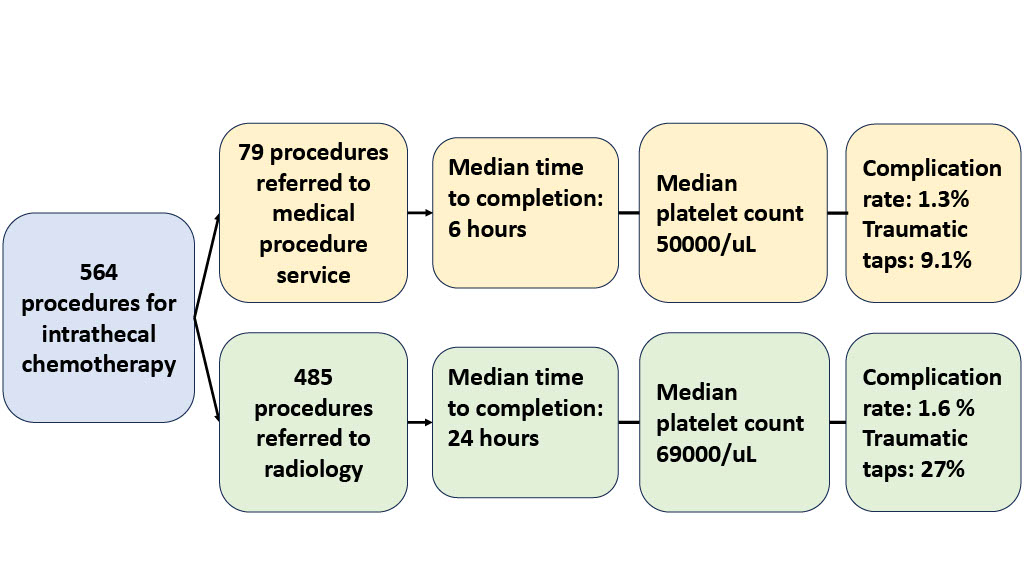
Results: There were 564 procedures that fit the inclusion criteria, 485 done by radiology and 79 by the MPS. MPS teams conducted the procedure at lower platelet thresholds (49% with platelet below 50,000 in MPS as opposed to 6.4% with radiology, p< 0.001). Both teams had a low complication rate, 1.3% for MPS and 1.6% for radiology. However, the MPS exhibited a 71% decrease in traumatic tap occurrence compared to those performed by Radiology (OR = 0.29 , p = 0.002). Furthermore, the MPS completed LPs much sooner after consultation requests (6 versus 24 hours, OR 0.41, p< 0.001).
Conclusions: Hospitalists are uniquely-positioned to fill gaps in the health system. Our study suggests that a hospitalist-run MPS can substantially expedite patient care in this vulnerable oncology population with a significantly shorter time to LP. MPS teams therefore have the potential to decrease a patient’s length of stay as well as costs associated with the procedure, as MPS teams are able to conduct the procedure more quickly and at bedside. Furthermore, the MPS performed LPs with low major complication and traumatic tap rates despite having more patients with thrombocytopenia. This supports a lower platelet threshold for LP in patients with hematologic malignancy. Further research should be done to better define the exact optimal platelet threshold. However, in the immediate period, this finding informs individual patient-provider risk/benefit discussions in patients with refractory thrombocytopenia undergoing LP.