Background: Recently there has been an explosion of smartphone apps with emphasis to improve healthcare of patients. With a poverty rate of 32% Cameron County is one of the poorest areas in the country. Compounded with a high prevalence of inadequate health literacy (45%), patients admitted to the hospital are unable to provide an accurate assessment of their medical conditions. Moreover transitions of care become difficult secondary to lack of understanding of health indicators and self-discontinuation of essential medications. As an initial feasibility study we aim to uncover an untapped potential in the form of smartphones as an option to hospitalists and primary care physicians to improve patient outcomes and communication by facilitating understanding of common medical conditions regardless of education level or health literacy.
Methods: This is a cross-sectional study; data was obtained through a survey with randomly selected patients from our federally qualified health center (FQHC) Internal Medicine clinic in Harlingen, Texas. The survey consisted of 12 questions addressing age, reading language, ethnicity, gender, education level, chronic medical conditions, likelihood of app use, types of electronic devices used, app use, types of apps, and health literacy ascertained through the STOFLA method (help needed reading hospital material).
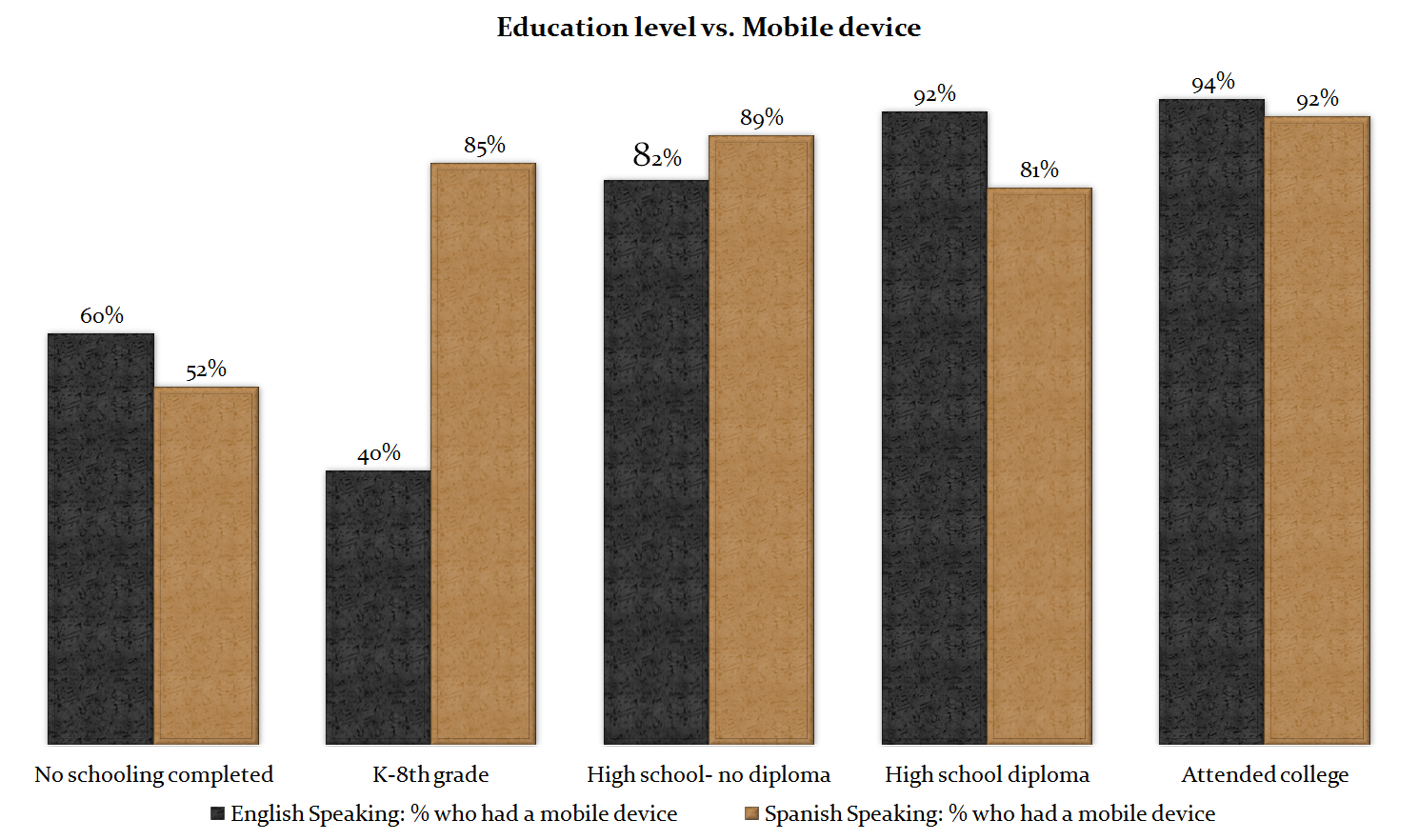
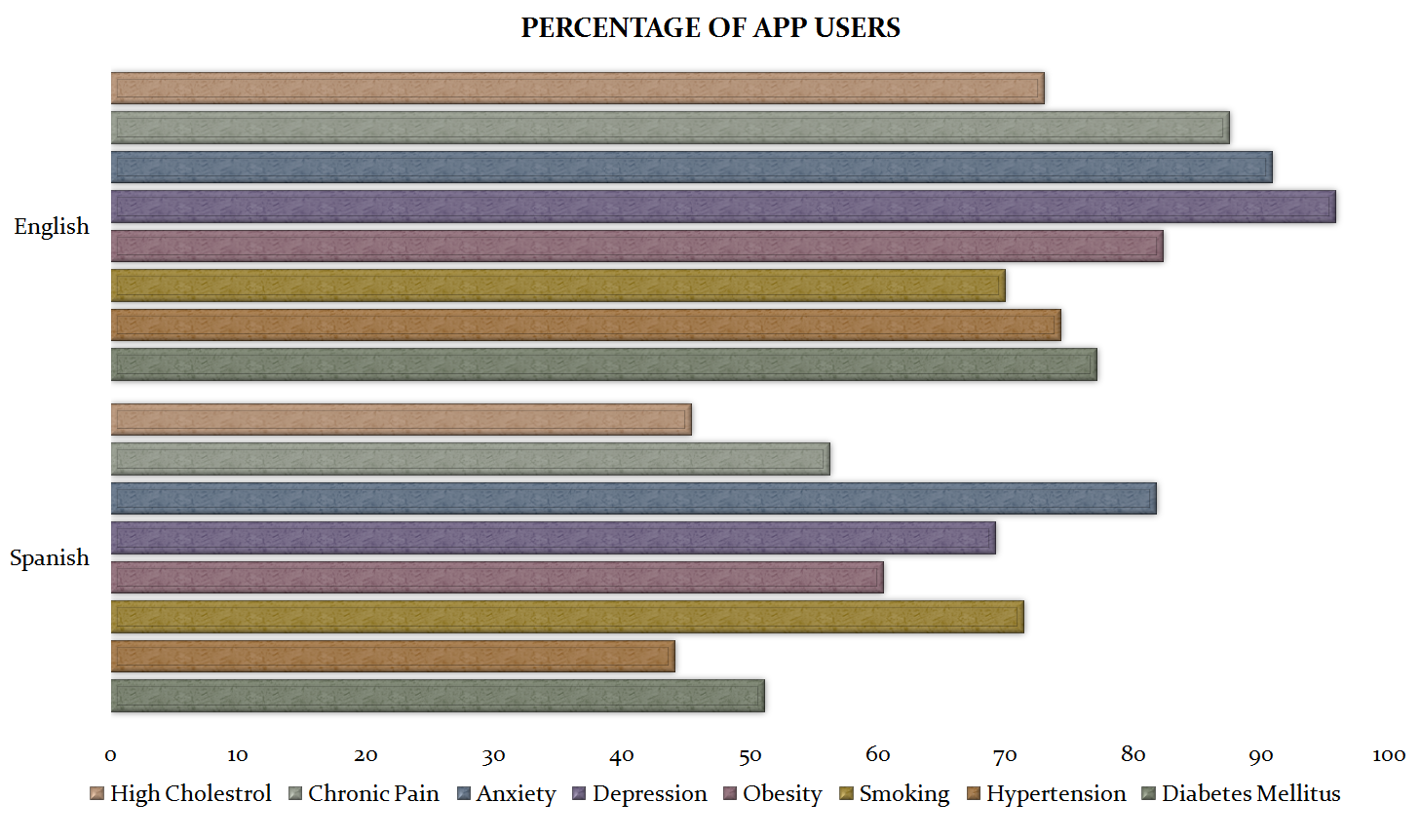
Results: A total of 202 people (24% males and 76% females) participated in our survey conducted in March 2017. 100 identified themselves as English readers and 102 as Spanish readers. The most common age group was 50-65 (41%) followed by 40-49 (27%), 18-29 (12%), 30-39 (10%), and 10% (65+). Education levels had the greatest levels of disparities with 73.5% (34/102) of Spanish speakers having less than a high school degree compared to 23% (18/100) of English speakers. Overall 41% had hypertension, 38% were obese and 38% suffered from diabetes. Smartphone use was similar in both groups, with 80% (80/100) and 78.4% (80/102) use in English and Spanish groups respectively. 81% (81/100) of English readers were using apps compared to only 60% (61/102) in the Spanish group. The most common type of app used was for texts/video calls and communication 66% (133/202) while 44% (82/202) used apps for health. When asked how often someone helps you read hospital/clinic materials, 33.3% (34/102) replied sometimes to always in the Spanish group compared to 18% (18/100) in the English group.
Conclusions: Despite only 26.5% vs. 77% (p<0.01) completing high school and lower health literacy 33.3% vs. 18% (p=0.003), the use of smart phones was nearly identical in our Spanish and English speaking populations 78.4% vs. 80% (p=.204). Furthermore 44% of respondents were willing to or were currently using apps for their healthcare needs. The FDA recently announced a ‘precertification’ program for mobile apps certification. Based on our data and previous studies this opens up numerous opportunities for clinicians to improve communication and transitions of care across the inpatient and outpatient spectrum. These simple measures can be revolutionary in areas without an integrated system, where gathering accurate information is extremely challenging. Further studies will be needed to implement available applications and to develop new software addressing health care delivery, literacy and education.