Background: Learning health systems (LHS) integrate evidence generation and implementation into clinical practice to improve healthcare delivery and health outcomes. Pragmatic clinical trials are an important form of LHS research, comparing approaches to clinical care in a real-world setting. The field of hospital medicine is uniquely positioned to advance pragmatic LHS research due to its large clinical footprint and attention to health system priorities in quality, safety, and high-value care.
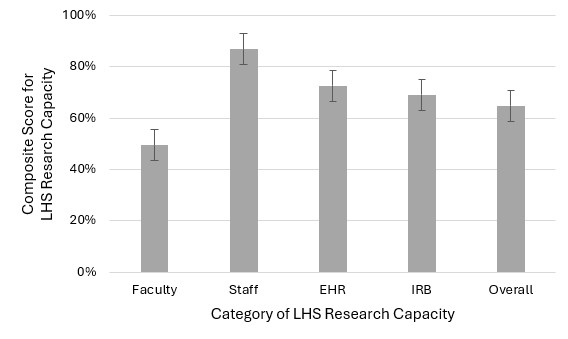
Methods: We conducted a cross-sectional, national survey to assess the research capacity of hospital medicine programs to conduct LHS research, including infrastructure elements that support pragmatic clinical trials such as electronic health record (EHR)-based recruitment, randomization, and data capture. Programs were invited to participate through the Hospital Medicine Reengineering Network (HOMERuN). The survey assessed hospital characteristics and the availability of research infrastructure in the following domains: faculty research experience, research staff resources, EHR-based tools, institutional support, and institutional review board (IRB) policies. Composite scores normalized to 100% were generated to summarize research capacity across domains.
Results: Forty-one programs (72% response rate), representing diverse geographic regions, hospital types, and bed capacities, completed the survey. Responding programs reported robust research capacity, with an average composite score of 69-87% across domains. Faculty commonly had experience with observational studies (85%) and implementation research (68%), though fewer programs reported experience with leading randomized trials (30-40%) or R01-funded research (37%). Research staff were accessible in 78-95% of programs. EHR tools for pragmatic research were available or accessible in 44-100% of programs, with physician builders and IT analysts being the most common. IRBs were reportedly supportive of pragmatic research by allowing EHR-based eligibility screening (82%) and waivers of consent when appropriate (70%).
Conclusions: Many academic hospital medicine programs possess the foundational infrastructure to engage in pragmatic clinical trials and related LHS research, including faculty expertise, EHR capabilities, and supportive IRBs. Leveraging institutional resources, fostering collaborations, and securing extramural and intramural financial support will be key to maximizing hospitalists’ role in advancing LHS research and improving healthcare delivery for hospitalized adults.
.jpg)