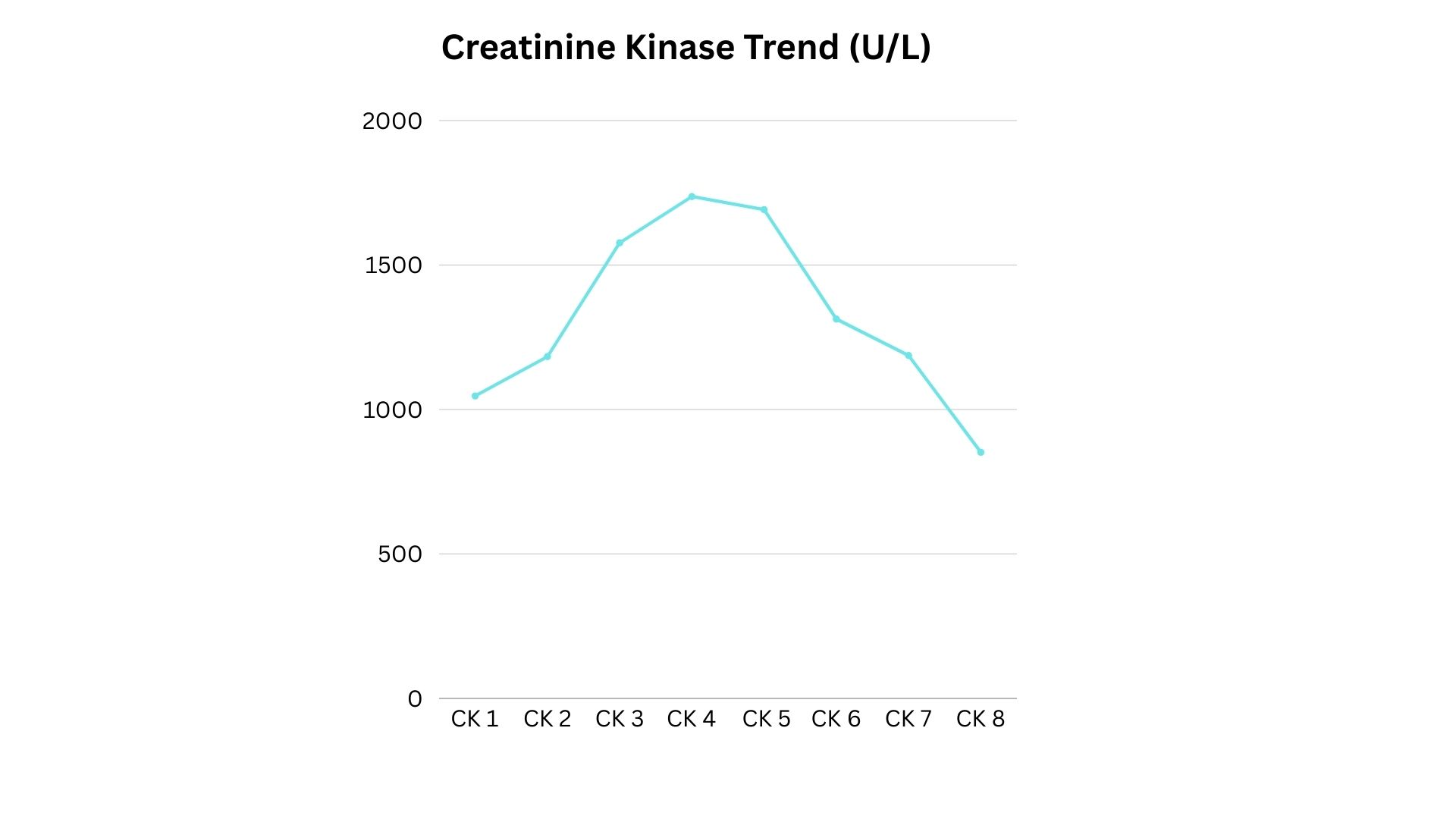
Case Presentation: A 61 year old male presented to the emergency department after he was unable to get up from his home recliner. He has a past medical history of hypothyroidism, obesity, chronic kidney disease stage 3, hypertension, and renal cell carcinoma status post nephrectomy and adrenalectomy. Patient had been experiencing myalgia and weakness in his lower extremities that had been ongoing for several months. In the emergency department, he complained of pain in his bilateral hips and ankles. Upon further questioning, patient admitted to not seeing his physician in over a year. He was taking one home medication at the time of admission which was propanolol. On physical exam, he had severe pain with active and passive movement of his lower extremities. His lower extremities were stiff. He had painful weakness of his bilateral hip flexors. There were +1 deep tendon reflexes noted overall. Muscle bulk was difficult to assess due to pain and presence of concurrent obesity. Initial CK level was 1,047 U/L. TSH was 59.3 uIU/mL. Free T4 was < 0.10 ng/dL. He was started on IV levothyroxine and aggressive IV fluid hydration. He was also given a stress dose of steroid due to his history of adrenalectomy. During his hospital admission, his CK level peaked to 1,737 U/L (see graph). Neurology was consulted to evaluate for underlying myopathy. Given his physical exam and laboratory findings, neurology clinically concluded that the patient's myopathy was due to Hoffmann's syndrome which occurred due to the patient's prolonged non-compliance in treating his underlying hypothyroid disease. During the patient's hospital course, his muscle pain gradually improved. He was transitioned from intravenous to oral levothyroxine. Patient was discharged to a skilled nursing facility for further rehabilitation.
Discussion: Hoffmann Syndrome is a rare form of hypothyroid myopathy first characterized by German neurologist Johann Hoffmann (1). The pathophysiology involves the effects of thyroid hormone deficiency on muscle metabolism, leading to abnormal muscle growth and functional deterioration (2). It is characterized by weakness of the proximal limb muscles with an increase of muscle mass, muscle stiffness, and cramps (2). It occurs most often in male adults with longstanding untreated hypothyroidism (3). In a recent meta-analysis study, there was no consistent concept for diagnostic work-up with typical findings. While muscle biopsy can provide additional clinical information, majority of cases were diagnosed clinically by the hallmark signs of muscular weakness and pseudohypertrophy of the calf muscles in combination with elevated CK and elevated TSH levels (3). One unifying clinical exam finding was pseudohypertrophy of the calf muscles (3). With regard to our patient, he met the clinical diagnostic criteria for Hoffmann syndrome. It was difficult to ascertain the presence of calf pseudohypertrophy due to his body habitus and difficulty with movement of his lower extremities. Magnetic resonance imaging could have been performed to confirm the presence of pseudohypertrophy, but the cost of testing would not have altered the treatment course.
Conclusions: In conclusion, Hoffmann syndrome is a rare myopathy found often in males with profound hypothyroidism. While invasive diagnostic measures can be used for diagnosis, hallmark clinical exam findings of calf pseudohypertrophy and muscle weakness with elvated CK and TSH levels are the most cost efficient and resourceful way of reaching the diagnosis and initiating prompt treatment.