Background: Clostridium difficile infection is a common infection encountered by hospitalists. While C. difficile colitis is an important cause of morbidity and mortality in the United States, C. difficile can be a normal colonizer of the large intestine. In our clinical experience, we have observed that many patients are inappropriately tested for C. difficile infection. Given this information, we sought to investigate whether patients who tested positive for C. difficile met clinical criteria for testing.
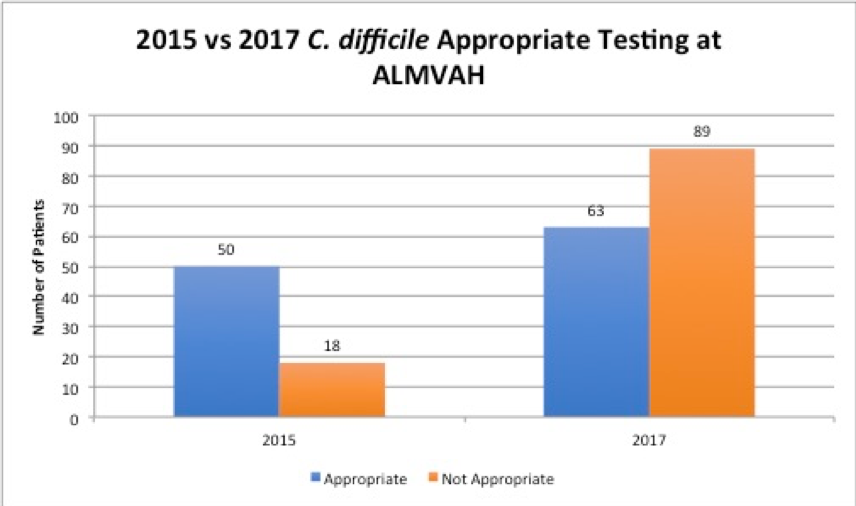
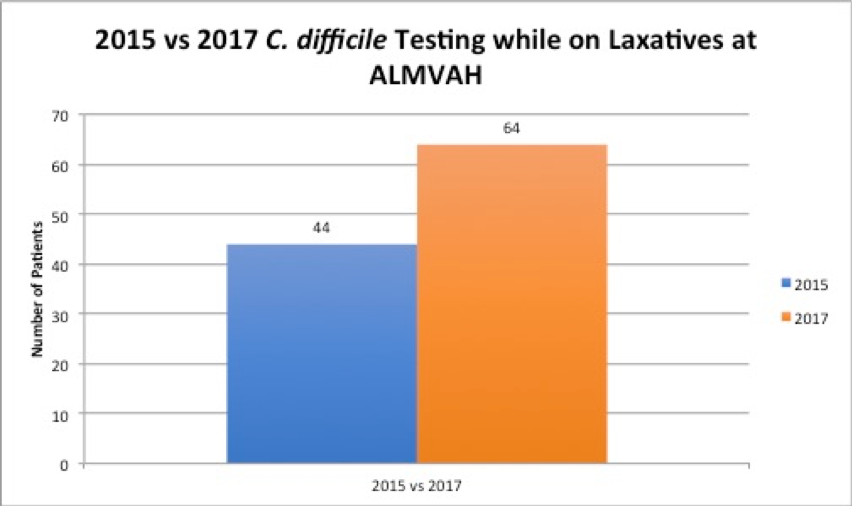
Methods: The Infectious Disease (ID) department and Infection Control teams at our participating hospital previously collected data on patients who tested positive for C. difficile in both inpatient and outpatient settings from October 2014 to September 2015. Using 2013 Infectious Disease Society of America (IDSA) and the Society for Healthcare Epidemiology of America (SHEA) criteria and their clinical expertise, they evaluated appropriateness of testing as well as confounding factors (e.g. laxative use). This analysis revealed that 24.7% of patients did not meet criteria for testing and 68.4% were on laxatives or stool softeners.
A cohort of 152 patients who tested positive for C. difficile at our participating hospital between January 1, 2017 through December 31, 2017 was used to update the data on C. difficile testing. Using the updated 2017 IDSA/SHEA C. difficile management guidelines, this analysis revealed 89 patients (59%) were inappropriately tested. Of the 152 patients who tested positive for C. difficile, 64 patients (42%) were on laxatives.
Our aim is to reduce inappropriate C. difficile testing from 59% to 30% within 12 months of launching a new order set which includes specific criteria based on the 2017 IDSA/SHEA C. difficile management guidelines.
In partnership with the aforementioned teams, we developed a new order set that requires physicians to assess if their patient meets criteria for suspected C. difficile infection using the updated 2017 IDSA/SHEA C. difficile management guidelines. The criteria are: (1) three or more loose bowel movements in a 24-hour period, (2) absence of non-infectious causes of diarrhea, such as use of laxatives or stools softeners. The new order set launched Tuesday, September 18, 2018. Instructions on how to find the order set were placed in the medicine and surgical team rooms. In addition, widespread communication via email was done to inform everyone of new order set.
Results: After the order set was launched, we reviewed almost 2-months of post implementation preliminary data. In this timeframe, 27 patients tested positive for C. difficile infection from September 9/18-11/20/2018. Of these patients, 37% (10/27 patients) did not meet criteria for testing and 9 of these patients had a non-infectious source (i.e. laxative use) to account for the diarrhea.
Conclusions: Our quality improvement project remains in progress. The results of the study have been limited due to a short time period of data. We plan to continue collecting data to assess the impact of the new order set on inappropriate C. difficile testing one year after the intervention. With this intervention, we hope to reduce the number of patients exposed to unnecessary antibiotics and decrease the cost burden of unnecessary C. difficile tests.