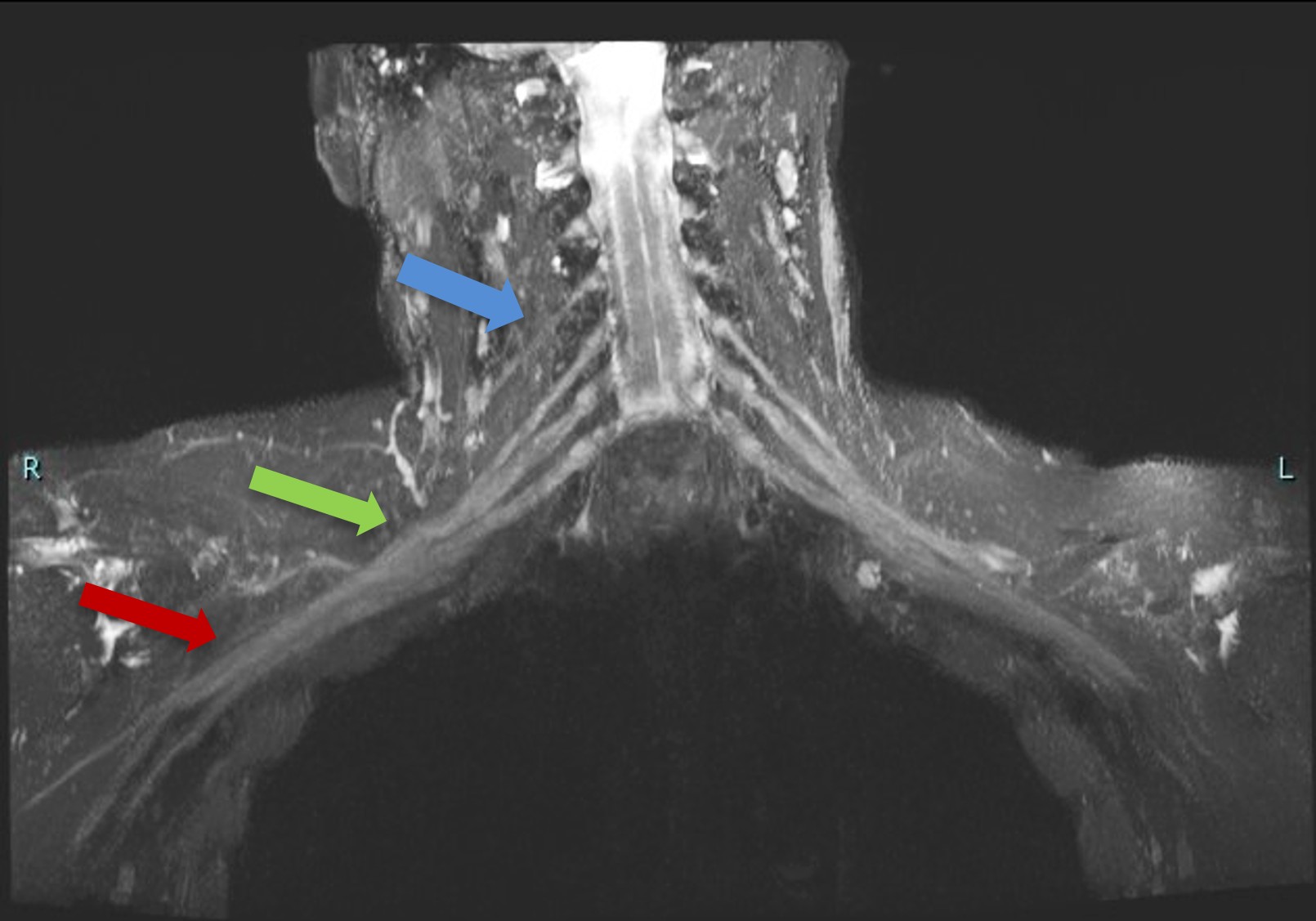
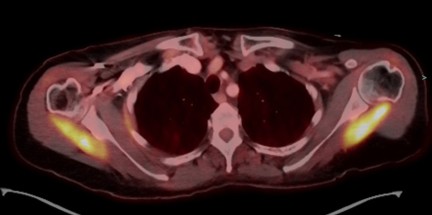
Case Presentation: A 70-year-old female presented with severe, stabbing, bilateral shoulder pain 21days following an autologous stem cell transplant (SCT) for multiple myeloma. Pain was described as severe, stabbing, in bilateral shoulders without radiation and exacerbated by movement, unrelieved by rest, and worse at night. She first noticed pain 8 days following SCT. Due to increasing symptoms and diagnosis uncertainty, she was hospitalized. Physical examination showed tenderness to palpation in both shoulder joints without swelling or erythema, range of motion was limited bilaterally with inability to raise her shoulders above 45 degrees. Mild muscle weakness was noted with slight right-sided scapular winging. Grip strength, sensation, and deep tendon reflexes were intact. Laboratory work up was unremarkable except for pancytopenia. Xray of both shoulders showed osteoarthritis. MRI of neck and shoulders showed increased hyperintense signal along roots, trunks and divisions of bilateral brachial plexi, suggestive of denervation neuropathy. MRI findings suggested brachial plexopathy. She was treated with a three-day course of high dose methylprednisolone 1000 mg and intravenous immunoglobulin (IVIG). At 12 weeks follow up her pain had improved, at seven month follow up it was resolved.
Discussion: Brachial plexopathy (BP) also known as Parsonage Turner syndrome is a rare neurological disorder characterized by the sudden onset of severe, often unilateral pain in the shoulder and upper arm. The reported incidence of BP is 2 to 3 cases per 100,000 people per year. [1]. In patients undergoing SCT brachial plexopathy seems more common than in the general population as shown by Konig et al., who reported nine brachial plexopathy cases among 841 stem cell transplant patients[2]. The etiology of BP is unknown. Preceding events include infections such as CMV, herpes zoster, surgery, and vaccinations. However, it can also occur without a precipitating history. Brachial plexopathy following SCT has previously been described in patients with multiple myeloma, amyloidosis, multiple sclerosis and hematologic malignancies. with onset of pain often described between 7 to 13 days after HSCT[2]. The usual presentation of BP is sudden, severe, unilateral shoulder and upper arm pain. The condition progresses through three phases: an acute pain phase, a phase of weakness and atrophy and a recovery phase. Severe acute stabbing pain usually lasts from a few days to several weeks followed by a persistent dull ache that can continue for several months to years. Bilateral presentations such as in our patient are exceedingly rare. Diagnosis can be challenging with MRI and nerve conduction studies having the highest yield. There are no established guidelines for brachial plexopathy treatment. High dose steroids combined with physical therapy are used. IVIG use has also been described in severe cases[3]. Most recovery occurs within several months to a year. Contrary to some of the post-transplant cases describing mild self-limited illness, our patient had severe sharp bilateral pain requiring hospitalization.
Conclusions: Brachial plexopathy is a rare, likely under diagnosed condition that can occur in the first week or two after hematopoietic stem cell transplantation. This case underscores the importance of high index of suspicion especially among patients undergoing SCT.