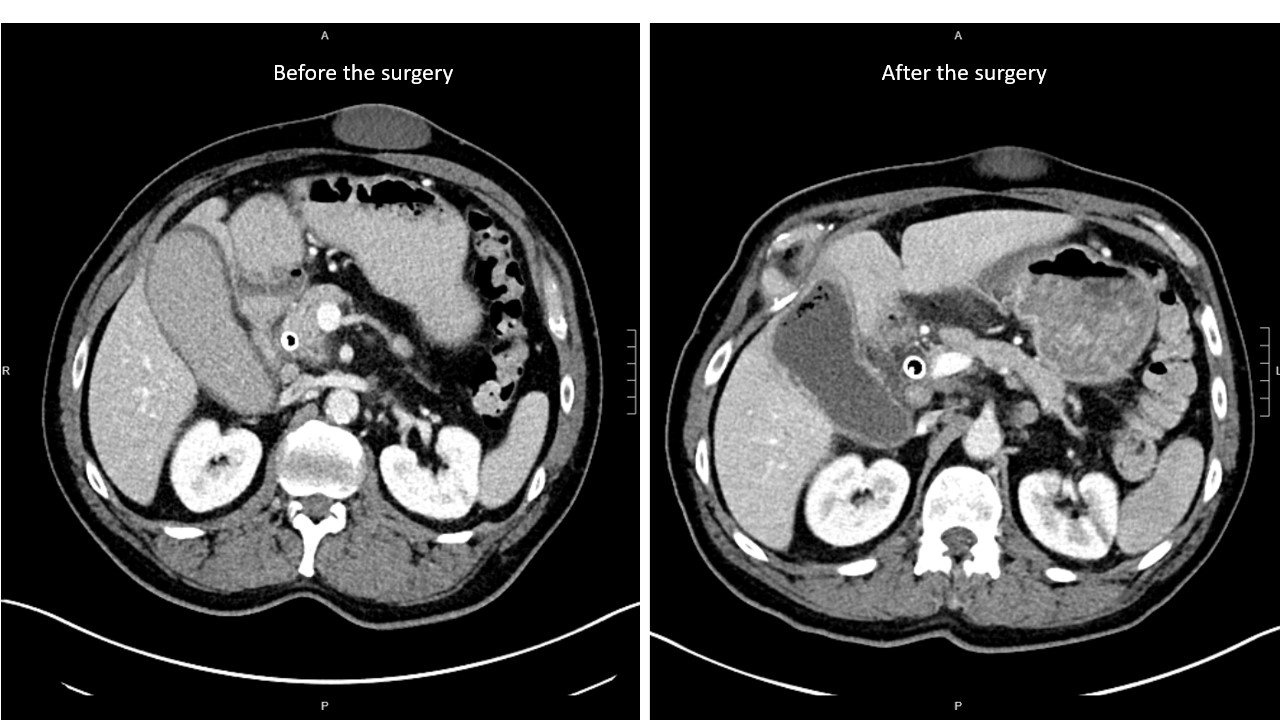
Case Presentation: A 52-year-old man with a history of chronic alcohol-induced pancreatitis and biliary strictures requiring multiple biliary stent revisions presented with abdominal pain. The workup was unremarkable with normal white blood cells (WBC) and total bilirubin. On the day of admission, the patient underwent ERCP for biliary stent exchange. He continued to have severe pain and was found to have post-ERCP pancreatitis. Due to lack of symptom improvement, MRCP was performed to re-evaluate the stents, and incidentally revealed development of acute cholecystitis. Subsequent labs showed increasing WBC to 15,430 /µL and CRP to 342 mg/L. Intravenous (IV) antibiotics were started, and surgery was consulted. He was taken to the OR on day 9, which revealed gangrenous cholecystitis. A fenestrating laparoscopic subtotal cholecystectomy was performed, and a drain was placed in the gallbladder aperture. The drain was removed on day 12, and antibiotics were de-escalated with a plan to discharge. However, the pain worsened and repeat CT imaging showed a “distention of the remnant gallbladder with gallbladder wall thickening.” Interventional radiology was consulted to place a percutaneous cholecystostomy tube on day 17 and antibiotic therapy was escalated back to IV formulations. Ultimately, he was discharged on a two-week course of levofloxacin and metronidazole following source control. A follow-up CT two weeks later confirmed decreased distention of the gallbladder remnant.
Discussion: This case highlights diagnostic and therapeutic challenges due to near-immediate presentation of symptomatic gallbladder remnants. Cholecystectomies are safe surgeries with a low rate of complications. In cases where complications are likely increased, such as severe inflammation, adhesions or bleeding to Calot’s triangle, surgeons may perform a subtotal cholecystectomy (SC), where most of the gallbladder is removed except for a cuff near Hartmann’s pouch. This cuff can be left open (fenestrating SC) or closed (reconstituting SC). A reformed gallbladder is a rare complication of the reconstituting approach, where the closed remnant re-forms a new gallbladder and causes biliary events. Although our patient had a fenestrating procedure, the rapid symptom onset and imaging findings suggests reconstitution – where the open stump was quicky walled off by omentum following drain removal, creating a closed infected space. Most symptomatic gallbladder remnants are long-term complications with a median onset of two years, rather than within one week post-operatively, as happened in this case. Diagnosis is often delayed (the median time-to-diagnosis 60 days) because symptoms can be isolated abdominal pain. If CT is inconclusive, ERCP or MRCP offers superior diagnostic yield (sensitivity of 85% and 90%, respectively). Definitive treatment is a complete cholecystectomy, although re-operation rates are highly variable, 4% to 76%. When re-operation is not indicated, percutaneous drainage can provide effective source control.
Conclusions: Hospitalists should recognize that a reformed gallbladder following subtotal cholecystectomy is a distinct clinical entity that requires a high index of suspicion. While it’s described as a late complication, this case illustrates that symptoms can start soon after the surgery.