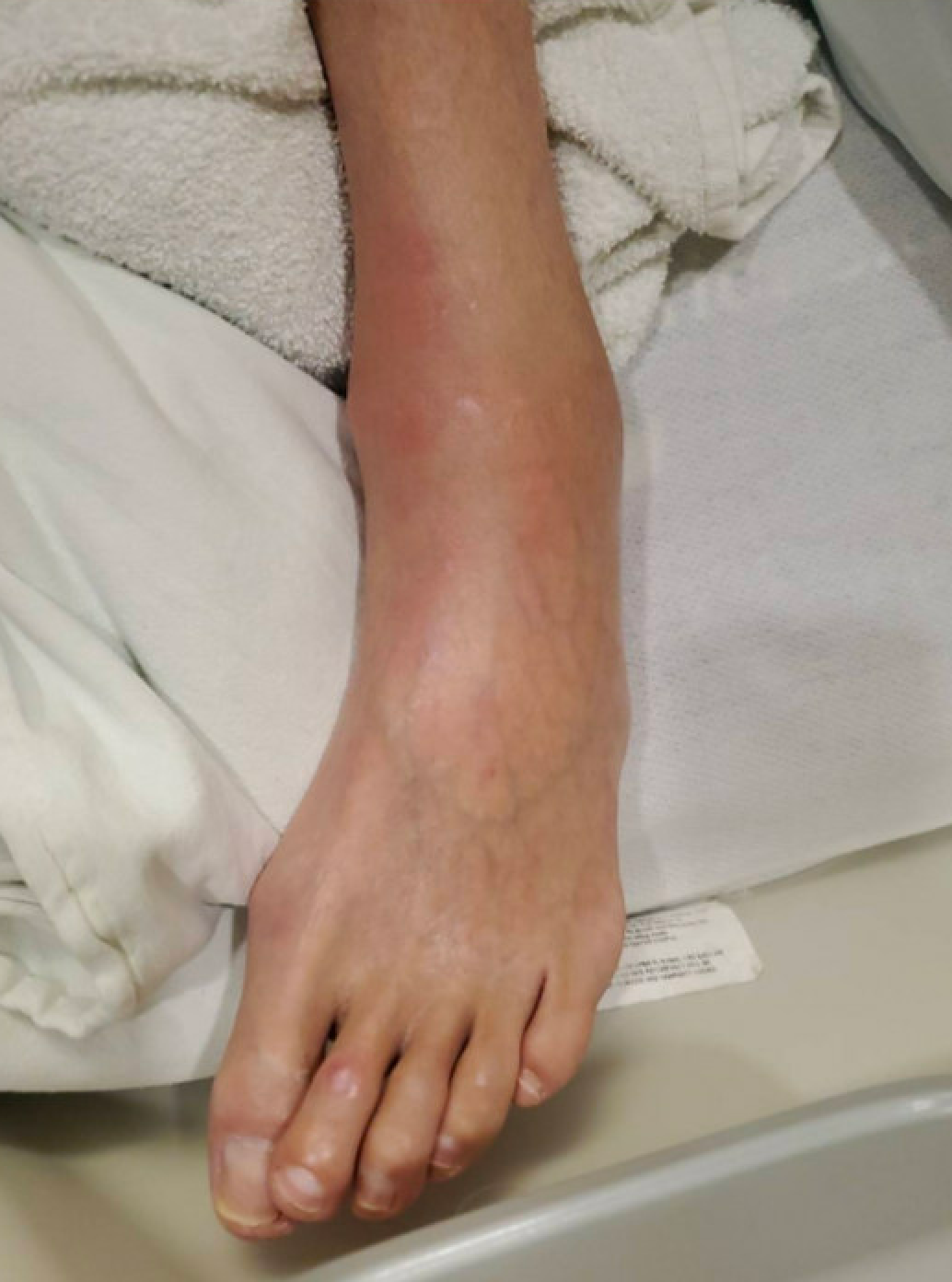
Case Presentation: A 43 year-old man presented with one day of diffuse joint pains and fevers. He had new onset severe joint pains and stiffness of the neck, shoulders, elbows, wrists, fingers, hips, knees, and ankles. He used a continuous subcutaneous insulin infusion device to manage type 1 diabetes. He recently had a small bowel obstruction complicated by small bowel fistulas and an intra-abdominal abscess. He did not have a cough, shortness of breath, chest pain, or abdominal pain. He had a temperature of 38.9 and blood pressure of 113/56. He had pain and decreased mobility with passive range of motion of the shoulders, elbows, hips, knees, and ankles. He had bilateral knee effusions and symmetrical synovitis of the bilateral hands, wrists and ankles. His white blood cell count was 10,000 with 68% neutrophils. C-reactive protein was 195. Creatine kinase, anti-CCP antibody, rheumatoid factor, and anti-nuclear antibody were normal. Blood cultures were negative. A right knee arthrocentesis had 9,000 white blood cells with 92% neutrophils, 290 red blood cells, no crystals, and a negative bacterial culture. He was given prednisone 20 milligrams daily with rheumatology consultation for suspected seronegative inflammatory arthritis. Steroid-induced hyperglycemia was managed in consultation with endocrinology. His continuous insulin basal rate was increased. He self-exchanged his insulin pump catheter. The next day he had an esophagogastroduodenoscopy to evaluate for gastrointestinal bleeding. Following the procedure, his blood sugar increased from 230 to 576. He had an anion gap of fifteen, a venous blood gas pH of 7.2, and an elevated beta-hydroxybutarate level of 2.5. His insulin pump catheter was kinked when examined. He was transferred to the medical intensive care unit for diabetic ketoacidosis management. His insulin pump was paused and continuous intravenous insulin was started. His insulin pump catheter was exchanged again. His diabetic ketoacidosis and hyperglycemia resolved, and his continuous subcutaneous insulin infusion was resumed.
Discussion: Use of a continuous glucose monitor plus a continuous subcutaneous insulin infusion (CSII) device can improve glycemic control and lower risk of hypoglycemia in patients with type 1 diabetes (1). Use of CSII is increasing. Over 60% of patients in the Type 1 Diabetes Exchange Registry used insulin pumps in 2015 (2). CSII is often continued for hospitalized patients. Insulin pump malfunction can be categorized as software problems, alarm errors, human factors, broken components, or related to transitions of care (3). The hardware of an insulin pump includes a pump device, an infusion set with a catheter and plastic cannula or stainless-steel needle, and a reservoir which holds up to three milliliters of insulin. The catheter and infusion set are typically exchanged every two to three days. Catheter kinking occurred in 0.4% to 2% of patients in two case series of insulin pump therapy in hospitalized patients (4, 5).
Conclusions: Unexplained hyperglycemia in hospitalized patients using continuous subcutaneous insulin infusion following exchange of an infusion pump catheter or following a procedure should immediately prompt a physical exam of the infusion pump device to exclude infusion catheter kinking. Diabetic ketoacidosis related to insulin pump malfunction should be managed with intravenous insulin, temporarily turning off the insulin pump, intravenous fluids, endocrine consultation, and electrolyte replacement.