Background: There is a growing interest around the variability of pediatric subspecialty consultations being untimely, inequitable, and non-patient centered, leading to concerns to patient safety and quality. Studies have shown that daily rounds vs twice weekly or irregular visits results in decreases in length of stay, morbidity and mortality, overall costs of hospitalization, and readmission rates. At the University of Minnesota Masonic Children’s Hospital, in a one month sample of ongoing consults from three specialties, only 66% of days had a visit from the consultant, and 24% of consults resulted in a one time visit with stated plans to follow up without follow up documentation.
Purpose: The aim of this project is to increase the expected consultant visit rate to 70% of days and reduce the number of consultations that result in no follow-ups to 10% in patients admitted to the pediatric hospital medicine teams at University of Minnesota Masonic Children’s Hospital.
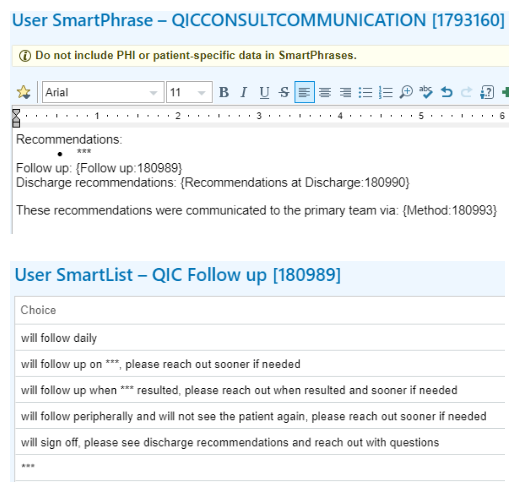
Description: The project team met with various providers from the pediatric consultation services to understand their workflow. Opportunities were identified to improve clarity around follow up planning. To address this, the team developed an Epic SmartPhrase to clarify expectations.This SmartPhrase included space for specific recommendations; an opportunity to state when and under what circumstances the consultant team would follow up, based on clinical judgement or necessity; or sign off. It also included space to provide recommendations around discharge including needed tests, imaging, and follow up time frame. The SmartPhrase was implemented across three pediatric subspecialty teams– gastroenterology, neurology, and infectious disease. Consultants were encouraged to utilize the SmartPhrase in a manner that best served their workflow: use as a stand-alone SmartPhrase, incorporation into a template, modification to better suit the consultant’s needs. PDSA cycle 1 lasted from July 1, 2025 through August 1, 2025. Team members provided weekly check-ins regarding the utility of the SmartPhrase and asked for feedback. Because this disabled the project team’s ability to track SmartPhrase usage, a manual review of all consult notes was undertaken. Manual chart review was performed by one team member of all consult notes. At the end of this time period the percentage of consultations without follow up dropped from 24% to 5% and the number of daily expected notes increased from 66% to 87%. Using Fisher’s exact test this resulted in p values of 0.017 and 0.001 respectively.
Conclusions: Standardized documentation allows for decreased variability between consultants, allows for clear communication regarding the proposed time frame between follow-up visits, and decreases miscommunications regarding discharge recommendations. Standardized communication allows also for large language models to appropriately extract information. SmartPhrases offer increased flexibility compared to standardized note templates, can be easily shared with others, and do not need IT or Epic builder approval. Some users chose to incorporate the SmartPhrase into their notes.
.png)