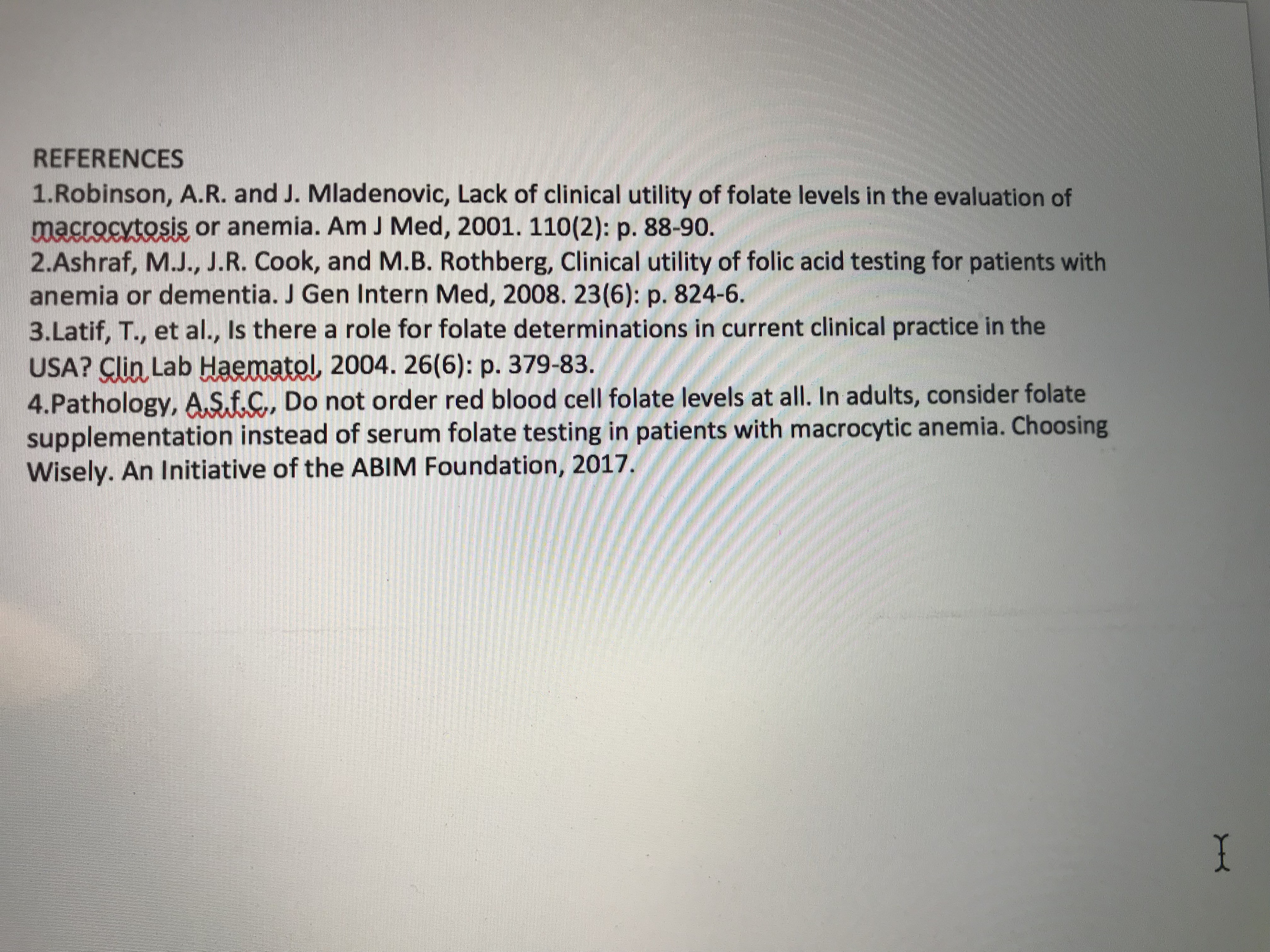
Background: While checking serum folate levels in hospitalized adults is no longer recommended, and only one hospital meal is needed to replete a low serum folate level, more than 2500 serum folate levels were obtained in 2015-2016 at our urban teaching hospital in New York City. Checking levels is considered wasteful in folate fortified countries. The lack of clinical utility of folate testing in macrocytic anemia was first demonstrated in 2001[1], followed by dementia and altered mental status in 2008[2]. Treating empirically with folic acid for suspected folate deficiency is more cost-effective than testing[4].
Following along the ABIM Choosing Wisely Campaign to reduce serum folate testing, we in the Division of Hospital Medicine at Mt Sinai West embarked on the following QI initiative.
Methods: Our data collection began with a retrospective review of all ordered serum folate levels on all admitted medicine patients in 2015-2016.
We found the frequency of low values, took all the patients with low values, looked to see whether low values changed managemen and observed that a fair number were ordered based on recommendations from consultants. We also conducted a cost analysis to determine the cost per testing and what the cost savings would be over a 1 year period.
We subsequently designed and implemented a series of hospital wide interventions to educate/reinforce the clinical futility of folate testing and the expected cost savings; 1) educational outreach to all hospital medicine providers and to our colleagues in psychiatry and neurology, 2) a stop built into our EMR tied to any provider attempt to order a folate level, 3) a dedicated screensaver employed hospital wide.
Results: Out of 2511 tests in 2015-16, less than 2% of levels tested were low. Abnormal folate levels were acknowledged by the treating team in 33% of cases and changed management in 37% of cases. 13% of patients were already on folate supplementation when the test was ordered. In 26% of cases, the recommendation came from our consultant services. With the cost of each folate test at $77.25, this amounted to a total hospital cost of $193,974.75 for 2015-2016. The cost of a 1 mg folic acid tablet is $0.079. The cost of daily treatment with folic acid for our CMI adjusted length of stay for that year of 3.83 days would have been $0.30 translating to a total yearly cost of $753.
During the six-month period from January to June 2017, prior to the intervention, the average number of folate levels ordered per month was 106 (range 96-122). Following our hospital-wide intervention, during the six-month period from May to October 2018, the average number of folate levels tested per month decreased to 18 (range 96-122).
Conclusions: Consistent with the literature, we found the prevalence of low plasma folate levels in our admitted patients was very low and that empiric treatment with folic acid was far more cost-effective compared to lab testing. We also showed that robust educational outreach can lead to a significant reduction in utilization of this futile laboratory test.