Background: Hospitalization is often stressful and confusing for patients and families, and hospitalists play a pivotal role in helping navigate complex treatment plans, integrating multiple consultant and ancillary service recommendations, and providing guidance and reassurance. To achieve this, hospitalists need to quickly develop rapport with patients and families. However, most hospital medicine patients are unable to identify their hospitalist (1) and have little understanding of the role of a hospitalist (2). Business cards (BC) for hospitalists may be one approach to enhance building rapport (3–6), but little is known about hospitalists’ perspectives on the use of BC. The objective of this study was to investigate the perspective of hospitalists regarding using BC in a tertiary care academic hospital.
Methods: Over the months of August and September 2024, hospitalists were provided an oversized, personalized BC containing their name, academic title, photo, education, and one sentence about the individual. The back of the card contained general education about hospitalists, hospital medicine and a QR-code linking to additional information online. Each element included on the card was created with guidance from the hospital’s ‘Patient Family Advisory Council’ consisting of former hospital patients who relayed what information would be helpful in building trust with their hospitalist. The cards were distributed to hospitalists at the start of a 7-day rounding stretch, and they were left to their discretion if and when they would give the card to patients. Following the two-month pilot, all hospitalists were asked to complete a questionnaire about their perspectives on the use of the cards, including identification of barriers to card use and a 5-point Likert scale on agreement with specific elements on the card. Each Likert response was given a point value from 1 (strongly disagree) to 5 (strongly agree).
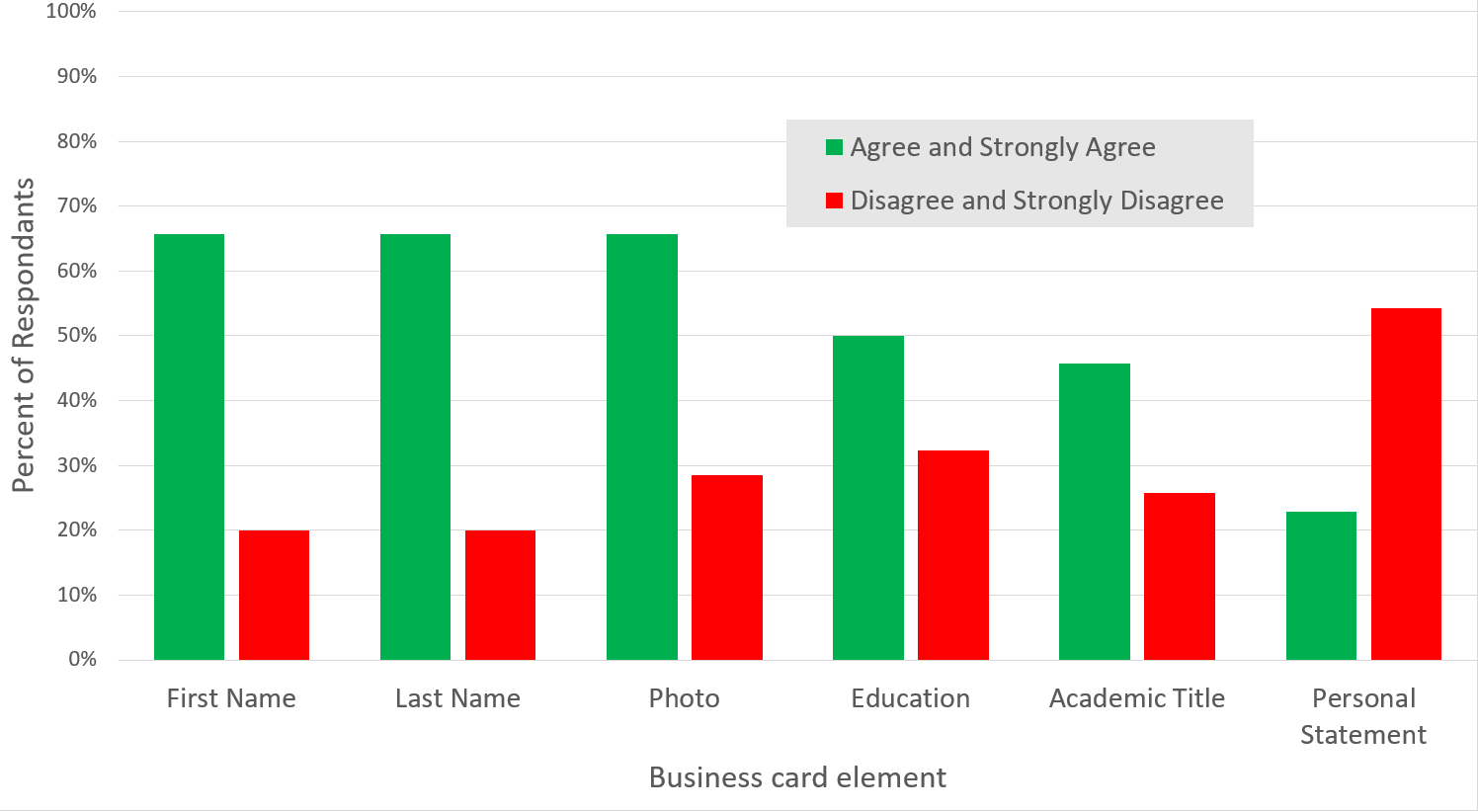
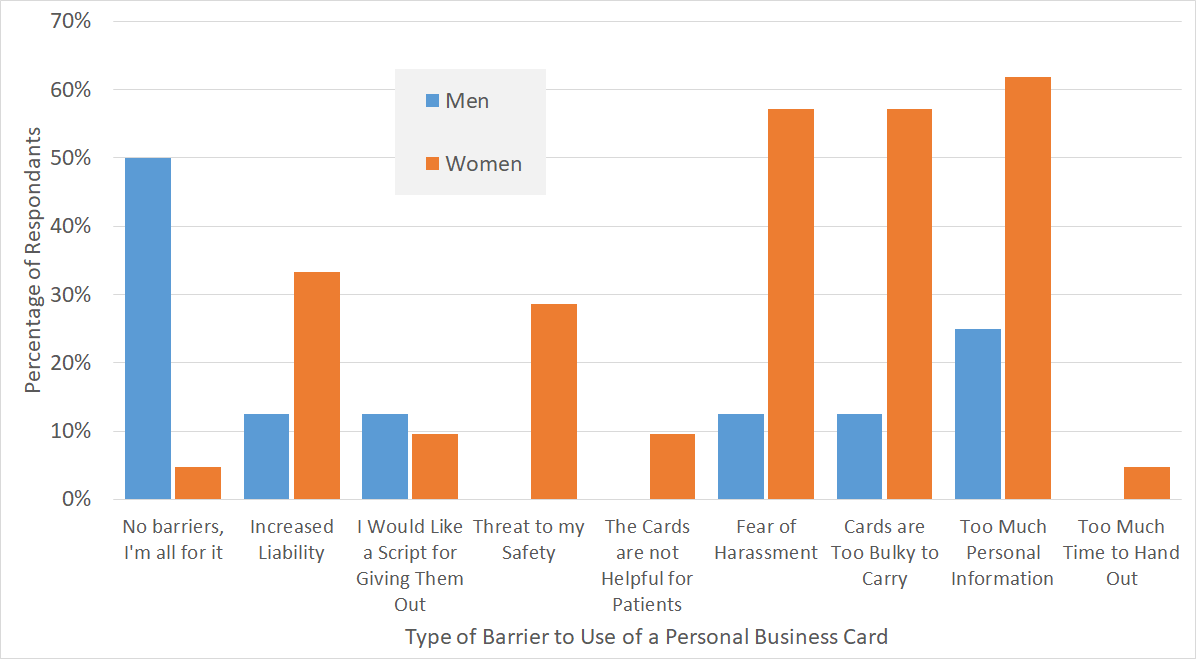
Results: The questionnaire was distributed among an academic hospitalist group consisting of 41 APPs and 74 physicians and was completed by 30.4% (35/115), most of whom were physicians at 82.9% (29/35). Gender identity was as a woman in 60% (21/35), as a man in 22.9% (8/35), and 17.1% (6/35) preferred not to say. 68.6% (24/35) had been practicing independently for >5 years. Hospitalists generally agreed that they felt comfortable with inclusion of their first name (mean score 3.6), last name (mean score 3.74) and photo (mean score 3.43). Results were more mixed for comfort about including education (mean score 3.26) and academic rank (mean score 3.26), and a majority felt uncomfortable with a personal sentence on a BC (mean score 2.49). The biggest barriers to using a BC were too much personal information, fear of harassment, and the physical size of the cards. These concerns were more prevalent among women compared to men with 50% (4/8) of men identifying no barriers to BC use and only 5% (1/21) of women identifying no barriers. Overall, hospitalists were in favor of continuing to use BC with select patients (mean score 3.60) but were opposed to allowing other individuals to hand out a BC on their behalf (mean score 2.34)
Conclusions: Hospitalists generally felt comfortable with a BC that they could distribute to patients, but barriers surrounding privacy and harassment were noted, especially among women. Further exploration into the impact of BC on workplace safety and patient satisfaction is needed.