Background: Hypotonic fluids have been historically used for maintenance intravenous fluids (mIVF) in acutely ill children (1). In 2018, the American Academy of Pediatrics released a Clinical Practice Guideline (AAP CPG) recommending that patients 28 days to 18 years receive maintenance isotonic fluids in order to prevent hyponatremia (2). Several published surveys have assessed mIVF prescribing practices in children with higher rates of hypotonic fluids selected (3-7). No published survey has focused on pediatric hospitalists and no survey has been published since the release of the AAP CPG. The goal of this survey was to assess mIVF prescribing practices among pediatric hospitalists after the release of this guideline.
Methods: A survey was distributed to the LISTSERV® for the AAP Section on Hospital Medicine asking their primary maintenance fluid choice for children younger than 28 days, 28 days to 1 year, and 1 year to 18 years of age. Respondents were also asked their mIVF choice in four clinical scenarios associated with elevated anti-diuretic hormone (ADH) in either a 27-day-old neonate, a 6-month-old infant, or a 13-year-old adolescent. The survey was developed iteratively using a previously published survey as a guide (6).
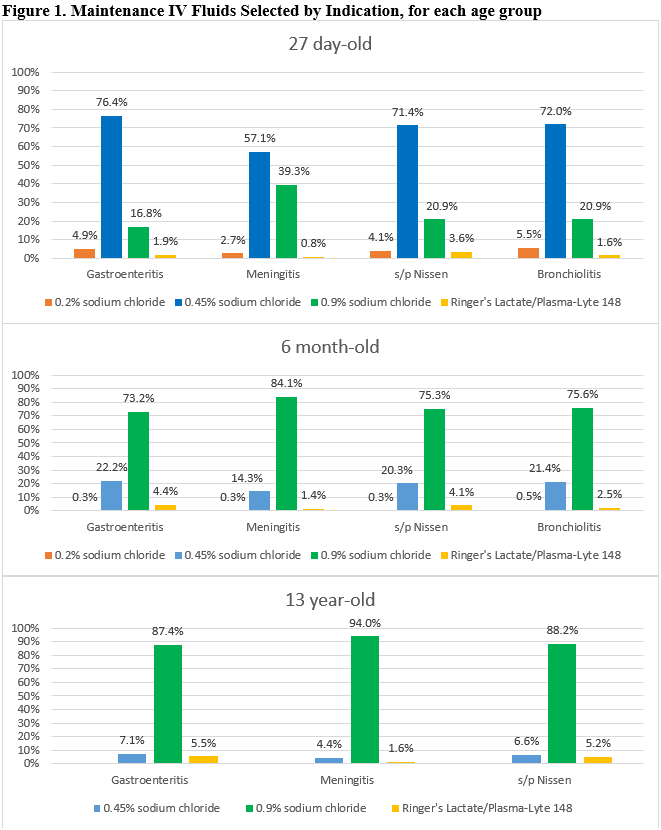
Results: There were 402 total responses (10.1% response rate). Isotonic solutions were preferred by respondents in older children compared to younger age groups, at 87.8% for the 1-18 years age group compared to 66.3% for the 28 days to 1-year age group and 10.6% for the younger than 28 days age group (all p values < 0.0001). When presented with disease states associated with ADH excess, isotonic fluids were preferred in higher percentages in the 6 month-old and 13 year-old age groups, but not in the 27-day-old group when 0.45% sodium chloride was preferred (see Figure 1 for specific disease state data); 0.2% sodium chloride was rarely chosen.
Conclusions: Based on survey responses, pediatric hospitalists are following the 2018 AAP CPG on mIVF and are more likely to choose isotonic fluids as their primary mIVF in pediatric patients outside of the neonatal period, including in scenarios of excess ADH.