Background: As bedside procedure services become more prevalent and their impact on patient satisfaction and length of stay become evident, the volume of procedures expected of services rises. These procedures require assistance from a bedside nurse for consent, patient positioning, medication administration, and lab acquisition. This pulls nurses away from their duties to other patients and delays procedural completion if a nurse is not available, decreasing the efficiency of the service. This in turn increases the time to procedure completion, thus delaying patient care and potentially discharge. In this study we evaluated the impact of incorporating a dedicated registered nurse (RN) navigator on the efficiency of a procedure service and faculty satisfaction.
Methods: This study was performed at an academic institution which has a procedure service comprised of one faculty attending performing bedside procedures throughout the hospital. Procedures offered included paracentesis, thoracentesis, lumbar puncture, arthrocentesis, central line placement and temporary dialysis line placement. Baseline data collection from 1/1/2024 to 5/30/2024 included number of rolled over procedures (procedures unable to be completed on the same day of consult), number of new consults received, number of completed consults, and percentage of completed consults per day. In the intervention phase, a dedicated registered nurse worked with the attending to assist with patient consent, procedural time out, medication administration (if indicated), patient positioning, and fluid lab labeling. The intervention phase lasted from 6/18/24 to 1/7/25. We compared the baseline period to days during the intervention period when a nurse navigator was deployed. Welch’s t-test was used to compare means and Fisher’s exact test was used to compare proportions.
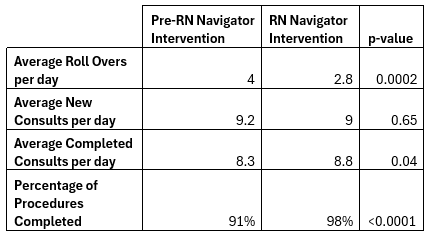
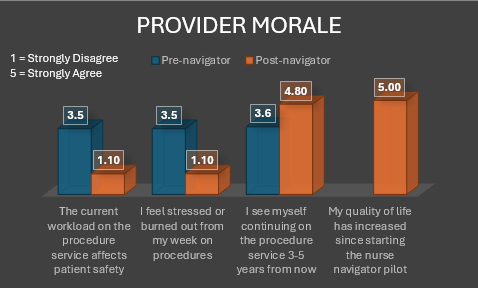
Results: A nurse navigator was deployed on the procedure team on 81% days (164/203) during the intervention period. The procedure team received a 9.2 new consults/day during the baseline period and 9 new consults/day during the intervention period (p=0.65). The average number of rolled over procedures decreased from 4/day to 2.8/day (p-value, 0.0002) and the average number of completed procedures increased from 8.3/day to 8.8/day (p=0.04). The percentage of completed consults per day increased from 91% (1263/1384) to 98% (1412/1439), p-value < 0.0001. Assuming that patients who were rolled over stayed in the hospital for at least 1 additional day to receive the procedure and our hospital’s cost per day at $1500/day, presence of a nurse navigator resulted in cost savings of $657,000/year. The results of a faculty survey on their satisfaction working on the procedure service in the pre and post nurse navigator period is presented in Figure 1.
Conclusions: This study showed that, for a busy bedside procedure service, the implementation of a dedicated RN significantly improves the number of procedures completed each day, decreases the number of procedures that get delayed to the next day, and increases the percentage of completed consults. This in turn has the potential to improve throughput by reducing length of stay. Finally, 100% of faculty reported an improvement in quality of life with the deployment of a nurse navigator.