Background: “Intern orientation” is the time between when interns arrive and start their clinical rotations in graduate medical education (GME), typically comprised of onboarding activities like EHR training. However, there are no published descriptions in internal medicine (IM) residency of typical orientation duration or content covered, which likely varies. Without this, there is risk of failing to adapt best practices in the undergraduate (UME) to GME transition. We aimed to describe common characteristics of IM intern orientation, including duration, administration, whether salary is provided, and content included, and explored factors contributing to these characteristics.
Methods: The nationally representative, web-based 2024 APDIM Annual Survey of IM PDs was administered to 78% (476/610) of residency programs with ACGME continued accreditation (the criteria for survey/study eligibility). One thematic section presented 15 Likert scale, select-all-that-apply, and write-in questions about intern orientation, including duration, salary, and content administered. The study also collected residency program characteristics in a separate section and through select third-party publicly available GME-specific data.
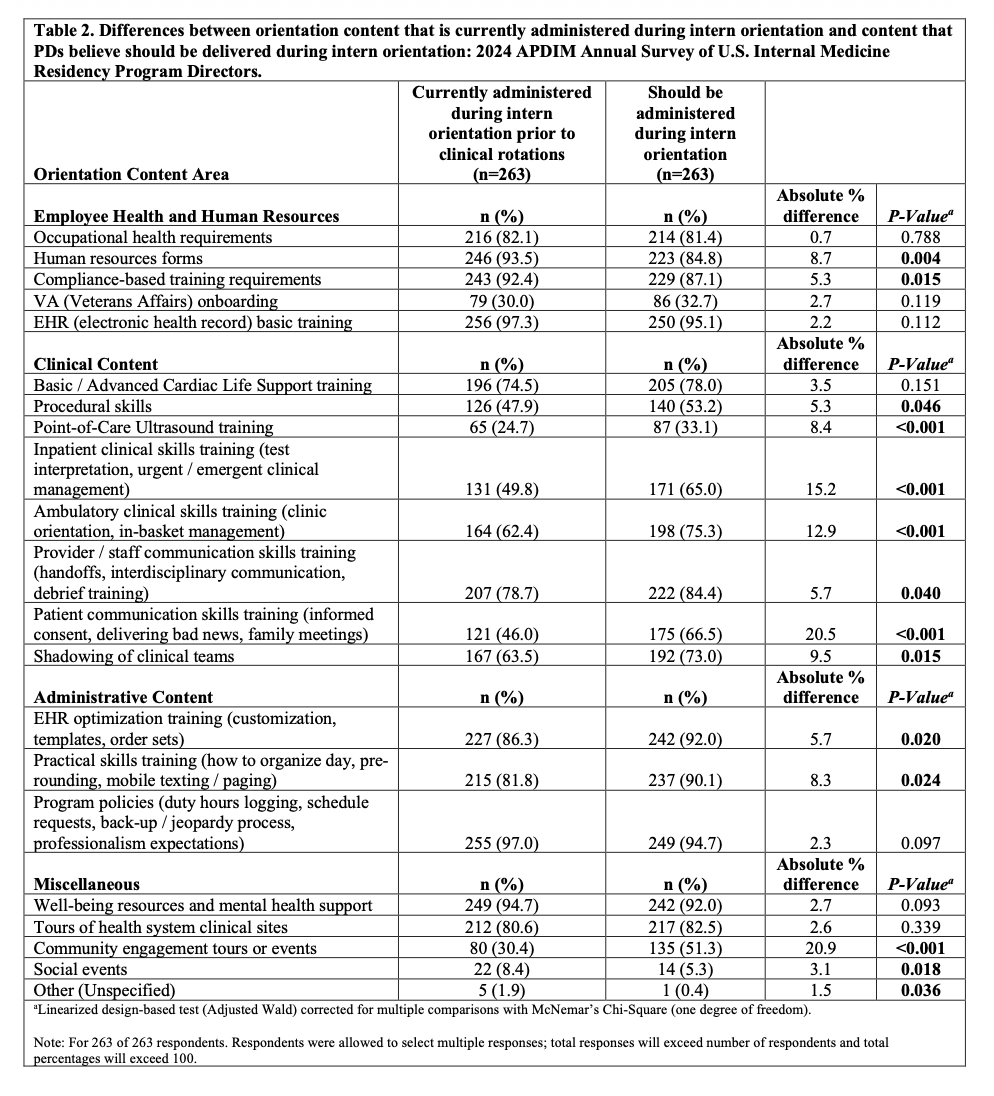
Results: Response rate was 55.3% (263/476 PDs). Mean reported intern orientation duration was 7.6 days (SD:3.7). When asked what contributed to duration, PDs most frequently identified GME/institution orientation start dates (71.5%, n=188), time required for hospital training requirements (64.6%, n=170), and rotation start dates (45.3%, n=119). Most PDs (n=202, 76.8%) felt time available for orientation was “just right” with mean duration of 7.7 days (SD:5.4) (p=0.002). Thirty-seven (14.1%) felt orientation was “too short,” with mean duration of 5.6 (SD:2.5) days, and 6.1% (n=16) “too long,” with mean duration of 10.5 days (p=0.002). Those reporting “too short” or “too long” identified their “ideal” duration as a mean of 8.8 (SD:5.3) days. Most programs (82.1%, n=216) paid interns for all orientation days; 8.4% (n=22) reported no intern salary during orientation and 9.5% (n=25) only partial salary. Programs with full salary were associated with longer orientation duration (median of 7 days; IQR:5) compared to those with no/partial salary (5; IQR:2) (p< 0.001), and being university-based, larger, or older accredited programs (Table 1). PDs reported what content currently is administered during orientation, and what content they believed should be delivered. The largest absolute differences between administered and desired content were community engagement/tours (30.4% administered vs 51.3% desired, p< 0.001), communication skills training (45.6% vs 66.5%, p< 0.001), inpatient clinical skills training (49.8% vs 65.0%, p< 0.001), ambulatory clinical skills training (62.4% vs 75.3%), and POCUS (24.7% vs 33.1%, p< 0.001) (Table 2).
Conclusions: Duration and content covered in intern orientation varies. Most PDs felt their orientation durations were “just right.” PDs believed more clinical content should be delivered as well as more community tours or engagement opportunities. Nearly 20% of PDs stated interns do not receive a full salary during orientation, despite US labor law stipulating that salary must be paid for mandatory orientation activities, which intern orientation is. This study informs PDs and institutions planning or optimizing intern orientations and may help in standardizing content and expectations during this formative period in training.
.png)