TEACHING TIME IN SHORT SUPPLY – PREFERRED STRATEGIES FOR ALLOCATING TRADITIONAL TEACHING DUTIES AMONG ACADEMIC HOSPITALISTS ACROSS SIX INSTITUTIONS
Catherine Callister, MD1, Michelle Brooks, MD2, Julia Caton, MD, EdM3, Angela Keniston, PhD, MSPH4, Sarah Mann, MA4, Shannon Martin, MD, n/a5, Lauren McBeth, BA6, Daniel McFarlane, MD, SFHM7, Daniel Ricotta, MD8, Marisha Burden, MD, MBA9, 1University of Colorado School of Medicine, CO, Centennial; 2Division of Hospital Medicine, South Texas Veterans Health Care System, San Antonio, Texas, USA, ; 3Department of Medicine, Zucker School of Medicine at Hofstra/Northwell, Uniondale, New York, USA, ; 4University of Colorado School of Medicine, ; 5University of Chicago, ; 6University of Colorado Division of Hospital Medicine, ; 7Division of Hospital Medicine, The Ohio State University College of Medicine, Columbus, Ohio, USA, OH, Columbus; 8Division of Hospital Medicine, Beth Israel Deaconess Medical Center, Boston, Massachusetts, USA, ; 9University of Colorado School of Medicine, CO
Abstract Number: 768
Background: Clinical growth is outpacing educational growth at academic medical centers (AMCs) reducing traditional teaching opportunities-especially in rapidly expanding fields like hospital medicine. Despite these pressures, little guidance exists on how leadership should allocate limited teaching time. Our goal was to explore academic hospitalists’ preferences for allocating traditional teaching time (i.e., time on services with interns and residents) amid clinical expansion.
Methods: A cross-sectional survey of academic hospitalists from six large Academic Medical Centers across the US with free-response questions analyzed qualitatively.
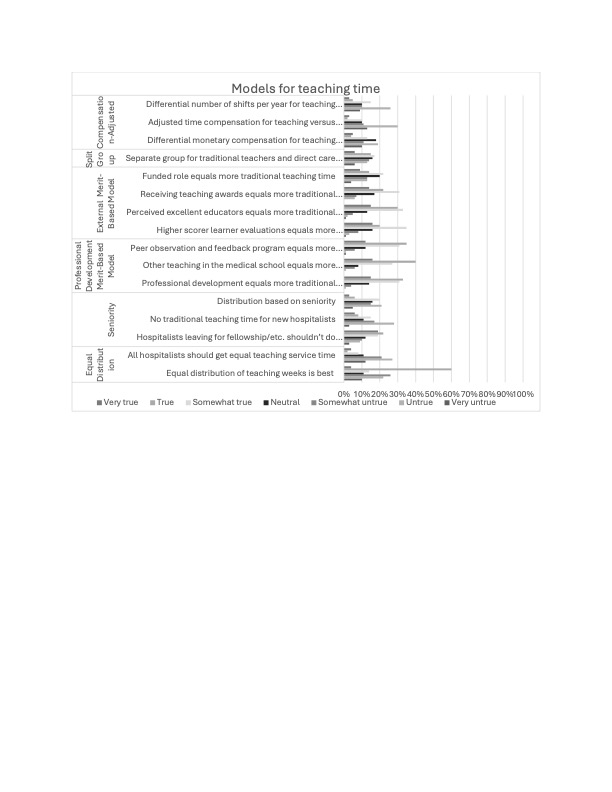
Results: Of 572 hospitalists surveyed, 156 academic hospitalists responded (27%). Respondents averaged 8.9 years’ experience and spent 25% of clinical time on traditional teaching services. Teaching was a strong professional priority: 74% rated it very or extremely important when considering new job positions, and 66% preferred it as their primary service role. Most respondents (81%) preferred a merit-based model that rewards teaching skill development and learner engagement beyond clinical care. An external recognition-based model (i.e., teaching evaluations) was also supported (64%) though respondents raised concerns about bias. Equal distribution, seniority-based and split-group models were less favored. Only 6% of respondents preferred working exclusively on direct care services (i.e., a service without learners).
Conclusions: Academic hospitalists highly value teaching but most spend little time on it. Hospitalists preferred a merit-based model, where faculty demonstrate their interest in and commitment to education by improving their teaching skills
IMAGE 1: Demographics
.jpg)
IMAGE 2: Models for teaching time
To cite this abstract:
Catherine Callister, MD1, Michelle Brooks, MD2, Julia Caton, MD, EdM3, Angela Keniston, PhD, MSPH4, Sarah Mann, MA4, Shannon Martin, MD, n/a5, Lauren McBeth, BA6, Daniel McFarlane, MD, SFHM7, Daniel Ricotta, MD8, Marisha Burden, MD, MBA9.
TEACHING TIME IN SHORT SUPPLY – PREFERRED STRATEGIES FOR ALLOCATING TRADITIONAL TEACHING DUTIES AMONG ACADEMIC HOSPITALISTS ACROSS SIX INSTITUTIONS.
Abstract published at SHM Converge 2026.
Abstract 768
2026 Converge - Posters.
https://shmabstracts.org/abstract/teaching-time-in-short-supply-preferred-strategies-for-allocating-traditional-teaching-duties-among-academic-hospitalists-across-six-institutions-2/.
October 24th 2026.
