Background: Children with medical complexity (CMC) represent a growing population on pediatric hospital medicine services, requiring pediatric hospitalists (PHs) to manage multisystem diseases and complex devices and teach these skills to residents. While residents report that a barrier to learning these skills may be a lack of sufficient expertise by the faculty, little is known about how PHs perceive or acquire this training themselves. This study assessed PHs’ satisfaction, perceived importance, and interest in developing physical examination (PE) and device management skills for CMC. Secondary aims included identifying how these skills are acquired and preferred learning modalities.
Methods: We administered a 25-question REDCap survey to a national convenience sample of PHs; this analysis reflects 10 items (4 multiple-choice, 3 Likert-scale, 3 free-text) related to the objectives above. Satisfaction and interest were measured on 5-point Likert scales (1=very dissatisfied/disinterested, 5=extremely satisfied/interested); importance on a 4-point scale (1=not important, 4=very important). Descriptive statistics summarized quantitative data, and free-text responses were reviewed for predominant themes.
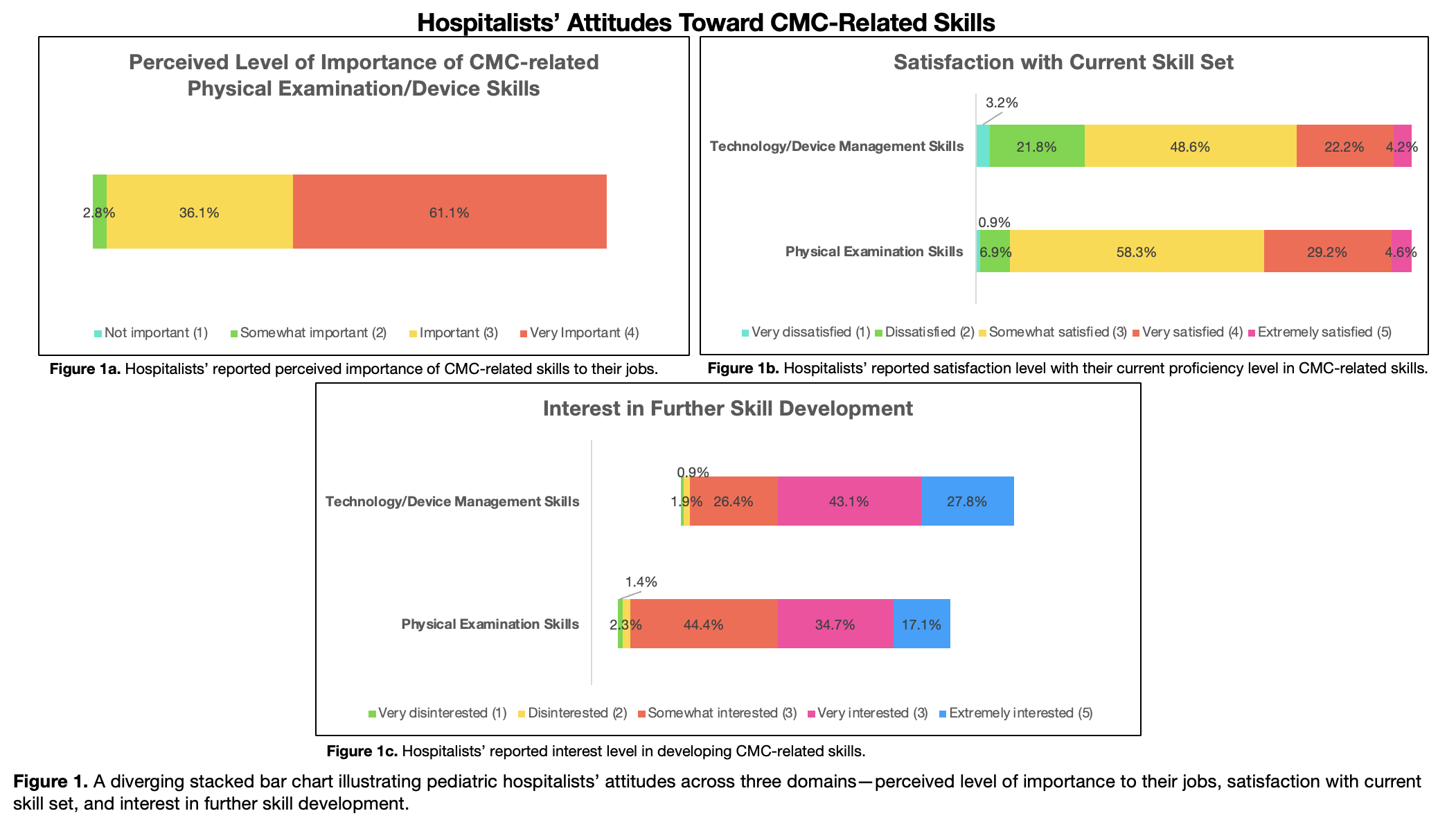
Results: Of 268 PHs surveyed, 221 (82.5%) responded, representing 53 institutions nationwide. Satisfaction, Importance, Interest: Respondents reported moderate satisfaction with their current PE and device management skills related to caring for CMC (mean 3.30, SD 0.70; mean 3.02, SD 0.86; 5-point scale, respectively) despite rating them as highly important to their work (mean 3.58, SD 0.55; mean 3.41, SD 0.68, respectively; 4-point scale) (Fig. 1). Free-text responses showed that those who perceived these skills as less important often relied on subspecialists and nurses for support. Respondents reported interest in further skill development (mean 3.63, SD 0.84 for PE; 3.94, SD 0.84 for devices; 5-point scale), with >96% at least “somewhat interested” in honing both PE and device skills. Education on neuromuscular examination, tracheostomy management, and feeding tube care were prioritized on multiple-choice and free-text responses. Skills Acquisition: Although PHs preferred formal, guided hands-on training with experienced providers (89.4%), most acquired these skills through informal on-the-job learning (75%) primarily during residency (82.4%). Other educational resources frequently used in practice were discussions with complex care providers (72.9%), institutional guidelines (62%), and online content (48.4%); 11.8% of respondents were unsure which resources to use.
Conclusions: PHs view PE and device management skills as essential to care for CMC but report only moderate satisfaction with their proficiency. Most acquired these skills informally during residency, revealing a gap between current training and preferred learning methods. Respondents who placed lower importance on these skills often leaned on subspecialists and nurses, suggesting opportunities to better support PHs in independent frontline assessments. Limited exposure to these skills, along with uncertainty about reliable educational resources, highlights the need for more standardized complex care skills curricula spanning the continuum from trainees to faculty. Future work should assess hands-on, specialist-led training to strengthen PHs’ skills, improve their care for CMC, and empower them to transfer this knowledge to residents.