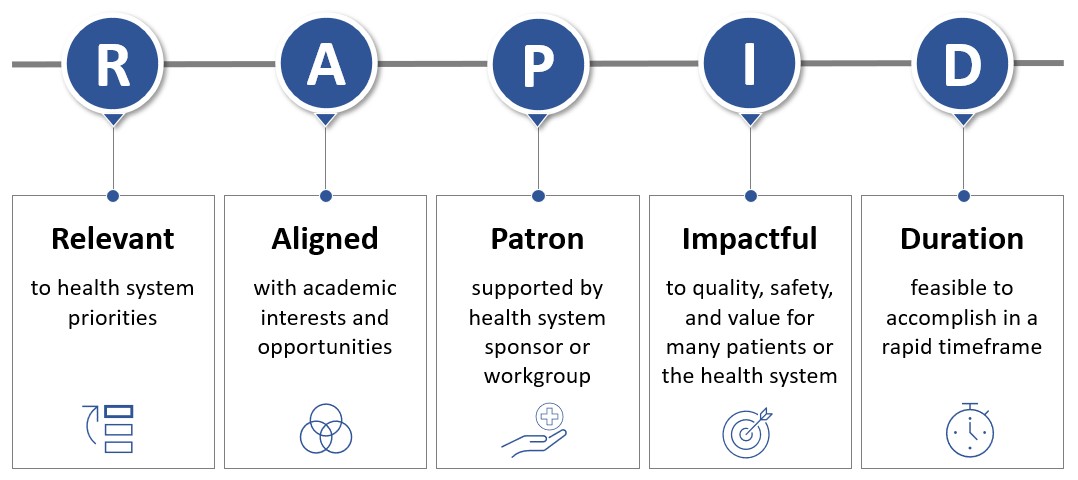
Background: Health systems face many common challenges when implementing initiatives in clinical practice, such as how to tailor interventions to local contexts, develop and carry out an effective implementation plan, and monitor effects on care delivery and patient outcomes. Implementation science and learning health system (LHS) science offer rigorous approaches that can be applied to real-world improvement efforts. To realize this potential, however, effective academic-operational partnerships and infrastructure are needed, centered around health system priorities and timelines. We describe the development and initial experience with a new model at Vanderbilt University Medical Center (VUMC) known as Realizing Accelerated Progress, Investigation, Implementation, and Dissemination in Learning Health Systems (RAPID-LHS).
Purpose: The overall goal of RAPID-LHS is to foster academic-operational collaborations in a LHS model by providing academic support to health system initiatives and supporting trainees’ involvement in LHS research. To design the program features, a needs assessment (Fall 2023) included interviews with VUMC leaders to identify key gaps/opportunities in existing LHS infrastructure, desired services, and potential priority projects. During a strategic planning retreat (December 2023), 27 academic and operational leaders reviewed the needs assessment, provided input on infrastructure and service mechanisms, and ranked an initial slate of projects. To provide ongoing guidance, a panel of several high-ranking academic and operational leaders meets quarterly to review progress, vet new priority projects, and assist with health system integration.
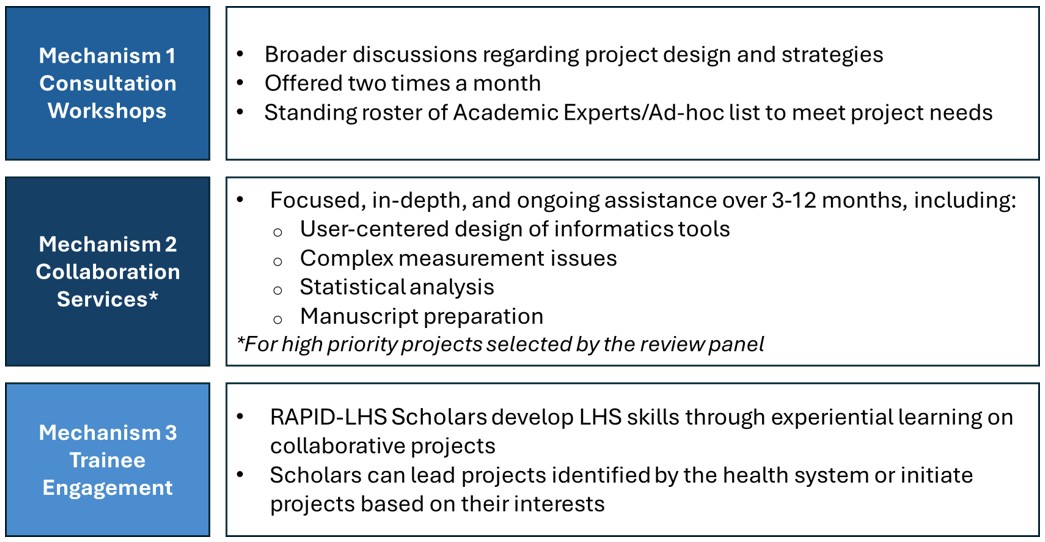
Description: RAPID-LHS is funded by institutional support and a P30 award through the AHRQ/PCORI Learning Health System Embedded Scientist Training and Research (LHS E-StaR) Centers program. The new RAPID-LHS services infrastructure includes mechanisms for 1) one-time consultation, 2) ongoing collaboration (for high priority initiatives), and 3) trainee engagement. Consultations usually provide input on project design, strategies for implementing practice change, and outcome assessment. RAPID-LHS collaborations provide 3-12 months of academic partnership for selected priority initiatives, for example, to assist with user-centered design of informatics tools, complex measurement issues, and statistical analysis which balances rigor and timeliness. Faculty trainees funded through the P30 help lead several collaborations. In the first 22 months, RAPID-LHS services have supported 11 consultations and 13 ongoing collaborations across the health system, ranging from design of antimicrobial stewardship programs to evaluating the impact of a hospital-wide discharge care center.
Conclusions: RAPID-LHS provides an effective and efficient model for academic-operational infrastructure to advance the mission of a learning health system.