Background: Colorectal cancer (CRC) is the third most common cause of cancer related death in the United States. Surgical resection is the primary treatment for patients presenting with non-metastatic disease. Current guidelines from major societies including American College of Gastroenterology (ACG) and US Multi-Society Task Force on Colorectal Cancer (USMSTF) recommend colonoscopy within 1 year post colorectal cancer resection. This study aims to examine adherence with these guidelines and identify reasons for non-adherence.
Methods: A retrospective chart review was performed for patients who underwent curative resection for colorectal cancer between January 2016 and June 2017. Our Electronic Medical Records(EMR) were screened for ‘Colonoscopy’ in Procedures, ‘Colorectal Cancer’ in Diagnosis and ‘Colorectal Surgery’ in Care Team Specialty. 136 patients were identified out of which 80 met our inclusion criteria of Stage 2 and 3 Cancer who underwent surgical resection.
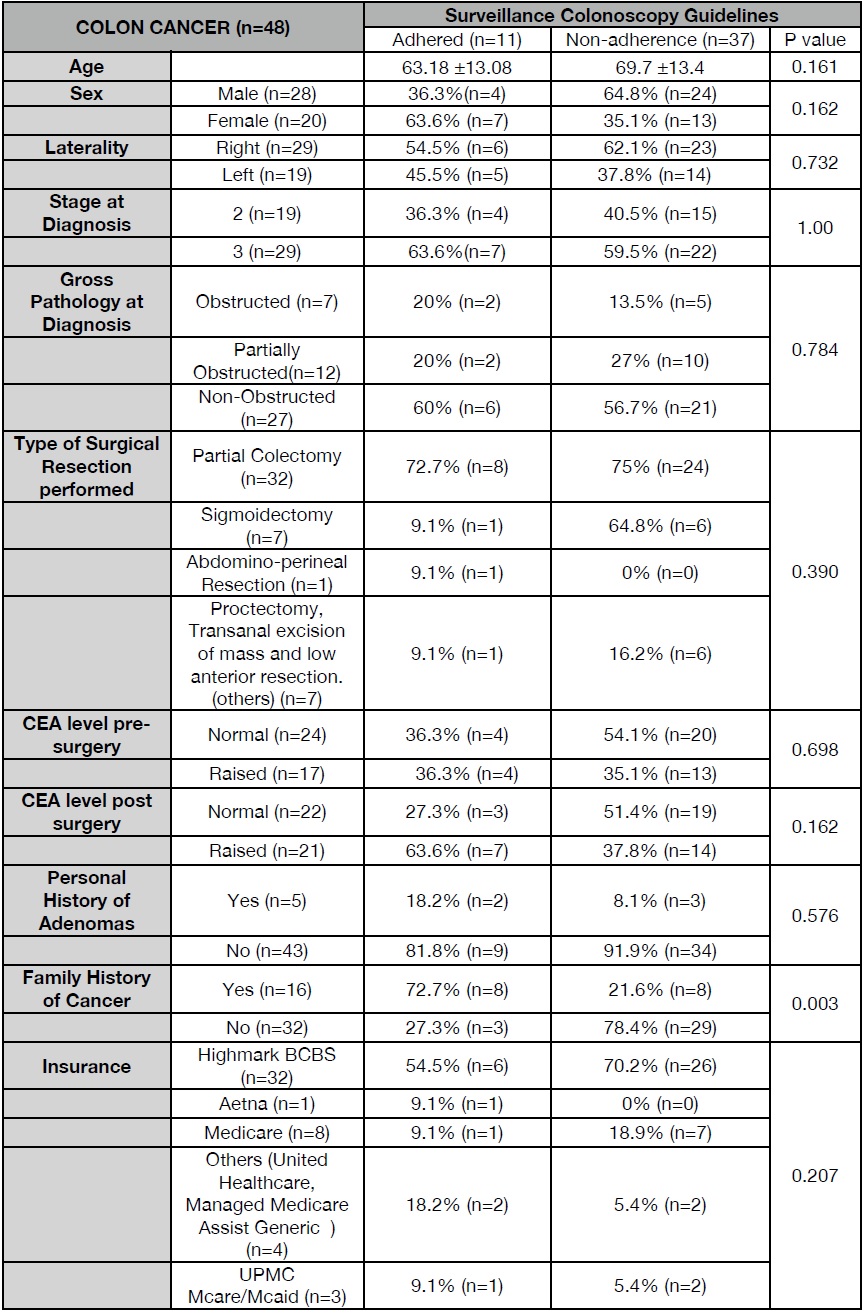
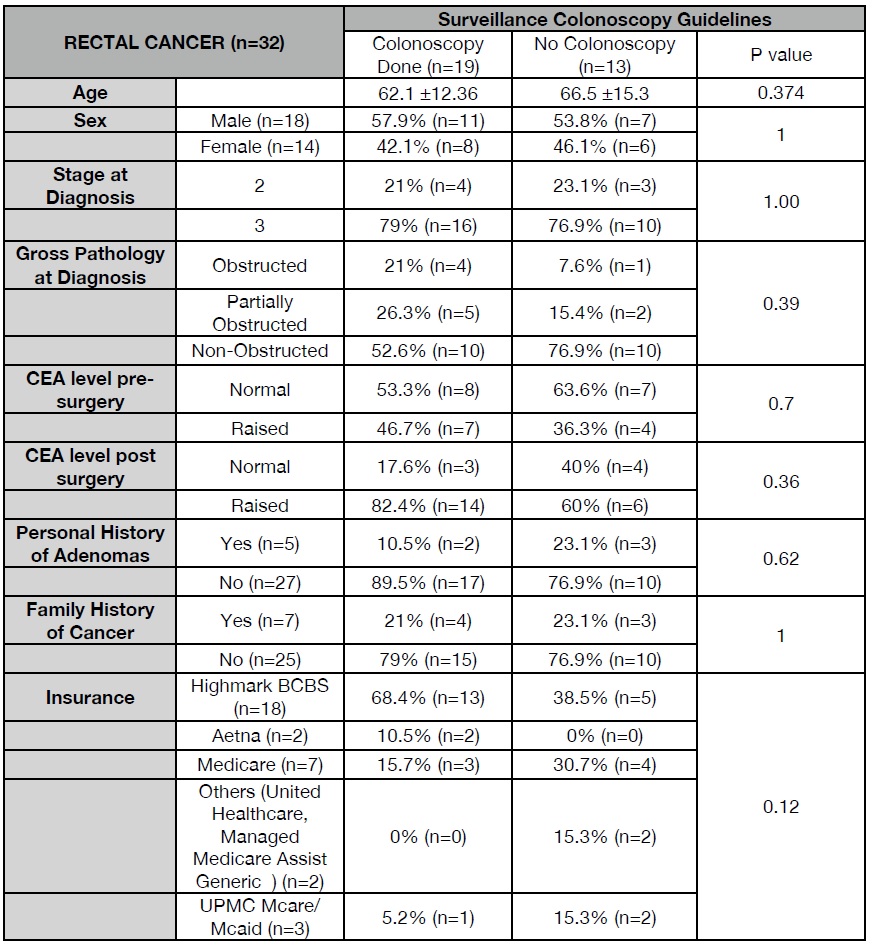
Results: Of the 80 patients included in our study, 60% (n=48) had colon and 40% (n=32) had rectal cancer. Mean age was 66 +/- 13 years and 58% (n=46) were males. Characteristics of patients with colon and rectal cancer are described in Tables 1 and 2, respectively. Among patients with colon cancer 40% had Stage 2 disease and 60% stage 3 disease. 23% (n=11) patients underwent surveillance colonoscopy within 1 year of surgical resection and mean time to colonoscopy was 315 +/-44 days. Common reasons for non-adherence were: Delayed colonoscopy (64%, n=23), no referral for colonoscopy (8.3%, n=3), detection of metastasis (6%, n=2), and loss to follow up (6%, n=2). Family history of colon cancer was significantly higher in patients who underwent surveillance colonoscopy post resection (73% vs 22%, p=0.003). Among patients with rectal cancer, 59% (n=19) underwent surveillance colonoscopy with mean time to colonoscopy= 369 +/- 103 days. Reasons for non-adherence to surveillance colonoscopy for rectal cancer were: Detection of metastasis (25%), patient-related factors (25%) and no referral for colonoscopy (8%).
Conclusions: Twenty three percent of patients with colon cancer underwent surveillance colonoscopy in 1 years time after surgical resection and 59% of patients with rectal cancer underwent a surveillance colonoscopy. Commonly identified reasons for non adherence with surveillance colonoscopy post resection were absence of a referral order for colonoscopy and loss to clinical follow up. Family history of colorectal cancer had a positive correlation to compliance with follow up colonoscopy which may be due to increased patient awareness regarding disease and surveillance. This data will be used to design a protocol to ensure patients with colorectal cancer have appropriate clinical and procedural follow up.