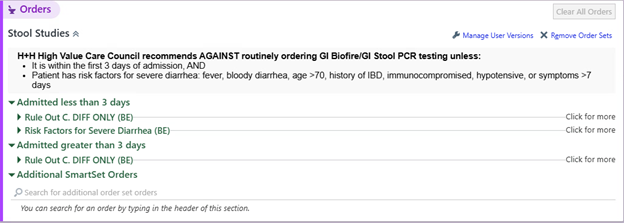
Background: Most patients presenting to hospitals with acute diarrhea without recent travel have self-limited viral or bacterial etiologies that can be treated supportively. Prior studies demonstrated that patients who develop diarrhea three or more days into a hospitalization are more likely to have Clostridium Difficile (C.Difficile) rather than other causative agents. Moreover, the diagnostic yield of the Gastrointestinal Pathogens Panel by PCR (GPP) decreases significantly after the first three hospital days. In an effort to reduce unnecessary use of GPP by PCR for patients who develop diarrhea while admitted to the hospital, we developed and implemented a standardized order set within our electronic medical record (EMR) to discourage inappropriate ordering of GPP by PCR for the inpatient workup of diarrhea.
Methods: In collaboration with system-wide Infectious Disease leadership, we developed best practices for evaluating diarrhea for newly admitted patients and those who had been admitted for more than three days. We developed an order set that included an advisory statement regarding appropriate ordering of the GPP by PCR (Figure 1). The pre-intervention period was from January 6, 2025 to April 3, 2025. After implementation of the order set, we identified technical errors that required its temporary removal from the EMR. After the technical issues were resolved, the updated order set went live on June 25, 2025. As a result, we consider the period between April 4, and June 24 to be a washout period. The post-intervention period was June 25 to September 23. Pre- and post-intervention data were compared with the primary outcome measure being order rates of GPP by PCR normalized per 1000 inpatient days. Data were abstracted by SQL queries on the Epic Clarity database, and analyses were performed using R version 4.0.3. This project was deemed a quality improvement project by the NYC Health + Hospitals research office, thus exempted from IRB review.
Results: The patient population in the pre- and post-intervention period were compared and weekly ordering rates were assessed for statistical significance via Welch’s t-test. In the post-intervention period, 32.3% of GPP tests were ordered through the order set. Weekly ordering rates of the GPP by PCR declined significantly after implementation of the order set, from 6.59 to 4.31 (p< 0.001). We also observed a statistically significant decrease in ordering of C.Difficile testing, from 4.09 to 3.33 (p=0.0057). We observed a statistically significant decrease in orders of GPP by PCR that were ultimately negative, from 2.48 to 2.13 (p=0.01).
Conclusions: The implementation of an order set for the inpatient evaluation of diarrhea significantly reduced rates of ordering both GPP by PCR and C.Difficile tests across a large public safety net hospital system. A decrease in the rate of negative GPP by PCR tests suggests that we were successfully able to decrease the rate of unnecessary tests sent in our hospital system. Though we are early in the post-intervention period, our preliminary results suggest our intervention may be a model for other institutions with limited resources.