Background: The practice of routine stress ulcer prophylaxis (SUP) with proton pump inhibitors (PPI) is discouraged outside of the intensive care unit (ICU).1,2,3 Prior studies have demonstrated that a significant portion of patients are prescribed SUP on the general medicine ward in the absence of an appropriate indication.4 Patients may be inappropriately continued on SUP when transferred out of the ICU and even on discharge.5 In addition to risks of adverse events such Clostridium Difficile infection, these prescriptions can add unnecessary cost to care.6,7 Previous efforts have described interventions focused on education and awareness campaigns, updated institutional guidelines, or a pharmacist-led approach to reduce inappropriate ordering patterns.8 Herzig et al. developed an intrusive clinical decision support tool recommending discontinuation of SUP if a patient was on a general medical ward.9 We developed a non-intrusive clinical decision support tool to reduce inappropriate orders of acid suppression therapy (AST) across 11 acute care hospitals.
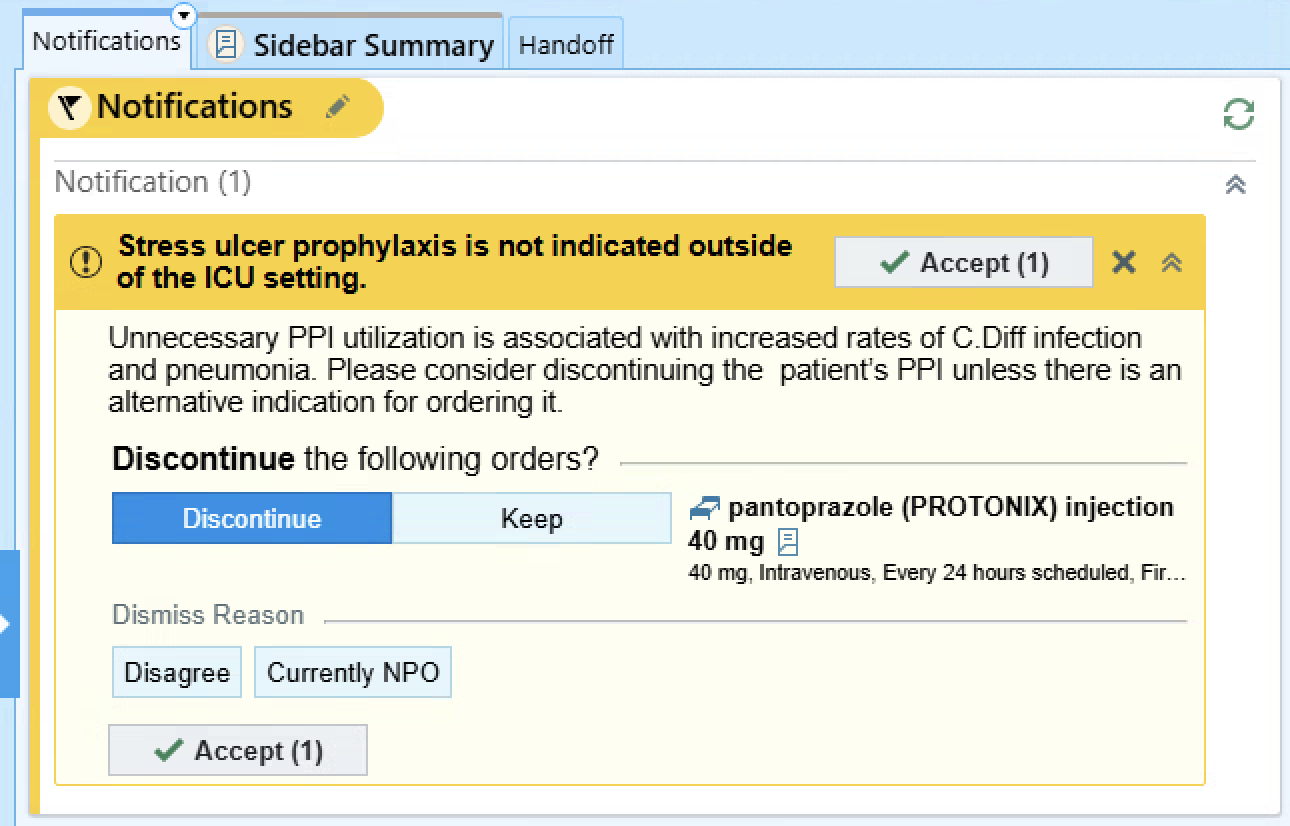
Methods: Our institution is a large municipal public health system comprising 11 acute care hospitals. The intervention was approved by system leadership in Gastroenterology, Internal Medicine, and High Value Care. A non-intrusive advisory was developed to appear for inpatients transferred out of the ICU and maintained on the standard dose of stress ulcer prophylaxis (once daily dosing of intravenous pantoprazole). Patients with AST listed as a home medication and without an active diet were excluded. The advisory recommended against continuing SUP and allowed providers to keep or discontinue the order; the alert could also be ignored (Figure 1). Baseline data on ordering rates of PPIs was obtained from January 3, 2023 to November 20, 2023. The patient population in the pre- and post-intervention period and weekly ordering rates were assessed for statistical significance via Welch’s t-test. Data were abstracted by SQL queries on the Epic Clarity database, and analyses were performed using R version 4.0.3. This project was deemed a quality improvement project by our institution’s research office, and was exempted from IRB review.
Results: The intervention period was from November 21, 2023 to March 31, 2025. While the difference in gender was not statistically significant in the pre- and post-intervention population, there were statistically significant (but not clinically significant) differences in age, length of stay, and distribution of racial/ethnic groups. We attribute this difference to the small number of encounters. The non-intrusive advisory was displayed in 2,349 encounters. The advisory was acted on 1,497 times for 1,124 orders. The provider discontinued SUP 38.6% of the time, continued the order 54.2% of the time, and discontinued then re-ordered SUP 7.1% of the time. There was a decrease in weekly PPI ordering rates normalized for 1000 inpatient days, from 27.05 pre-intervention to 25.21 post-intervention (p < 0.05). Statistically significant decreases were seen at five of the eleven hospitals.
Conclusions: We demonstrated that a non-intrusive advisory can prompt discontinuation of PPI orders in the inpatient setting. These actions suggest that our intervention prompted the discontinuation of inappropriate or unnecessary SUP orders. Our intervention provides a framework for other scenarios when a non-intrusive advisory may be effective to reduce unnecessary care.